This article seems like a cherry picking exercise. In particular the cherry not picked is the exponential drop in the cost of solar, wind and HVDC lines. Taking the dates of 2000 to now for fossil fuel energy percentage is a picked cherry in that the cost of unsubsidized solar has happened just within the past five years. Sure, don't expect much in the next two or three years but in the next two or three decades everything energy wise will have changed because the technologies are now in place and will only get better.
Perhaps the reliable writing on the wall is in the stock market where the enterprise value of oil and gas companies has been falling since about 2011. That's because investors require a thirty year time frame for financial viability and that window is already closing.
You can still buy buggy whips but that industry is not what it used to be.
Exponential drop in the cost of solar/wind is good, but will not necessarily continue for long, and to become a large % of the grid will also need to come with gigantic storage projects. If all it took was plopping enough solar panels down and wiring them up, this would be pretty straightforward. Nobody knows how to quickly scale up the storage though. Lots of pumped back hydro? Trillion dollar projects, and we have water crises all over, so we can't just dam up any river that it is convenient to do it either.
We won't be exponential forever, an S-curve will show up eventually but the conservative estimates are not even close.
> and to become a large % of the grid will also need to come with gigantic storage projects
This isn't really true. There are already grids with 60%+ renewables without any storage projects to speak of. Large grids already have a lot of diversity and the existing hydro is already a big buffer.
> Lots of pumped back hydro? Trillion dollar projects, and we have water crises all over, so we can't just dam up any river that it is convenient to do it either.
Most of the time those kinds of estimates are predicated on the assumption that we must produce exactly what we consume and thus storage needs grow exponentially. If you have a really really cheap source of power (right now solar) and your problem is that you can't store it, just overproducing it is a better solution. The reality is that we will do a mix of many things but all the simulations I've seen show this to be well within even our current technology and cost. Most claim the total cost of the resulting energy goes down not up.
No-one thinks we need lots of storage, except people who used to think renewables didn't work, and would never be cheap, and we didn't have room and they'd kill all the birds and now need another way to put off facing being totally wrong for a short while longer.
When it's the dead of night, no wind, no solar, and the ambient temp. is 85 F here in Texas how are we going to power everyone's AC without an energy storage solution?
Texas isn't really a state known for building hydropower.
Well here's a prediction of how they'd do if they could store a small amount of hydrocarbons made from green energy. 3 hours of battery storage.
And if they can't handle the flexible gas, a few more batteries would do it. 12 hours.
I mean they could just run a gas plant and capture the carbon as the oil industry has been claiming they will, but that would be cheating wouldn't it. We need that last watt of power to be pure and green or else the massive amount of money saving renewables that Texas has already installed doesn't count.
3 hours worth of batteries charged by solar and wind and if that runs out a turbine burning green hydrogen.
The link I gave you goes into extreme detail on this and is based on historical data of exactly how often such windless nights occur and what the Texas grid demands overnight.
It then works out the cheapest combination of solar/wind/battery/etc.
Do you think Texas has anywhere we could store some hydrocarbons?
I don't even think that report is optimistic enough, Green Hydrogen production and EVs as demand response and some grid connections will solve the issue cheaper, but I don't want to blow anyones mind, so you've got to meet them halfway with an in-depth accounting of how the vast majority of Texas energy use could be renewable with ease at a low cost.
Low cost won't cut it. It needs to be cheaper than existing technologies. Citizens don't vote for candidates with a pitch of "what we're going to do is change policy to require significant capital expenditure that is coming out of your pocket".
Failing that if you can find a way to line some politicians pockets in the process, that could work.
It is apparently hard to sell this to certain political groups, who get their funding from more expensive sources of energy, but the truth has a way of making itself known when money can be earned and/or saved.
So you think the capex of building new types of energy generation & storage is less than the opex of the existing grid generation centered around fossil fuels, like natural gas?
I'm not sure if you think this requirement is not actually necessary, or if you are thinking of using nuclear to make up a large percent of the base. The latter is certainly an option.
It's generally not necessary in the quantities and timeframes used in some anti-renewables arguments (those often being "now" and "all the capacity the renewables are generating").
It sometimes comes to people as a surprise how little solar / wind is actually installed and that the production mostly follows the peaks in daily consumption.
Basically, the idea is that if we go installing new renewables at current speeds, we won't need any real battery storage for years.
Sand and basalt-based thermal batteries sound promising. Essentially just heat up rocks in insulated containers, then run Rankin- or Stirling-cycle generators off the stored heat. Power-to-weight's probably awful, but that doesn't matter for grid applications, just cost per kWh:
Pumped hydro is the only way, really. Coire glas, snowy 2, fengning, etc.
The problem isnt so much the scale or cost, just the amount of time it takes to commission and build them. You can deploy a solar farm in months, but pumped storage is like building a dam. It takes several years.
There also isnt a lot of point to storage unless you turn the gas off sometimes and I think we basically never do even at the sunniest and windiest. Not yet.
We should have been preparing for this for years rather than letting Putin pull the rug out from under our feet.
Pumped storage is in the same category as nuclear. If it's already built then we might as well use it as long as it's not about to collapse, but any new build is probably dubious from a cost benefit angle.
There's some articles going over the numbers for Snowy 2 and it'll probably be a bad investment overall.
> We should have been preparing for this for years rather than letting Putin pull the rug out from under our feet.
Not to be that guy, but one does have to wonder what European leaders were thinking was going to happen after sanctioning a major source of their oil and natural gas.
> Perhaps the reliable writing on the wall is in the stock market where the enterprise value of oil and gas companies has been falling since about 2011.
Huh? ExxonMobil stock is near all time highs, they've been posting record never-seen-before profits ( much to the chagrin of politicians and general public) .
One has to consider why the cost is dropping... which has a lot to do with manufacturing in China. I don't take it as a given that in the geopolitical turmoil that seems to be developing, and the trend to deglobalisation, that the prices will continue to fall, or even remain stable. The other aspect of this is that after Europe's recent experience everyone is likely to get much more paranoid about energy securtiy and redundant capacity, which will also affect uptake of renewables. It is also not clear to me that the same driving forces in the West will apply to the big fossil fuel consumers of the next 50 years, India and China.
But it doesn't matter I guess, if renewables are cheaper they will win whatever someone thinks.
We still haven't solved the energy storage problem of solar and wind, which there is no indication we will in th next 30 years. Betting our future on something that doesn't exist is foolish.
They also take up significantly more land than coal, gas, and nuclear. They also don't work in all climates.
Nuclear is the only viable option today if you want rapid decarbonization.
> With every iteration in the research and with every technological breakthrough in these areas, 100% RE systems become increasingly viable. Even former critics must admit that adding e-fuels through PtX makes 100% RE possible at costs similar to fossil fuels. These critics are still questioning whether 100% RE is the cheapest solution but no longer claim it would be unfeasible or prohibitively expensive. Variability, especially short term, has many mitigation options, and energy system studies are increasingly capturing these in their 100% RE scenarios.
I wouldn't say we haven't solved it. The solution are straightforward, but they represent an scale of project that most people don't understand at all. However, there are examples of humans doing projects at such scale before. Most notably, the totality of the infrastructure we built to extract and refine the amount of fossil fuels we do today. The gigantic offshore rigs, the thousands of miles of pipelines, the refineries, etc.
Doable, but can't happen overnight without everyone dropping everything and working on only this.
"The main barriers to the widespread implementation of large-scale renewable energy and low-carbon energy strategies are seen to be primarily social and political rather than technological or economic"
Man who famously said the same thing about EVs, even after 2 million had been sold.
Said it was just Obama making stuff up.
> LET ME BEGIN WITH A DISCLAIMER: I am neither promoting
electric vehicles nor denigrating them. I simply observe that the
rational case for accepting EVs has been undermined by unrealistic market forecasts and a disregard for the environmental effects
involved in producing and operating these vehicles. • Unrealistic forecasts have
been the norm. In 2008, Deutsche Bank predicted that EVs would claim 7 percent of the U.S. market by 2016; in 2010, Bloomberg Businessweek put the 2016
share at 6 percent. But actual sales came to 158,614 units, just 0.9 percent of the
record 17.55 million vehicles sold that year. • In his 2011 State of the Union address,
then–U.S. president Barack Obama called for 1 million EVs on the road by 2015,
and a concurrent report by the Department of Energy claimed that the country’s production capacity in that year would reach 1.2 million units. But the 2015
total came to 410,000 units, representing just 0.15 percent of all vehicles on the
road, and sales of U.S. brands reached about 100,000 cars. • And this triumph of
hope over experience continues. The worldwide total of EVs on the road reached
2 million units in 2016. If you plot the trajectory of the global stock of EVs since
the beginning of their sales to the year 2016, you will see that the equation that
best fits the data (a fourth-order polynomial) projects about 32 million units in
2025.
There was 4.2 Million EVs sold in the first half of this year. If sales remains entirely flat then between now and 2025 then just the cars sold over the next 4 years will top his prediction for installed base.
Sales won't remain flat.
> The myth that the future belongs to electric vehicles is one of the misconceptions of the modern energy era”. -- Vaclav Smil
He is still saying essentially the same about EVs ..
> "The notion that any EV is a zero-carbon car is nonsense."
or at length:
> There are no EVs. They are battery vehicles reflecting the electricity’s origins. If I were to buy an EV in Manitoba, it would be a 100% hydroelectricity, truly zero carbon energy, car. In North China it is a 90% coal car, in France it is a 70% nuclear car, in Russia mostly a natural gas car and in Denmark a 50% wind car et cetera.
His message is that we will need to burn a lot fossil fuel and emit a lot of carbon in order to eventually consume less and emit less .. and in the meantime we could stand to insulate more and drive smaller lighter cars, etc.
Yes, he's not stupid. He goes to great pains to stress that the climate change denial articles he writes for the climate change denying AEI aren't denying climate change. Good heavens no.
He's merely saying that all of the solutions to climate change are bad and all the people suggesting them are stupid. Thats just facts, not denial.
I don't even remotely see how hybrids factor in. Yes there are "plug in hybrids" but no one is required to plug them. Other than that they burn fossil fuels. That's it.
So what? Even if I cut my car's fossil fuel consumption in half, I'm still burning fossil fuels. Actually forget half. Let's cut it by 99%. I'm still burning fossil fuels. You still have a carbon footprint.
"It's more efficient" is not good enough. It has to be zero or negative carbon production.
So you will accept nothing less than 0 carbon tech, right now, in a world where there's lots of inefficient uses of fossil fuels we could replace and save money?
Seems a bit extremist.
Also, ICE and hybrids can run on e-fuels. Not ideal as they still have local pollution and arent very efficient but entirely possible without adding fossil carbon to the system. EVs (and bikes and trains) are better though.
I have read one of Vaclav Smil’s books and I think he is too stuck on the idea that history will repeat itself. I don’t think this transition compares to the past examples he uses for political and technological reasons and in fact Energy Myths and Realities doesn’t age well because of how rapidly the statistics got out of date on renewable adoption.
That said the book is a great and useful historical work.
His steadfastness to this hypothesis that “all transitions are like past transitions” is explicitly stated in the end of one of his books:
"A world without fossil fuel combustion is highly desirable, and, to be optimistic, our collective determination, commitment, and persistence could accelerate its arrival. But getting there will be expensive and will require considerable patience. Coming energy transitions will unfold, as the past ones have done, across decades, not years." (Vaclav Smil, Energy Myths and Realities)
Take lithium for example. Famous for being the big part of an EV battery. Lithium is up about 5x in approximately a year and about 3x in 3-4 years, in terms of price. And we are going to need even more, hence we need to procure supplies.
How long does a lithium mine take to build? Can we build this lithium mine in a country that Europe/US can do business with(question that is really serious after Ukraine)? Do people want to see a lithium lake in Europe/USA, knowing the sorts of pollution it causes? What about recycling those batteries?
And all of those questions just for lithium. Cobblt, REMs needed for solar panels, etc have their own questions.
One of the issues with energy historians, if you want to call them, like the ones doing alternative energy adoption projections, is that they have been so conditioned to fossil fuel and previous alt energy failures that they just don't seem to appreciate the bare economics of solar/wind/EV. In solar/wind, the economics are so clear (even gas turbine is losing on LCOE) that nothing can stop it.
I think we are running into a "humans don't comprehend nonlinear/exponential curves". Much like Moore's law, there is enough convergent economies of scale and research development that there has been and probably will be a decade of exponential improvement. I believe some of this is because there was so much large scale suppression of alt energy and EV tech by big oil that so many researches and projects are now being linked together to produce an effective 20-30 year exponential improvement curve.
We're now a solid 5 years into economic supremacy of solar and wind. The 60% efficient gas turbine was the last gasp of big oil, they have nothing else to fire back with. Mazda and some other companies are trying compression-combustion gas engines now, and there's a spate of articles on inside out rotaries and other desperation, but the ICE drivetrain is going the same route: economic obsolesence in the face of an exponential improvement curve by BEVs.
Their projects of adoption of alt energy and EV were head scratchingly conservative given the raw economics, and thankfully real adoption has been much more rapid. I wonder if there was political pressure applied to slow any policy aids/regs/subsidies from coming through congress. Thankfully, the Ukraine war and inflation have turbocharged policy. Thanks Putin!
EVs are rapidly heading that way towards total economic supremacy over the ICE.
Sodium Ion is coming into mass production next year, and that should be at densities that should enable the 200-300 mile EV use cases (SR Model 3s, city cars of the european/chinese design, the cars that at least five billion people would use in the world).
High density LFP (200 wh/kg at pack level allegedly in mass production this year) should do the 300-400 mile range cars.
Solid state, which has some fusion "always five years away" does seem poised for five years away, and will probably handle most of the luxury and ultralongrange applications, probably won't beat LFP or sodium ion in cost for quite a while though.
Lithium apparently just needs development (salton sea, etc). Battery recycling is likely going to take care of itself between grid batteries, resale/reuse markets, etc. The nice thing about a big battery pack is that you can disassemble it and reuse the batteries that still work, and use them in a ton of different ways. Only after several cycles will you get to the issue of actual materials recycling.
Solar panels will probably get an LFP-style "good enough and ultracheap" design with some perovskite derivative in the short term.
Yes there are scale issues, but grid storage may be solved by the move of transportation to batteries and reusing car batteries as distributed grid storage. Home solar will reduce grid load of cars moving to EV drivetrains, and make civilization more resilient.
There is so much investment and research in this, with lots of headroom, that the old guard doesn't seem to wrap their heads around it.
It's the closest thing to a real technological miracle/magic in my lifetime, with the transistor/semiconductor scaling being the other contender.
What kills me about batteries and solar is I wonder how much earlier we could have moved to this without oil/gas companies actively blocking it. But I'm not super familiar on what materials technologies and imaging/analysis would have been necessary to get to usable 200 mile EVs back in the 1970s or 1980s.
The author is right though, when we look back when we MOST NEEDED to get efficient on gas vehicles for global warming, in the 1990s, the big SUV trend went exactly the opposite direction. I shook my head back then at people that bought those, and I still do.
I'm not saying that renewables will loose(IMO they will eventually win simply because this is the final nail in "commodities trade is not political", having self sufficiency is and will continue to be a natsec question), but I predict a very bumpy ride price-wise. This is a tech board, but IMO this is probably the highest alpha trade for the next 5-10 years if you nail correctly.
The big item I don't hear too many folks talking about is the nitrogen-based fertilizers we obtain from natural gas. That's an issue at the center of the Russian invasion of the Ukraine. Russia's halting of natural gas shipments to the West doesn't just affect heating homes, it affects fertilizers as well. Soaring fertilizer prices are playing a part in our soaring food prices.
The interesting question is do we have to be carbon-neutral to avert the largest calamities due to anthropogenic climate change? Can we continue using natural gas to produce fertilizer? Are some crops more fertilizer-intensive than others?
Think its likely that the recent IRA makes Green Hydrogen cost competitive with Gray so we should see some movements on this soon. Lots of incoming projects in Australia and I'm assuming the EU will be accelerating this due to recent invasions too.
For both of these scenarios, nitrogen-based fertilizer and plastics used for medicine, I don't know how much they contribute to atmospheric C02. For example, how does using oil to make plastic compare to using oil for transportation? How does using natural gas for making fertilizer compare to using natural gas to heat homes? I really don't know.
Here is a short presentation by Simon Michaux concerning peak rare earth metals which a required for all renewable energy production. One can easily infer from
that there will be no renewable energy production that is anywhere close to what
is being produced by fossils, we live in a finite world.
https://www.youtube.com/watch?v=JRGVqBScBRE
1. No building nuclear, the only base load that is carbon free.
2. No building the water storage option because of the environmental impact
3. Not allowing for the scale of up of mining necessary to supply the materials for batteries
These three things are why the people who speak about solutions and know are Subject matter experts say: here is what needs to happen, but it will never happen because of environmentalists and how they have corrupted the layperson’s mind to these ideas.
We can look to Europe to see how the environmentalists will doom society.
Yet he also effectively says we have to move forward as best we can anyway. The emotional side is as so often happens a distraction from the core material.
> Fossil fuels now supply about 83% of the world’s commercial energy, compared to 86% in the year 2000. The new renewables (wind and solar) now provide (after some two decades of development) still less than 6% of the world’s primary energy, still less than hydroelectricity.
> What are the chances that after going from 86% to 83% during the first two decades of the 21st century the world will go from 83% to zero during the next two decades?
This is a hard dose of reality for renewable maximalists. What is the counter point to these facts?
First of all, the most important point is, that by switching from using the chain
fossil fuels -> heat -> usage
to the chain:
renewable source -> electricity -> usage
We need 2/3rds less of energy, as e.g. heat pumps are more than 3x efficient at heating than burning things, electric cars are 3x as efficient as ICE vehicles and so on. That reduced the problem considerably.
And then, we of course need an exponential growth of the deployment of renewables, which absolutely should be doable, especially in solar, which is mostly about manufacturing capacity, it is relatively easy to deploy it in the needed numbers.
Where do you get the idea that electric cars are 3x as efficient? I haven't heard this number before.
Also the idea of "renewable source -> electricity" is conveniently omitting an important step for lots of renewables. That is "heat". Solar panels don't need this, but for example thermal solar (using a working material like molten salt) does.
You haven't heard the number before? Combustion engines are physically limited to a maximum of 40% efficiency. But that is at their peak performance point. That is basically the efficiency a thermal power plant runs on. But with cars, you are often far off the optimal operations point, so the real life efficiency is much lower, real-world efficiencies are below 20%. That is also the reason, hybrid engines save some fuel, as they aim to raise the average efficiency a bit.
Electric engines have efficiencies of about 95%. There are some charging losses and network transmission, but the 60% efficiency needed to be 3x efficient as ICE cars are easy to hit.
Or to calculate the other way around: a Tesla Model 3 uses less than 20kWh/100km. That roughly equivalents to 2l of fuel per 100km. Most cars use 6 to 8l for comparable performance, so the 3x factor checks out well.
The life cycle emissions of an EV are about half those of an ICE. So maybe a 2x factor is better. EV manufacture has a higher environmental cost than ICE.
You're just changing the point you measure the conversion losses at. Yes, electric motors are commonly 90%+ or 95%+. Even really bad ones hit that number.
When an EV is being charged by a natural gas turbine hooked into the electric grid, the efficiency is about the same.
Basically imagine if instead of having an transmission in my regular truck I just coupled my engine to an enormous alternator. Then used the electrical energy to run electric motors driving the wheels. It is in no way more efficient.
Even if you generate energy using oil or natural gas, it helps that the combustion happens in a 55-60% efficient combined cycle power plant rather than a 20-30% efficient car engine.
And of course it enables power generation that is not bound to inefficient combustion - be it hydro, solar PV, wind etc.
Absolutely, it is a step in the right direction. But the small jump in efficiency from say 40% to 55% doesn't really do anything. You've still got a carbon footprint that is non-zero.
Unless you convince society to build zero-carbon electrical generation it's the equivalent of the British calling the American Revolutionary War a victory on their part. The difference is purely political, societal, and cultural. None of which can change the laws of physics.
My observation is United States society simply doesn't want or care about zero carbon electrical generation. Nuclear fission was figured out a long time ago & we basically never built any significant capacity in that regard. Fossil fuels are cheap, which means cheap energy.
It's pretty easy to point to a lack of government investment in renewables and incentives to get rid of fossil fuels. The US has had a leader for more than half those years that was pro-oil and anti-renewables.
Imagine a 1 trillion dollar investment into renewables in 2003 instead of the Iraq war. Imagine a carbon cap tax in 2008.
Additionally, technology has increased in that time. Its quite reasonable that the first few decades of development won't see very commercially viable products -- they are new and in development. Renewables becoming better than fossil fuels for many tasks will happen eventually and would be like flipping a switch. At that point, it just takes the government printing money and spending it on something that matters for a change.
In general, I share his perspective but these things often follow an S curve. If you think of renewable energy as a new technology, and assume that its adoption will follow curves of other technologies, you can't extrapolate later rates of adoption from earlier rates because the adoption accelerates.
The adoption curve is probably going to look like that of initial electricity ultility uptake, or of moving from coal to patroleum, but maybe accelerated a bit more because of additional pressures.
My guess is this will end up being slower than many would like, but slightly faster than he suggests, and more diversified. That is, you're not going to see moving to all EVs, but a proportion of EVs, a proportion hydrogen, city restructuring to support mass transit, some hybrid engines, and some ICEs that never go away completely. Probably also some things we're not even discussing now because they haven't been invented yet.
That renewable energy deployment is (currently) growing exponentially, rather that linearly. We will see much more than 3% improvement, but very probably wont go to 0 in 20 years.
Even if we were on pace, there's likely to be a long tail, so no, we won't be going to zero. It's just a question of how much we can accelerate progress.
The counterpoint is that global warming is real and is going to obsolete or destroy a significant amount of human infrastructure, destroy enormous wealth, and displace millions of people.
Any analysis of “what we’re doing to fight to global warming” that does not start with the physical reality of it is pointless. And yet a tremendous amount of the conversation does just that.
The alternative to reducing greenhouse gas emissions is not that everything just keeps going as it was. Our choice is pay to decarbonize, or pay to deal with everything in my first paragraph. We can pick either one but there is no secret 3rd option where we shout down the “renewable maximalists” and then everything is fine.
So the practical answer is that we’ll do things much faster when we feel we must. So predicting the pace has more to do with predicting public/government sentiment than it does with linearly extrapolating what we’ve done up to this point. You could not have predicted the nuclear bomb in 1930 by extrapolating weapons development since 1910.
Additionally Sektorenkopplung (the electrification of Heating and Transportation), will reduce the need for primary energy.
For example, a heatpump can produce 5MW of heating from 1MW of electricity by concentrating the heat from the environment. An electric car is 90% efficient while a combustion vehicle is about 30% efficient, roughly speaking.
> For example, a heatpump can produce 5MW of heating from 1MW of electricity by concentrating the heat from the environment.
Don't those struggle in cold climates (e.g. winters consistently below freezing)?
> An electric car is 90% efficient while a combustion vehicle is about 30% efficient
On the other hand, even the best batteries have far less energy density than a gallon of gasoline, and some of that "waste" heat can be put to good use (e.g. heating in cold climates).
Yes, the colder the air is, the less efficient a heat pump is. My 10 year old heat pump has a COP of 3 but shuts off at -15C because below that it's less efficient than an electric baseboard heater. Newer air-to-air heat pumps have a COP of 4 or higher so they can handle down to -20C or -25C.
I keep my EBBs set to come on a few degrees below where I keep the house so they will kick in when the heat pump shuts off and they kick out when the heat pump comes back on. This tends to happen at night when I don't mind the house getting a bit cooler anyway. Where I live in Canada, the heat pump typically only shuts off half a dozen nights in the second half of January. It's not like my heat pump is useless 6 or 8 months of the year.
There are also geothermal heat pumps that push/pull heat to/from water from underground (eg. a well, a pond, or a buried coil of pipe) where, even in the winter, the ground remains warm. These don't suffer a loss in efficiency in the winter.
Regarding EVs, most EVs get between 3 and 4 miles/kWh. The Porsche Taycan gets only 2 miles/kWh. The Tesla Model 3 gets 5 miles/kWh. The Aptera gets 10 miles/kWh, which with the 100 kWh battery, gives you 1,000 miles of range.
Sounds weird right? But it really is true: heat pumps pump heat, from one place to another, like a fridge and airco etc. Current heat pumps for home heating use can pump about 3-5 units of energy from outside to inside while the pump requires 1 unit of energy to run.
Trick (to understand maybe?) is to not convert the energy from chemical to heat, but to take existing heat energy and pump that around.
Peltier elements have a efficiency of about 30% of converting temperature differences back to electricity. So if a heat pump pumps 5 times of the energy it needs around, you only need 20% of that converted back to electricity for it to be a self-sustainable perpetuum mobile. Of course this is impossible, but where is the error?
A heat pump takes heat produced elsewhere (eg in air outside). If that stops or it gets too cold, the heat pump stops working. It's not a perpetuum mobile because it needs an external energy source (eg. the sun to warm the air)
Heat pumps use energy to _move_ heat, not create it. Your refrigerator, for example, moves heat from inside the fridge to outside the fridge. Your AC operates on the same principle. Pump the refrigerant in the other direction (note: mechanically this isn't possible in garden variety ACs) and you reverse the effect. Given the same amount of energy and typical conditions - this won't work to absurdly cold temperatures - it's several times more efficient to use it to run a heat pump than to convert it to heat directly.
I'm always amazed at how in the US there are "garden variety ACs" that lack the very small amount of parts needed to be reversible. I haven't seen any models like that for sale in Europe. Since having AC is also much more frequent in the US than in Europe it's really a shame that isn't just regulated as mandatory or something so that electrifying house heating becomes that much easier.
This also leads to the counterintuitive notion that it’s more efficient to burn natural gas to spin a turbine, and create electricity used to run a heat pump, than it is to burn that same natural gas directly for heat. It’s one of those situations that just shouldn’t make sense, until you do the math and see that it does (although only for ambient temperatures above a certain threshold.)
They start to lose efficiency roughly around freezing, so not very cold, and can cease working entirely at zero Fahrenheit or so. But geothermal can work much longer because you dig holes deep enough to use the ambient earth temperature instead of air.
This won't work in permanently frozen areas like Antarctica.
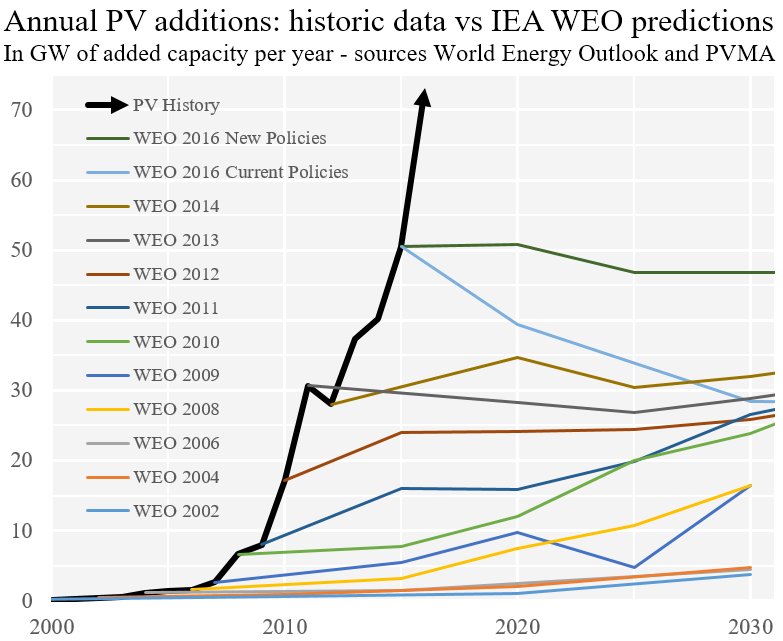
According to that graph, onshore wind has been cheaper than fossil fuels since 1995. What will be different about the next 20 years that this price difference will suddenly cause a huge surge in adoption, when it has already been cheaper for decades without making a huge impact?
I can't answer that and aslo I know people who are "deeper into this", this being energy economics, that can't agree either.
The fact is that the bids for offshore wind has been going down for a while now.
https://ieefa.org/articles/offshore-wind-prices-fall-new-rec...
New tech often takes off slow but hits exponential adoption later on.
If you look at oil production from 1900 to 1973, for example, it grows by ~7% every year but after that it has only grown linearly by ~326TWh/year since -73.
Meanwhile, renewable energy generation has grown at a decent rate the last 20 years, so if it goes exponential (if it hasn't already) the chances are... okay? Hopefully?
I think this whole article is a huge strawman fallacy. Approximately zero people think we’ll be able to fully decarbonize in 20 years. Only slightly above that number of people think we’ll be able to fully decarbonize in 100 years. What serious people are saying is that we should make progress towards that goal regardless. (Hell, even the author says as much at the end of the article.)
I don’t understand the author’s need to score rhetorical points against an imagined second party here, it’s completely unnecessary.
> There are no EVs. They are battery vehicles reflecting the electricity’s origins.
Why is it necessary to split hairs in definitions like this? Electricity is used to propel the car. Yes, that electricity often comes from carbon today. But EV’s take us from cars that must use fossil fuels, to cars that may use other sources of energy. Isn’t that a positive? Yes, carbon is used to make the materials out of which the car is built, but that’s true of all vehicles, and it’s possible in principle to decarbonize that process as well. We’re trying to tackle the problem from both ends at once here, and that’s the only way to make progress, because otherwise you have chicken-and-egg problems (“it’s not worth it to make EV’s if we don’t have clean energy” vs “it’s not worth it to have clean energy because cars still use oil”, etc.)
“Rapid decarbonization is a fantasy”… yeah, if you define “rapid decarbonization” as being some impossible goal of zero carbon in 20 years, sure. No duh.
It's important to make this point that they are "battery electric vehicles" because you're prematurely declaring victory. It's not "splitting hairs". Until society actually builds net-zero carbon electrical generation we haven't done much for carbon footprint.
Why is the phrase “battery electric vehicles” more accurate at conveying the mixed energy sources than “electric vehicles” exactly? How does adding the word “battery” change anything?
EV’s run on electricity. The phrase “Electric Vehicle” has no implication one way or the other how you get said electricity. Adding the word “battery” changes exactly nothing, except maybe winning arbitrary strawman internet points.
> Until society actually builds net-zero carbon electrical generation we haven't done much for carbon footprint.
Ok so if my electricity is provided by a nuclear plant, I still can’t call my car an EV because there exists other sources of electricity out there? Please.
Electricity is not the same thing as energy. Most energy use in the UK is going to be heating and transportation which are both overwhelmingly fossil fuel based.
And a large amount of transport energy is moving oil and coal.
"Nearly half of freight-rail transportation is used to move coal—most of the other half is wheat and food. A not-so-surprising revelation from a close study of the Sankey diagram: our fossil-fuel supply chain is itself a major consumer of fossil fuels." (Saul Griffith, Electrify: An Optimist's Playbook for Our Clean Energy Future)
Not in the UK - both coal production and coal power generation have been aggressively phased out over the last 50 years. (And natural gas - which has replaced it - flows through pipes, mostly.)
We’re also running gas plants more than normal for this time of year and exporting the electricity generated to mainland Europe as our gas interconnecters can’t keep up with demand
Earth is the the pot, the atmosphere is the water, and we're the frog. The water has been gradually warming for the past 150 years. Simple physics tells us how fast the water is heating and when the water will boil. It's not a doomsday cult - it's forethought. The irony is forethought is something humans seem to be able to do pretty well on an individual basis but can't do in large populations. I defer to the anthropologists as to why that is.


Perhaps the reliable writing on the wall is in the stock market where the enterprise value of oil and gas companies has been falling since about 2011. That's because investors require a thirty year time frame for financial viability and that window is already closing.
You can still buy buggy whips but that industry is not what it used to be.