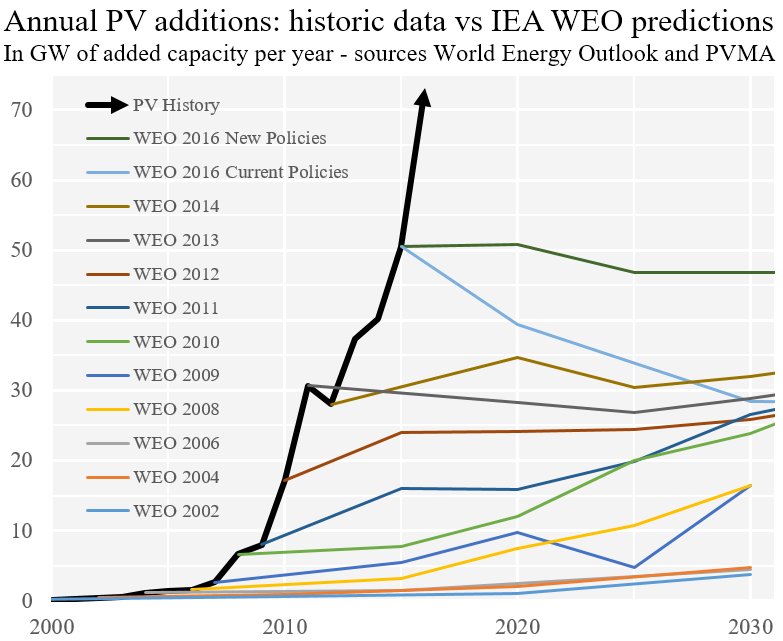
This article seems like a cherry picking exercise. In particular the cherry not picked is the exponential drop in the cost of solar, wind and HVDC lines. Taking the dates of 2000 to now for fossil fuel energy percentage is a picked cherry in that the cost of unsubsidized solar has happened just within the past five years. Sure, don't expect much in the next two or three years but in the next two or three decades everything energy wise will have changed because the technologies are now in place and will only get better.
Perhaps the reliable writing on the wall is in the stock market where the enterprise value of oil and gas companies has been falling since about 2011. That's because investors require a thirty year time frame for financial viability and that window is already closing.
You can still buy buggy whips but that industry is not what it used to be.
Exponential drop in the cost of solar/wind is good, but will not necessarily continue for long, and to become a large % of the grid will also need to come with gigantic storage projects. If all it took was plopping enough solar panels down and wiring them up, this would be pretty straightforward. Nobody knows how to quickly scale up the storage though. Lots of pumped back hydro? Trillion dollar projects, and we have water crises all over, so we can't just dam up any river that it is convenient to do it either.
We won't be exponential forever, an S-curve will show up eventually but the conservative estimates are not even close.
> and to become a large % of the grid will also need to come with gigantic storage projects
This isn't really true. There are already grids with 60%+ renewables without any storage projects to speak of. Large grids already have a lot of diversity and the existing hydro is already a big buffer.
> Lots of pumped back hydro? Trillion dollar projects, and we have water crises all over, so we can't just dam up any river that it is convenient to do it either.
Most of the time those kinds of estimates are predicated on the assumption that we must produce exactly what we consume and thus storage needs grow exponentially. If you have a really really cheap source of power (right now solar) and your problem is that you can't store it, just overproducing it is a better solution. The reality is that we will do a mix of many things but all the simulations I've seen show this to be well within even our current technology and cost. Most claim the total cost of the resulting energy goes down not up.
No-one thinks we need lots of storage, except people who used to think renewables didn't work, and would never be cheap, and we didn't have room and they'd kill all the birds and now need another way to put off facing being totally wrong for a short while longer.
When it's the dead of night, no wind, no solar, and the ambient temp. is 85 F here in Texas how are we going to power everyone's AC without an energy storage solution?
Texas isn't really a state known for building hydropower.
Well here's a prediction of how they'd do if they could store a small amount of hydrocarbons made from green energy. 3 hours of battery storage.
And if they can't handle the flexible gas, a few more batteries would do it. 12 hours.
I mean they could just run a gas plant and capture the carbon as the oil industry has been claiming they will, but that would be cheating wouldn't it. We need that last watt of power to be pure and green or else the massive amount of money saving renewables that Texas has already installed doesn't count.
3 hours worth of batteries charged by solar and wind and if that runs out a turbine burning green hydrogen.
The link I gave you goes into extreme detail on this and is based on historical data of exactly how often such windless nights occur and what the Texas grid demands overnight.
It then works out the cheapest combination of solar/wind/battery/etc.
Do you think Texas has anywhere we could store some hydrocarbons?
I don't even think that report is optimistic enough, Green Hydrogen production and EVs as demand response and some grid connections will solve the issue cheaper, but I don't want to blow anyones mind, so you've got to meet them halfway with an in-depth accounting of how the vast majority of Texas energy use could be renewable with ease at a low cost.
Low cost won't cut it. It needs to be cheaper than existing technologies. Citizens don't vote for candidates with a pitch of "what we're going to do is change policy to require significant capital expenditure that is coming out of your pocket".
Failing that if you can find a way to line some politicians pockets in the process, that could work.
It is apparently hard to sell this to certain political groups, who get their funding from more expensive sources of energy, but the truth has a way of making itself known when money can be earned and/or saved.
So you think the capex of building new types of energy generation & storage is less than the opex of the existing grid generation centered around fossil fuels, like natural gas?
I'm not sure if you think this requirement is not actually necessary, or if you are thinking of using nuclear to make up a large percent of the base. The latter is certainly an option.
It's generally not necessary in the quantities and timeframes used in some anti-renewables arguments (those often being "now" and "all the capacity the renewables are generating").
It sometimes comes to people as a surprise how little solar / wind is actually installed and that the production mostly follows the peaks in daily consumption.
Basically, the idea is that if we go installing new renewables at current speeds, we won't need any real battery storage for years.
Sand and basalt-based thermal batteries sound promising. Essentially just heat up rocks in insulated containers, then run Rankin- or Stirling-cycle generators off the stored heat. Power-to-weight's probably awful, but that doesn't matter for grid applications, just cost per kWh:
Pumped hydro is the only way, really. Coire glas, snowy 2, fengning, etc.
The problem isnt so much the scale or cost, just the amount of time it takes to commission and build them. You can deploy a solar farm in months, but pumped storage is like building a dam. It takes several years.
There also isnt a lot of point to storage unless you turn the gas off sometimes and I think we basically never do even at the sunniest and windiest. Not yet.
We should have been preparing for this for years rather than letting Putin pull the rug out from under our feet.
Pumped storage is in the same category as nuclear. If it's already built then we might as well use it as long as it's not about to collapse, but any new build is probably dubious from a cost benefit angle.
There's some articles going over the numbers for Snowy 2 and it'll probably be a bad investment overall.
> We should have been preparing for this for years rather than letting Putin pull the rug out from under our feet.
Not to be that guy, but one does have to wonder what European leaders were thinking was going to happen after sanctioning a major source of their oil and natural gas.
> Perhaps the reliable writing on the wall is in the stock market where the enterprise value of oil and gas companies has been falling since about 2011.
Huh? ExxonMobil stock is near all time highs, they've been posting record never-seen-before profits ( much to the chagrin of politicians and general public) .
One has to consider why the cost is dropping... which has a lot to do with manufacturing in China. I don't take it as a given that in the geopolitical turmoil that seems to be developing, and the trend to deglobalisation, that the prices will continue to fall, or even remain stable. The other aspect of this is that after Europe's recent experience everyone is likely to get much more paranoid about energy securtiy and redundant capacity, which will also affect uptake of renewables. It is also not clear to me that the same driving forces in the West will apply to the big fossil fuel consumers of the next 50 years, India and China.
But it doesn't matter I guess, if renewables are cheaper they will win whatever someone thinks.
We still haven't solved the energy storage problem of solar and wind, which there is no indication we will in th next 30 years. Betting our future on something that doesn't exist is foolish.
They also take up significantly more land than coal, gas, and nuclear. They also don't work in all climates.
Nuclear is the only viable option today if you want rapid decarbonization.
> With every iteration in the research and with every technological breakthrough in these areas, 100% RE systems become increasingly viable. Even former critics must admit that adding e-fuels through PtX makes 100% RE possible at costs similar to fossil fuels. These critics are still questioning whether 100% RE is the cheapest solution but no longer claim it would be unfeasible or prohibitively expensive. Variability, especially short term, has many mitigation options, and energy system studies are increasingly capturing these in their 100% RE scenarios.
I wouldn't say we haven't solved it. The solution are straightforward, but they represent an scale of project that most people don't understand at all. However, there are examples of humans doing projects at such scale before. Most notably, the totality of the infrastructure we built to extract and refine the amount of fossil fuels we do today. The gigantic offshore rigs, the thousands of miles of pipelines, the refineries, etc.
Doable, but can't happen overnight without everyone dropping everything and working on only this.
"The main barriers to the widespread implementation of large-scale renewable energy and low-carbon energy strategies are seen to be primarily social and political rather than technological or economic"


Perhaps the reliable writing on the wall is in the stock market where the enterprise value of oil and gas companies has been falling since about 2011. That's because investors require a thirty year time frame for financial viability and that window is already closing.
You can still buy buggy whips but that industry is not what it used to be.