Rights are always conditional in practice. The "right" to live in the EU comes with strings attached too:
1. You can only stay for three months. After that, at least in some states, you have to prove you can financially support yourself and family if you want to stay, i.e. you need to find a job pretty fast.
2. You can be refused if you have committed a crime.
For instance this is true of Germany. It's easy to fail these requirements. However you can't lose the right to live where you're born.
The reason not many people cared is that this requirement isn't much different to normal visa rules for most Brits. If you don't have a job and you move somewhere, you need to find someone to hire you fairly fast which means but you wouldn't have time to become fluent in the language unless for some reason you already were (not true of nearly all Brits). You can do it if you have specialized skills that compensate for non-fluency. But if you have specialized skills you can probably convince a company to hire you ahead of time, and that usually unlocks a visa anyway.
There are edge cases where this right is useful, but there aren't that many, which is why it didn't come up much ten years ago and why so many Brits move to non-EU countries.
> However you can't lose the right to live where you're born.
Yes you can. And many have.
> The reason not many people cared is that this requirement isn't much different to normal visa rules for most Brits. If you don't have a job and you move somewhere, you need to find someone to hire you fairly fast which means but you wouldn't have time to become fluent in the language unless for some reason you already were (not true of nearly all Brits). You can do it if you have specialized skills that compensate for non-fluency. But if you have specialized skills you can probably convince a company to hire you ahead of time, and that usually unlocks a visa anyway.
1. I literally listed examples with no income in that list.
2. You'd be amazed how much English is spoken in Berlin. Even political slogans, so you'll get the point of e.g. this even if you don't translate it/understand German: https://made-in-germany-2030.de
This is even a point of contention, for obvious reasons.
3. That it's a small number who cared (though 48% voting for anything it isn't what I'd call a "small"), doesn't mean you're using "right" correctly.
If Texas seceded from the US, their citizens would (probably) lose the rights of US citizenship; if Ticino seceded from Switzerland, the rights of Swiss citizenship; if Scotland from the UK, UK citizenship. The British stopped being citizens of an EU nation, and consequently lost the rights that are afforded by treaty and which are broadly described as "rights of EU citizenship".
That you can get those rights back by going through a process of changing citizenship is what it means to have lost them in the first place.
How do you lose citizenship of the place you're born without explicitly giving it up?
If you can support yourself off savings you don't need an income, which is why retirees can go to Spain. But you do need to be able to support yourself financially and without much time to do so.
I wouldn't be that amazed, given I've been to Berlin many times. Sure, you can go to big cities and then compete with locals for unskilled work without speaking the local language. You might be able to find temporary jobs where it's not strictly required. Most people don't want to do that.
> though 48% voting for anything it isn't what I'd call a "small"
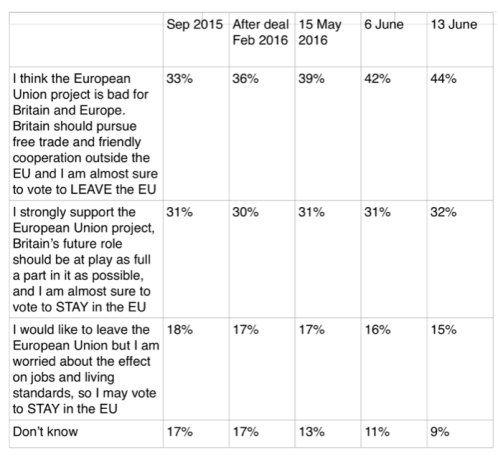
But we're talking about moving abroad here. Of that 48%, 15% were primarily motivated by the false claims made about economic armageddon.
Only about 30% of the population actually supported the EU for any reason (we don't know which ones). If you could go back in time and tell people 10 years ago that leaving would have no impact on GDP, no impact on trade, and no impact on jobs, the vote would have gone to Leave by maybe 65-70% (rough guess, can't be bothered to recompute the numbers with the 9% of don't knows excluded).
> If Texas seceded from the US, their citizens would (probably) lose the rights of US citizenship
This is ultimately a not very interesting debate about the precise semantics of the word "right". In the past I've attended a lecture by a human rights lawyer who argued there might be actually no such thing as rights, because if you try and nail down the term to legal precision it always ends in a mess.
But OK - what rights would Texans lose? Citizenship is a status, not a right. The rights afforded by the Bill of Rights? Probably not unless secession involved rewriting the constitution from scratch. The right to move to California and live there? Unless it was a very nasty split they'd presumably retain the ability to apply for an H1B or green card, like anyone else.
Moving to the EU was never a right in the sense citizenship rights are, because the "right" to move to other EU countries was always contingent on massive monetary payments, and something you have to purchase isn't normally described as a right. A better analogy than Texas seceding is if someone walked into a shop and declared "I have the right to own this expensive watch". It would just confuse people to talk like that and they'd disagree with you, because you'd have to pay for it first. If you bought it and then said, "Now I have the right to this watch" you'd again be talking very unidiomatic English (at best).
That's just one reason the EU isn't a nation and never has been, despite how some people dream of one. A nation doesn't charge you a subscription fee to be a citizen of it. The EU does. It's why EU federalists talk about empires and colonies when they think nobody is listening.
> How do you lose citizenship of the place you're born without explicitly giving it up?
By action of the government of that place. Its kind of like asking how you go to prison without doing anything wrong; governments are neither universally well-intentioned nor infallible even when they are well-intentioned, so the outcome of their actions does not universally adhere to any idealistic set of standards of what should be.
> How do you lose citizenship of the place you're born without explicitly giving it up?
The UK explicitly gave up EU membership, so you can't play that card.
That said, other than wars, and other than the e.g. UK home secretary determining you're not allowed to have a UK citizenship any more because they recon you're entitled to another one so they're not bound by obligations to leave someone stateless, there's the specific example I gave:
Secession.
> But we're talking about moving abroad here. Of that 48%, 15% were primarily motivated by the false claims made about economic armageddon.
1. You're literally telling people who did the moving that our lived experiences don't matter. I'm reminded of US politicians who were against gay marriage responding to gay men who said they wanted the right to get married with "But you can get married, nobody's stopping you marrying any woman!"
2. I can also suggest a number of the 52% were primarily motivated by the false claims made about economic costs, c.f. that bus.
3. "False claims"? The GDP loss as per the linked article this entire thread is about, is 12-16 times higher than the UK's net contribution to the EU, which was about 0.5% GDP:
Why do you insist that all the rights that in law depend on citizenship are not rights?
> Moving to the EU was never a right in the sense citizenship rights are, because the "right" to move to other EU countries was always contingent on massive monetary payments, and something you have to purchase isn't normally described as a right. A better analogy than Texas seceding is if someone walked into a shop and declared "I have the right to own this expensive watch". It would just confuse people to talk like that and they'd disagree with you, because you'd have to pay for it first. If you bought it and then said, "Now I have the right to this watch" you'd again be talking very unidiomatic English (at best).
Oh, now you care about "massive monetary payments"? Do you know how much it costs to become a UK or US citizen, all-in? Bearing in mind that you count the EU's net budget contributions (0.5% GDP) as "massive", you must surely agree to count the taxes these migrants have to pay, and in the UK's case the immigration health surcharge as part of that cost, not the ceremony, not even just that and visa fees, if you're counting the UK's net contribution to the EU budget, you have to count everything tax-like.
I wouldn't do this. So far as I'm concerned, the UK telling itself that EU citizen rights were not "rights" because they were "contingent on massive monetary payments" is like being someone who just became homeless because they voluntarily left home as a young adult on the grounds they didn't like their parents (i.e. you're allowed to, you did, what happens next is all your own responsibility) who is telling themselves that nobody had any right to a house anyway because to live in a house in the UK is "contingent on massive monetary payments" of "council tax" — council tax on A-band properties in the UK back then being approximately 3 times higher than the UK's net payments to the EU.
Nobody lost citizenship when the UK left because there's no such thing as EU citizenship. Only nations can issue citizenship, and the EU isn't one. I know you claim it is, and the EU itself likes to sometimes pretend it is, but no country on Earth recognizes the EU as a nation.
> 1. You're literally telling people who did the moving that our lived experiences don't matter.
Where do I tell you your experiences don't matter? I myself moved to Europe from Britain! What I'm telling you is that very few people have our experiences. Settlement abroad might have mattered a lot to you or me, but it didn't matter to the vast majority of people. And that's just a fact, you can check in old polls from that time if you like. Freedom of movement only ever came up in the inbound direction.
> I can also suggest a number of the 52% were primarily motivated by the false claims made about economic costs, c.f. that bus.
It's disappointing that this comes up so often, ten years later. That was a true claim, a true cost. The belief it was the wrong number revolves around a net vs gross calculation and the gross number is correct. Net spending reflects the EU's priorities, not the priorities of locals. If I am forced to give you $100 and you use that to buy me something that cost $20, but I didn't want that thing, you don't get to claim I only spent $80. I'm still $100 down from where I wanted to be. If I quit that arrangement the $100 is a genuine saving.
> The article under discussion itself that shows 6-8% GDP loss
There has been no GDP loss. Please read the actual paper and evaluate it critically. It is, like all claims there has been a negative economic impact of leaving, a lie. There's a thread starting here: https://news.ycombinator.com/item?id=45934061
This claim of economic harm comes up every few months and the underlying research is always like this. Usually they compare the UK against an insane counterfactual scenario, like assuming economic growth would have suddenly 3x-d out of nowhere after voting to Remain whilst the rest of the EU didn't. Or they compare the UK to a non-EU country like the USA and then say, UK growth would have matched if it had stayed in. Or they compare to a fictional country they made up on a spreadsheet (e.g. Goldman). The authors know all this is deceptive and they also know it works on people already predisposed to being fans of the EU, because they won't read any papers telling them what they want to hear.
> Why do you insist that all the rights that in law depend on citizenship are not rights?
This is another semantic problem. A status can lead to a "right" in law. The status itself is not the same thing as the right. The law can change to say "citizens no longer have a legal right to X" and that doesn't affect whether anyone is a citizen or not. The two things have to be kept separate.
I didn't follow your argument in the last few paragraphs. The British government gives people a home even if they don't/can't pay taxes. It costs a few thousand dollars to apply for citizenship normally in most countries, a one off payment that isn't a subscription fee. Once you paid you got it and won't lose it. The costs cover the processing, they aren't a general tax in the way EU membership fees were.
To recap:
1. There is no such thing as EU citizenship. It's not a country that can grant citizenship. You know this. It's just playing with words to pretend otherwise.
2. Citizenship is a status that can lead to "rights".
3. "Rights" should be put in quotes because it's a messy and misleading concept when you try to pin it down. A "right" is normally argued to be something inherent that can't be taken away from you, but what you're talking about was contingent on subscription payments. It was more accurately described as a purchase.
4. My argument about fees isn't contingent on how large they are. It's about definitions.
5. There was no economic loss to the UK from leaving. Claims to the contrary are always playing with numbers to try and sustain a deceptive and dishonest narrative, as all such economic narratives have been from the start.


1. You can only stay for three months. After that, at least in some states, you have to prove you can financially support yourself and family if you want to stay, i.e. you need to find a job pretty fast.
2. You can be refused if you have committed a crime.
For instance this is true of Germany. It's easy to fail these requirements. However you can't lose the right to live where you're born.
The reason not many people cared is that this requirement isn't much different to normal visa rules for most Brits. If you don't have a job and you move somewhere, you need to find someone to hire you fairly fast which means but you wouldn't have time to become fluent in the language unless for some reason you already were (not true of nearly all Brits). You can do it if you have specialized skills that compensate for non-fluency. But if you have specialized skills you can probably convince a company to hire you ahead of time, and that usually unlocks a visa anyway.
There are edge cases where this right is useful, but there aren't that many, which is why it didn't come up much ten years ago and why so many Brits move to non-EU countries.