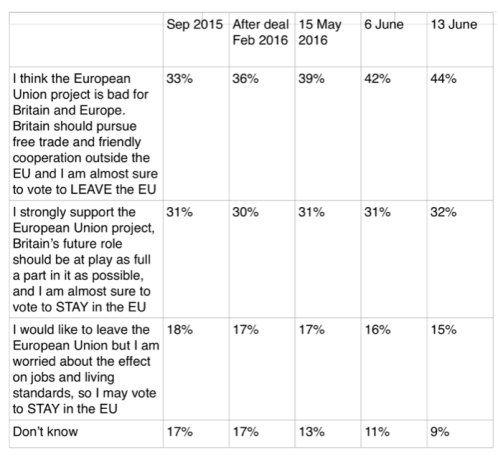
How do you decide which were the 2% that tipped the scale? Could have been the 18-22 years old too, no? Could have been any cohort, it’s a mathematical fallacy to pretend otherwise I feel.
Well, yes. But then again the 'Take Back Control' campaign had those UKIP buses saying "We send the EU £350 million a week, let's fund our NHS instead". An average person is a bit too removed from the GDP/investments conversations anyway.
And their representatives didn't want to leave so decided to drag their feez and do a shit job of it anyway.
I didn't vote either way but I expect those paid to represent us to actually do it.
Some did. Economic Euroscepticism is far older than the EU. The idea that the UK can return to the productivity of the Victorian industrial era, with WW2 bravado.
Of course it's tosh, and it unravels as soon as the first horse spooks, but in the run up to the referendum people were making all sorts of stupid claims about what we'd be able to have. Remember Soft Brexit? The idea that the EU would give us favourable terms when we were in no position to negotiate? Absolute madness.
It's not somewhat of a stretch, it's a deliberate lie. We get stories like this one every few months here on HN. It's always this kind of thing. They make up an unsupportable counterfactual and then claim a reduction relative to their fantasy world. People point it out and get downvoted by the I'm-an-EU-citizen types who can't accept that there was no impact on the UK from leaving. No negative impact on GDP, no negative impact on trade with the EU, no change to academic funding (UK is back in the Horizon programme, for better or worse, which was supposedly impossible cherry picking).
You can see all such claims are lies by just looking at the relevant graphs and comparing like with like. UK GDP has continued to track that of France. These are neighbors with similar economies, one in the EU and one out.
You could also compare to prior trajectory or look at trade impact.
This study doesn't do any of those things. It makes up a convoluted economic simulation and compares against that, with "uncertainty" being a major component. It's the same technique used to predict a recession immediately following the 2016 vote that would cause 800,000 job losses. No recession happened and employment numbers hit record highs. The prior failure of economic forecasting doesn't stop them from doing it again, with full confidence.
The establishment tell these lies about Brexit for the same reason they doctor video footage of Trump. They staked their credibility on these things being a disaster, and when the sky didn't fall it shook their worldview. Letting go of their prior beliefs is hard because the updates required would affect everything, so some of them decided that maybe if they lie hard and often enough they can live in the fantasy forever.
> there was no impact on the UK from leaving. No negative impact on GDP, no negative impact on trade with the EU, no change to academic funding
I think that is a bit disingenuous
- Good exports are down significantly and exponentially while services exported are up significantly [1]. This has a massive impact on agriculture, fishing as well but it is its own can of worms historically.
- Migration between EU continues to drop and the promise that free movement would continue is not true [2]. There is a stagnation and decline in speciality medical jobs in the UK post Brexit [4] and a significant decrease in investment forecast and outrun [5]. These both have led to less than projected increases UK job numbers.
- The UK is now paying the EU £6.4bn a year for no benefit [3]
It's not disingenuous, the problem is you're not doing the comparisons correctly. Goods exports are down to both EU and non-EU countries. Look at the graph on page 10:
There is no divergence between goods exports between EU and non-EU after the end of the transition period. They continue to move in sync and certainly haven't "fallen exponentially". Therefore, this slight fall isn't due to Brexit. If you look at the graphs in (1) you can see that the big falls are things like textiles, footwear/headgear and "raw animal hides", which haven't been big exports from the UK for over a century!
Imports did diverge immediately after leaving, but got back in sync in around Jan 2023, so any effect was temporary (p11).
Services exports were totally unaffected by leaving. They continued to grow strongly on their prior trends after the hit caused by lockdowns (p13).
So the commentary in (1) is thus very misleading, but it's an academic paper so what do you expect. You can't rely on commentary from academics to understand this issue, they are driven by ideological agendas.
> the promise that free movement would continue is not true
Who do you think promised free movement would continue? Ending it was one of the goals of leaving.
> There is a stagnation and decline in speciality medical jobs in the UK post Brexit
The UK has been giving out visas to medical staff nearly for free for decades, there are tons of non-EU medical workers in the UK. What does this have to do with Brexit?
> The UK is now paying the EU £6.4bn a year for no benefit
I think that's not per year, it's an estimated total remaining intended to cover things like pension payments, and once paid (over a period of many years) it will stop being required. This number is much lower than what the UK paid as a member!
I can only give anecdotes, but the majority of the support I saw for leaving the EU wasn't rooted in hard economics – there were claims about doing our own free trade deals and having an extra £350 Million being spent on the NHS instead, but that was about it. A lot of support centred around how our culture & history ought to be perceived, limiting migration, and not having faith/trust in the EU and our Governments.
Again anecdotes, but the most common reprieve I hear from Leave supporters is that leaving would've been great if not for 1) the years of political deadlock 2) Johnson's deal being naff. For most of us life hasn't improved since leaving (the pandemic right after didn't help); and after the promises about the sunlit uplands if we left, I don't think anything short of a miracle would make it feel like it was worth it.
I think the only people who feel like it was worth it were those who voted Leave through a culture/prestiege lens and put the fact that we left above everything else.
>> A lot of support centred around how our culture & history ought to be perceived, limiting migration
In reality they voted to replace immigration from EU with immigration from other countries. I guess it is better for UK culture to have more Asian people instead of European.
The guy who voted Brexit because he was fine with German and Polish immigrants who came to the U.K. and worked but he didn’t want Iraqi and Syrian refugees told me everything I needed to know about democracy.
As a 24 year old this is the biggest kick in the teeth, and I had no say in the matter because I wasn't old enough to vote. Apparently the EU is in discussion with the UK to continue the Youth Mobility Scheme - I hope it happens.
It's a good opportunity to experience what most people on Earth have to deal with. Please don't take it personally Simon, it's just that your compatriots tend to be the most entitled people I've met.
Yes, but getting a visa was never the main overhead involved in moving to Europe. That's why in practice very few British people ever used that ability outside of retirees going to Spain, and why it didn't play a part in the debate. Some people liked the idea that they could in theory live in France or Germany, but moving to the US, Australia or Canada has always more popular for British workers despite being harder.
I'm one of the few Brits that actually did move to Europe, specifically to Switzerland at a time when being in the EU didn't help, so I went through the usual immigration process. The paperwork wasn't an issue. 99% of the work was language learning and social integration. Hence why Anglophone countries get the bulk of the UK emigration.
If someone said, "I've lost the right to move to America" it would be interpreted as meaning you can't go there even if you go through the usual process that is otherwise required.
If the word meant that, then I have had a "right" to every job in existence except for those that have birthright requirements and that requirement cannot be altered, plus all the benefits schemes that exist worldwide that aren't necessarily contingent on birthright.
Do you actually use the word that way? I have yet to meet anyone who has accepted such a use.
Using the word "right" in such an expansive way would be saying that I have both a right to Californian food stamps and Norwegian child benefits and a Chinese pension; as a Brit living in Germany, I assert that this is a silly use of the word "right".
You can't spell "birthright" without "right". I don't have the "right" to become US president because I was not born there. And yet, changing the USA's constitution has a "usual process that is otherwise required" — the fact that it is so does not mean I can reasonably say that I have the "right" to become a president of the USA.
The fact is, before Brexit, any Brit could freely travel around and relocate to the other EU countries for any reason. No visa requirements which you could fail. Student with no income? Sure. Builder needing a job, as per plot of UK comedy series Auf Wiedersehen, Pet, despite low pay in this profession? Again, fine. Pensioner with no job? Also fine. Musician with expensive instruments? No need to prove you're not actually importing them to the EU. Truck driver making a delivery? Just cross the border, make sure you know which side of the road to drive on.
Going from the UK to the rest of the EU used to be as easy as if you were going from England to Wales.
Rights are always conditional in practice. The "right" to live in the EU comes with strings attached too:
1. You can only stay for three months. After that, at least in some states, you have to prove you can financially support yourself and family if you want to stay, i.e. you need to find a job pretty fast.
2. You can be refused if you have committed a crime.
For instance this is true of Germany. It's easy to fail these requirements. However you can't lose the right to live where you're born.
The reason not many people cared is that this requirement isn't much different to normal visa rules for most Brits. If you don't have a job and you move somewhere, you need to find someone to hire you fairly fast which means but you wouldn't have time to become fluent in the language unless for some reason you already were (not true of nearly all Brits). You can do it if you have specialized skills that compensate for non-fluency. But if you have specialized skills you can probably convince a company to hire you ahead of time, and that usually unlocks a visa anyway.
There are edge cases where this right is useful, but there aren't that many, which is why it didn't come up much ten years ago and why so many Brits move to non-EU countries.
> However you can't lose the right to live where you're born.
Yes you can. And many have.
> The reason not many people cared is that this requirement isn't much different to normal visa rules for most Brits. If you don't have a job and you move somewhere, you need to find someone to hire you fairly fast which means but you wouldn't have time to become fluent in the language unless for some reason you already were (not true of nearly all Brits). You can do it if you have specialized skills that compensate for non-fluency. But if you have specialized skills you can probably convince a company to hire you ahead of time, and that usually unlocks a visa anyway.
1. I literally listed examples with no income in that list.
2. You'd be amazed how much English is spoken in Berlin. Even political slogans, so you'll get the point of e.g. this even if you don't translate it/understand German: https://made-in-germany-2030.de
This is even a point of contention, for obvious reasons.
3. That it's a small number who cared (though 48% voting for anything it isn't what I'd call a "small"), doesn't mean you're using "right" correctly.
If Texas seceded from the US, their citizens would (probably) lose the rights of US citizenship; if Ticino seceded from Switzerland, the rights of Swiss citizenship; if Scotland from the UK, UK citizenship. The British stopped being citizens of an EU nation, and consequently lost the rights that are afforded by treaty and which are broadly described as "rights of EU citizenship".
That you can get those rights back by going through a process of changing citizenship is what it means to have lost them in the first place.
How do you lose citizenship of the place you're born without explicitly giving it up?
If you can support yourself off savings you don't need an income, which is why retirees can go to Spain. But you do need to be able to support yourself financially and without much time to do so.
I wouldn't be that amazed, given I've been to Berlin many times. Sure, you can go to big cities and then compete with locals for unskilled work without speaking the local language. You might be able to find temporary jobs where it's not strictly required. Most people don't want to do that.
> though 48% voting for anything it isn't what I'd call a "small"
But we're talking about moving abroad here. Of that 48%, 15% were primarily motivated by the false claims made about economic armageddon.
Only about 30% of the population actually supported the EU for any reason (we don't know which ones). If you could go back in time and tell people 10 years ago that leaving would have no impact on GDP, no impact on trade, and no impact on jobs, the vote would have gone to Leave by maybe 65-70% (rough guess, can't be bothered to recompute the numbers with the 9% of don't knows excluded).
> If Texas seceded from the US, their citizens would (probably) lose the rights of US citizenship
This is ultimately a not very interesting debate about the precise semantics of the word "right". In the past I've attended a lecture by a human rights lawyer who argued there might be actually no such thing as rights, because if you try and nail down the term to legal precision it always ends in a mess.
But OK - what rights would Texans lose? Citizenship is a status, not a right. The rights afforded by the Bill of Rights? Probably not unless secession involved rewriting the constitution from scratch. The right to move to California and live there? Unless it was a very nasty split they'd presumably retain the ability to apply for an H1B or green card, like anyone else.
Moving to the EU was never a right in the sense citizenship rights are, because the "right" to move to other EU countries was always contingent on massive monetary payments, and something you have to purchase isn't normally described as a right. A better analogy than Texas seceding is if someone walked into a shop and declared "I have the right to own this expensive watch". It would just confuse people to talk like that and they'd disagree with you, because you'd have to pay for it first. If you bought it and then said, "Now I have the right to this watch" you'd again be talking very unidiomatic English (at best).
That's just one reason the EU isn't a nation and never has been, despite how some people dream of one. A nation doesn't charge you a subscription fee to be a citizen of it. The EU does. It's why EU federalists talk about empires and colonies when they think nobody is listening.
> How do you lose citizenship of the place you're born without explicitly giving it up?
By action of the government of that place. Its kind of like asking how you go to prison without doing anything wrong; governments are neither universally well-intentioned nor infallible even when they are well-intentioned, so the outcome of their actions does not universally adhere to any idealistic set of standards of what should be.
> How do you lose citizenship of the place you're born without explicitly giving it up?
The UK explicitly gave up EU membership, so you can't play that card.
That said, other than wars, and other than the e.g. UK home secretary determining you're not allowed to have a UK citizenship any more because they recon you're entitled to another one so they're not bound by obligations to leave someone stateless, there's the specific example I gave:
Secession.
> But we're talking about moving abroad here. Of that 48%, 15% were primarily motivated by the false claims made about economic armageddon.
1. You're literally telling people who did the moving that our lived experiences don't matter. I'm reminded of US politicians who were against gay marriage responding to gay men who said they wanted the right to get married with "But you can get married, nobody's stopping you marrying any woman!"
2. I can also suggest a number of the 52% were primarily motivated by the false claims made about economic costs, c.f. that bus.
3. "False claims"? The GDP loss as per the linked article this entire thread is about, is 12-16 times higher than the UK's net contribution to the EU, which was about 0.5% GDP:
Why do you insist that all the rights that in law depend on citizenship are not rights?
> Moving to the EU was never a right in the sense citizenship rights are, because the "right" to move to other EU countries was always contingent on massive monetary payments, and something you have to purchase isn't normally described as a right. A better analogy than Texas seceding is if someone walked into a shop and declared "I have the right to own this expensive watch". It would just confuse people to talk like that and they'd disagree with you, because you'd have to pay for it first. If you bought it and then said, "Now I have the right to this watch" you'd again be talking very unidiomatic English (at best).
Oh, now you care about "massive monetary payments"? Do you know how much it costs to become a UK or US citizen, all-in? Bearing in mind that you count the EU's net budget contributions (0.5% GDP) as "massive", you must surely agree to count the taxes these migrants have to pay, and in the UK's case the immigration health surcharge as part of that cost, not the ceremony, not even just that and visa fees, if you're counting the UK's net contribution to the EU budget, you have to count everything tax-like.
I wouldn't do this. So far as I'm concerned, the UK telling itself that EU citizen rights were not "rights" because they were "contingent on massive monetary payments" is like being someone who just became homeless because they voluntarily left home as a young adult on the grounds they didn't like their parents (i.e. you're allowed to, you did, what happens next is all your own responsibility) who is telling themselves that nobody had any right to a house anyway because to live in a house in the UK is "contingent on massive monetary payments" of "council tax" — council tax on A-band properties in the UK back then being approximately 3 times higher than the UK's net payments to the EU.
Nobody lost citizenship when the UK left because there's no such thing as EU citizenship. Only nations can issue citizenship, and the EU isn't one. I know you claim it is, and the EU itself likes to sometimes pretend it is, but no country on Earth recognizes the EU as a nation.
> 1. You're literally telling people who did the moving that our lived experiences don't matter.
Where do I tell you your experiences don't matter? I myself moved to Europe from Britain! What I'm telling you is that very few people have our experiences. Settlement abroad might have mattered a lot to you or me, but it didn't matter to the vast majority of people. And that's just a fact, you can check in old polls from that time if you like. Freedom of movement only ever came up in the inbound direction.
> I can also suggest a number of the 52% were primarily motivated by the false claims made about economic costs, c.f. that bus.
It's disappointing that this comes up so often, ten years later. That was a true claim, a true cost. The belief it was the wrong number revolves around a net vs gross calculation and the gross number is correct. Net spending reflects the EU's priorities, not the priorities of locals. If I am forced to give you $100 and you use that to buy me something that cost $20, but I didn't want that thing, you don't get to claim I only spent $80. I'm still $100 down from where I wanted to be. If I quit that arrangement the $100 is a genuine saving.
> The article under discussion itself that shows 6-8% GDP loss
There has been no GDP loss. Please read the actual paper and evaluate it critically. It is, like all claims there has been a negative economic impact of leaving, a lie. There's a thread starting here: https://news.ycombinator.com/item?id=45934061
This claim of economic harm comes up every few months and the underlying research is always like this. Usually they compare the UK against an insane counterfactual scenario, like assuming economic growth would have suddenly 3x-d out of nowhere after voting to Remain whilst the rest of the EU didn't. Or they compare the UK to a non-EU country like the USA and then say, UK growth would have matched if it had stayed in. Or they compare to a fictional country they made up on a spreadsheet (e.g. Goldman). The authors know all this is deceptive and they also know it works on people already predisposed to being fans of the EU, because they won't read any papers telling them what they want to hear.
> Why do you insist that all the rights that in law depend on citizenship are not rights?
This is another semantic problem. A status can lead to a "right" in law. The status itself is not the same thing as the right. The law can change to say "citizens no longer have a legal right to X" and that doesn't affect whether anyone is a citizen or not. The two things have to be kept separate.
I didn't follow your argument in the last few paragraphs. The British government gives people a home even if they don't/can't pay taxes. It costs a few thousand dollars to apply for citizenship normally in most countries, a one off payment that isn't a subscription fee. Once you paid you got it and won't lose it. The costs cover the processing, they aren't a general tax in the way EU membership fees were.
To recap:
1. There is no such thing as EU citizenship. It's not a country that can grant citizenship. You know this. It's just playing with words to pretend otherwise.
2. Citizenship is a status that can lead to "rights".
3. "Rights" should be put in quotes because it's a messy and misleading concept when you try to pin it down. A "right" is normally argued to be something inherent that can't be taken away from you, but what you're talking about was contingent on subscription payments. It was more accurately described as a purchase.
4. My argument about fees isn't contingent on how large they are. It's about definitions.
5. There was no economic loss to the UK from leaving. Claims to the contrary are always playing with numbers to try and sustain a deceptive and dishonest narrative, as all such economic narratives have been from the start.
If you're an older person who's secure and has a pension and whose biggest problem is fear of other people, then this costs you almost nothing and probably alleviates your fears.
Though I know yours is a rhetorical question, I'll answer: No. Brexit was essentially an anti-immigration and pro-deregulation movement. Simple small-c conservatism. (It was also anti-status-quo, but that was implicit.)
The, uh, "Conservatives" who were tasked with implementing Brexit supercharged immigration and, with considerable assistance from the EU, doubled down on ridiculous social and business regulations, paperwork, and red tape. There was no upside. They just made everything much worse. I know that they expected the Brexit vote to fail, and I think there's a term for their subsequent actions: "Malicious compliance."
Now England is a powder keg if there ever was one. If things are going to kick off, it'll happen there first. As Weimar as America is these days, England is worse.
The main problem is that Brexit Meant Brexit: the Leave camp was promoting a dozen different and contradictory goals at the same time, and every pro-Leaver was free to cherry-pick their own interpretation of Brexit from it.
This obviously led to a massive issue when they actually won: you simply can't have your cake and eat it - especially when it involves another foreign power! There is no universe in which it would've been possible for the UK to completely detach itself from all EU rules, while still retaining completely free transit of goods, while also taxing import certain goods for protectionist reasons. Similarly it was never going to be possible for UK citizens to retain unlimited visa-free travel to the Schengen area while retaining the possibility for the UK to arbitrarily block access to certain groups of EU citizens.
The most obvious example of this is Northern Ireland: you can't leave the Common Market, and keep an open border between NI and RoI (thus not blowing up the Good Friday agreement and not starting another civil war), and keep an open border between NI and GB (thus not partially giving up sovereignty and suggesting acceptance of a slow move towards a united Ireland). Failing to deliver on all three at once (as promised piecemeal by various pro-Leave people) isn't malicious compliance - it's reality. Something has to yield, and if you don't decide up-front you'll of course get a nasty surprise later on.
Nazis are bad because they deny other people’s freedom to exist.
That LGBTQ flag doesn’t say straight people are wrong or shouldn’t exist. Literally all it’s saying is that people are welcome to exist publicly as their true selves. The odds are high that those kids know someone who falls under that umbrella, and this is an age appropriate way to say that’s okay just as straight people’s mating habits are discussed at the level of “mommy and daddy loved each other so much they got married and had you”.
> It may surprise homosexuals, but we do not actually tell kids all about our mating habits. Heterosexuals' lives do not revolve around our sexual proclivities; we don't seem to have the same urge to expose vulnerable children to sexual themes.
It's your mistake of conflating homossexual with something pornographic and unfit for kids, in reality it's about normalising that people from the same gender can feel love for each other, love as in caring, being a partner in life, and that people should be free to demonstrate that.
Heterosexuals (like myself) do that all the time, most will demonstrate love inside the house, hugs, kisses, caring. You're the one with the twisted view that homossexuals want to be pornographic instead, look inside yourself a little.
Nothing really. Unless your world view is somehow anchored on identity political symbols.
Disgust can be a very strong emotion you can have towards others and in that case, you could have issues with inclusion and human dignity regarding $people_i_dont_like. Thankfully, 3 year olds in kindergarden dont care about any of this, yet.
god forbid we teach children that people are different, and they matter, and they can love who they want and practice what religion they want. the horrors!
i hope your kids turn out cishet for their sake and only date white folk, otherwise they're going to be in for a bad time. what's so bad about caring for other people and respecting others?
The immigration betrayal was obvious to anyone familiar with UK history.
It's how the ruling class works. They import cheap labour from the (former) colonies to drive down wages. Then they pay their puppet politicians to hyperventilate about how terrible immigration is, how filthy these foreigners are, and how it Must Be Stopped.
It's been happening for centuries - the same scam, over and over.
Estimates are that between 1870 and 1913 net emigration of British citizens averaged about 131,000 per year, i.e. more people left the UK than arrived:
In the 1881 census of England and Wales, "natives of foreign states" were 174,372 people, just 0.671% of the population.
In the 19th century, England was a country of emigrants, with net migration at roughly -100k/year. From 2014–24, you're looking at typically +200k to +900k per year. This is totally unprecedented to put it mildly. And now, like it or not, I'm sure that things are going to get ugly.
The few families that rule the UK were undecided if joining EU was benefiting, mainly for them, or not. They experimented, the experimemt failed and they cancel it. I believe the most important reason was that they felt subordinate to the Germans and couldn't predict this feeling beforehand.
Who gained financially from Brexit? I mean in terms of the "elite" behind the scene. If no one gained that would be really weird. Someone or some group of people must have gained something, financially, even in an indirect way. Can you think of anyone who benefitted?
I honestly believed that Britain would find a way to hold a second referendum before Brexit, given that the polling almost universally favored "remain" after the vote, and the vote itself was so close (52% to 48%). Now what surprises me is the lack of enthusiasm for Scottish independence (62% voted to remain), though I can't claim to keep up on Scottish politics. Maybe someone knows?
I went on a couple of marches for that but no. The percentage of MPs willing to vote for that never went higher than ~40 or 45%.
I think the thing is a bit of a travesty though. At the time of the vote, the apathetic who didn't bother voting were about 60% remain so the overall balance of the population was pro remain but it got forced through for better or worse, probably worse.
It's not uncommon in some democracies to require multiple votes for major changes (such as constitutional changes or leaving/entering intergovernmental orgs). And 4 points may be a clear margin, but it's not a large margin, and polling showed an immediate shift in opinion. In terms of the Scots, 62% is an actual blowout. And I'd think it might be enough to overcome the 10 point gap on their vote on independence (pre-Brexit).
Yes, but this wasn't the usual two-party election. The 1972 referendum to join the EU got a 67% "yes" vote, the 2011 Alternate Vote referendum got a 68% "no" vote. You see similar number with, say, California's ballot propositions: a "solid win" is closer to a two-thirds majority. 52-48 is close enough to flip depending on the weather.
Rejoining the EU can absolutely be done, but I think it's unlikely the UK could join on the terms it had before, I can't see that being accepted in the current political climate in Europe.
In theory, any new country joining the EU has to switch to the common currency, the Euro, something the UK was able to gain an exemption from while still a member along with Denmark, Sweden and a handful of others, a long time ago when the Euro was first introduced.
This has always been an issue when discussing Scottish independence too, given the SNP have always claimed Scotland could rejoin the EU and keep the pound; the EU has always said otherwise.
Instead of "breenter" it would probably be more realistic for the UK to join up with Mexico, USA, and Canada as a fourth member of that trace bloc. Together they would then have more power to negotiate a favorable trade deal with the EU.
I'm assuming this was posted to draw a parallel with current U.S. international policy, such as tariffs and protectionist measures, which share some fundamental similarities with Brexit.
The paper just came out. I would assume they're posting it because it's interesting to a generally economically curious audience, and Brits in particular. No need for posting to be some targeted snipe at America.
Hopefully it leads to more investments in other places. That way the voters will eventually get what they want in a monkey’s paw way. Less immigration because the home countries get more investments and more opportunities.
Do you mean it turns out America was already great (despite still having some problems) and that’s why the whole world was flocking to it. In fact, it was so great that it was sucking up potential greatness from other countries.
The same people who tell you that GDP means nothing to the average person and that investments only go to the rich will tell you that Brexit was bad because it reduced GDP and investments.
as a casual observer living in the uk, what brexit has done is stopped the influx of highly educated and economically contributing people from the EU, and instead replaced them with people who are claiming "asylum" from asian and african countries
As a long term Brit I kind of get that impression too although there has been a lot of regular immigration also. I bet the brexit voters who tended not to be keen on immigration have been pleased with that.
Also a lot of regular Brits have moved abroad. Dyson who famously advocated for brexit to help Britain moved to Singapore, my friends have moved to France, Portugal, Spain and Dubai.
Downvotes because while you're right it has reduced immigration from the EU, the vast majority of post-Brexit migration to the UK has no been asylum seekers, and most asylum seekers have not been Asian or African.
OK let's look at other measurements: Did Brexit increase UK soft power? Did Brexit increase cultural exchanges? Was Brexit good for the universities? Is the food better and more wholesome? Was racism reduced?
Most of those are in the same class - not things that directly affect many people. Most people in the UK don't know what 'soft power' is (I'm not being condescending; most people don't get into international relations on that level of detail) and its effect is indirect. How many people are directly affected by the quality of universties? - of the population that attends, many are just as happy regardless and aren't concerned with world-class professors and research.
Brexit can be a bad idea and at the same time the GP can have a good point about globalization.
>Recently, weren't there supply and inflation issues regarding food?
From a US perspective, the supply and inflation issues regarding food were primarily focused on eggs, and the problem resolved itself as soon as companies stopped killing chickens due to whatever avian flu was going around. That being said, it might be different for the land of kidney pies, I'm not sure.
Also, I should've been clearer in my original comment. I usually hear the whole "but what about the food?" argument from people who are just upset that deportation of illegals will make their favorite empanada restaurant close, or who argue that the original food of a place is terrible and by introducing migrants of legal or illegal status, then everything (culinary scene & life in general) will magically become better.
Are you trying to be provocative? Talking about "illegals", and expressing contempt for people who care about them. Whatever the legal status and whether or not someone should be in the country, they are people and others legitimately care about them and their rights and freedom. Being deported, espeically in the way it's often conducted, is awful.
Not that it matters for immigration policy, but Britain's food was greatly improved by immigration; it's not magic. In the US it's hard to say because, other than things like corn and bison, etc., all cuisine is from immigrants!
>Talking about "illegals", and expressing contempt for people who care about them.
I do have contempt for illegals and the people in the countries where they're illegally present who care about them and stymie attempts to remove said illegals. It's a gross violation of the social contract and I'm tired of people just hand waving it away like it's no big deal and we just have to accept it.
>Not that it matters for immigration policy, but Britain's food was greatly improved by immigration
I agree with you that it doesn't/shouldn't matter for immigration policy, but at the same time I've heard this argument used by people who brand themselves as pro-immigration as a reason why we can't do anything about illegal immigrants because if they're deported, who will cook their unique cuisine?
These are the dying days of neoliberalism where only a fasicst police state is capable of propping it up.
The core problem here, and pretty much everywhere else, is rising inequality. We have seen a truly massive wealth transfer from the poor to the rich (either directly or via the government) and we're rapidly reaching the point where the poor simply won't have anything left.
Post-GFC austerity measures have been an abject failure. Successfully blaming those failures on immigration (as what became the Reform movement did) directly led to Brexit because neoliberalism in the UK is uniparty. So here we are where Nigel Farrage is odds on favorite to be the next Prime Minister of the UK (barring whatever leadership coups take place in Labor in until the next election, at least 1 of which is expected).
So the problems of neoliberalism are blamed on migrants. There is no counter-narrative to that. So we see a rise in isolationism and nationalism. And nothing improves. Well done, the system works.
What I find particularly fascinating is that many who push this agenda fetishize the 1950s (particularly in the US), which is funny because there was vastly less inequality and the marginal tax rate (in the US) was 91%.
Switzerland and Norway have better navigated being on the edge of the EU but not in it. But Norway has vast oil reserves (and, to their credit, is using them for a sovereign wealth fund instead of minting a handful of billionaires). Switzerland was the banking center but is really losing that title. Britain was once the heart of a vast empire and it too is a financial hub and a center for international money laundering (ie real estate) but, much like Switzerland, it doesn't really produce anything anymore.
The post-neoliberals have created even more inequality, and openly oppose any efforts to fix it. The US government is still trying to disrupt food programs for the hungry.
> There is no counter-narrative to that. So we see a rise in isolationism and nationalism.
Few argue for a counter-narrative, but there are plenty. One is that almost everyone in the US is in a family of immigrants. The economic counter-narrative is overwhelming. Also economics is not a zero-sum competition - it's not beggar-thy-neighbor: If your neighbor does well, you do well - they are your employers, customers, employees, lenders, borrowers, renters, etc. Fewer neighbors is a smaller, slower economy.
Surely replacing neoliberalism with social democratic sharia sectarian state will bring prosperity to all. There are so many examples of succesful, prospering countries that have choosen this path in the East. Lebanon, Syria, Iraq, Pakistan, Indonesia...
>> GDP is a meaningless measure for all but governments and the very elite.
Source?
The top three GDP per capita are: Lichtenstein, Luxembourg, Bermuda. The bottom three are: Afghanistan, Yemen, South Sedan. As an average person I would rather live in the top countries of the list than the bottom but that's just anecdote.
I don't know why people are being to negative towards GP. (Maybe because he didn't argue his point?) It's well known that GDP is not a good measurement for common people.
You can have a rich elite and a high GDP, but that doesn't mean the common people are doing as well as the GDP suggests.
A good example of this is Ireland. It has a huge GDP. 129,132$ per capita. It's the 3rd richest country in the world if you look at it like that (Liechtenstein and Luxembourg are first and second).
But do you think the average Irishman actually makes 129,132$ per year? No. Ireland is a tax heaven and its artificially inflated by tax shenanigans from foreign multinationals.
There are other reasons why absolute GPD is bullshit. Even PPP GDP is a little bullshit.
> It's well known that GDP is not a good measurement for common people.
It has many flaws, but can you name a better one?
> that doesn't mean the common people are doing as well as the GDP suggests.
Nobody who understands GDP would say everyone is doing as well (or poorly) as GDP suggests. Some people do better, some worse.
But people in places with higher GDP reliably do better. Visit a poor or middle-income country; the difference is unmistakeable and this debate becomes absurd.
Inequality is a major problem in high-GDP countries; that doesn't mean GDP is meaningless.
Your point is a serious one, and well taken. But “South Sedan” made me smile. Seemed like a reference to rusting sedans on cinder blocks in the low-gdp rural south.
Taking maximas and minimas is only saying that the scale of GDP figures is interesting to look at. Like does it have 3 figured or 6 figures ? But that metric is easily done with others measures than GDP.
And yeah, if you study GDP its easy to see it’s a giant scam and the economy cannot be put into numbers. Qualities are better than quantities
Why would you need that ? GDP does not have good theoretical foundations. We don’t need to pretend it’s a natural science like biology, it’s constructed from bad statistics, it’s worth nothing
Its an argument from authority. All those people could be wrong about what the economy is about, it does happen that 90% of people are wrong about something, collectively. And every country measures it differently.
Even if it was really meaningful, by the simple Cobra effect it would be made meaningless
Well this just tells you that if you play by someone else's rules you get money and investment pouring in and GDP going up. If you don't then its the opposite. The main question is do you prefer to play by your own rules or rules imposed by investment interests.
Edit: For an average person its not always true that an illusion of prosperity is always good. Eventually there might be a payback for all this capital.
this is such a bad way to evaluate a metric. we want something that can distinguish small percentage changes in affordability for the people who live there
The average citizen in those places do not reap the rewards. Those places are countries where laws are built for the rich and to shield money. GDP is not a great measure for the average person unless communism is fully realized.
The average citizen is much better off than in low-GDP places. The issue is how much prosperity they miss out on because it's captured by a few.
The world has never seen an explosion in prosperity, and reduction in poverty, like the post-WWII and post-Cold War years, and it was accomplished via free markets, trade, etc. (not perfectly or exclusively, of course). Look at S Korea, Taiwan, Japan, Brazil, China, India - like nothing the world has ever seen. Billions lifted from poverty.
Look at Western Europe after the absolute destruction of two world wars, and compare their recovery with places that did not follow the path of free markets and trade.
That's an overly simplistic take. Obviously the absolutely richest nations in the world are better places to live than the absolutely poorest. But that doesn't mean there is a strict ranking based on GDP.
For example, based on GDP/capita:
  - The United States outrank the Netherlands.
  - The United Arab Emirates outrank Italy.
  - Puerto Rico outranks South Korea.
  - Saudi Arabia outranks Japan.
I don't know about you but for all of these pairs I'd rather live in the latter rather than the former.
I remember someone on HN complaining that there were places selling authentic Polish sausages in London, and somehow it sounded they were deeply unhappy about it.
I don't know if average Londoners can still afford authentic Polish sausages, but if they can't, I hope the original commenter is happy now.
It only makes sense to compare GDP between countries on PPP basis. Otherwise you don't account for currency rate fluctuations and difference in averge price level.
IMF figures for 2025:
87% GDP per capita PPP,
50% nominal GDP per capita
Yes, but a third of Poles emigrated, largely ending Brits' moral panic about Polish plumbers stealing the jobs, social housing and increasing housing prices.
Not that it solved the issue of jobs, social housing or housing prices of course.
What issue is that? Propagandistic, lying media spreading misinformation to the public as corrupt politicians, being paid off by malign foreign actors intent on destroying the influence and power of Britain on the world stage?
Yeah, but long term it will increase GDP due to the UK being able to have better (fewer) regulations than those allowed by the EU. It does require Parliament getting it together.
Ok but the current vibe in the UK is Parliament wants to watch you while you sleep so they can judge your worthiness. Not exactly an "efficient regulations" regime.
> long term it will increase GDP due to the UK being able to have better (fewer) regulations than those allowed by the EU
Speaking from finance view, the trade from Britain has been moving capital out for years. Not in. The stock market has shrunk,
If real deregulation comes at some point, maybe the curve changes. That remains unlikely, however, given to export anything the UK would have to meet their importers’ (read: America and Europe’s) standards.
(The benefits of deregulation are absolutely swamped by the benefits from trade. This inequality grows the smaller your economy is relative to your trading partners’.)
By leaving the EU, they greatly increased regulation of intra-European trade and labor movement. Both used to be generally open and free - deregulated.
GDP is a measurement that doesn't reflect the wealth of the average voter and foreign investment less so.
What good is 8% higher gdp if that only belongs to richest. A lower gdp but higher wages is a win for the average citizen and a loss for the banking class.
Brexit was a loss for the banking class but win for the average person.