> Declining church membership suggests organized religion is no longer the community builder it once was.
This is all they have to say about this, which is unfortunate, because it dramatically understates just how important religion has been as a community builder and just how much of the loss of the third space is actually just a loss of religion. In 1999 70% of Americans were a member of a formal organized church/synagogue. In 2023 that number was down to 45% [0]. That is an absolutely staggering difference.
Some commenters have noted that it's hard to find a third space in suburbia. This is true if and only if you ignore churches as an option. In your average US suburb or small town you'd have a hard time finding a home that isn't within walking distance of some church or another. These were the third space for most of America for most of history, and they were very accessible.
No matter your opinion on what the future of organized religion should be, it's weird to have a discussion about the disappearance of third spaces in the US while only giving a token nod to our single most significant historical source of community.
When people talk about third spaces, they usually mean a place you can casually show up to at 6pm (with or without family members), take a seat, and maybe chat with some familiar faces. As someone who grew up going to church, I feel like my church was neither my parents’ third place nor my own! It was simply a place we went to on Wednesdays and Sundays to worship our God. We would hang out afterwards, but that was limited to 0.2857 of our free afternoons/evenings.
I think the article gets it right in that the collapse of American third places goes beyond just church attendance. Ideal third places are things like guild halls, bars, parks; places where you can show up and no one asks why you’re there or what you did today. The leveling and inclusive aspect is key: you need to be able to bring anyone who might otherwise need a third place, and they must be greeted as just another conversation member.
This is how high school Super Smash Brothers days were at Blaine’s house: unlocked door, say hi
> We would hang out afterwards, but that was limited to 0.2857 of our free afternoons/evenings.
I fully believe you that church never felt like your third place. That disconnect between generations is a large part of why churches have declined. But speaking as a parent of small children—if your parents were allocating two nights a week to go hang out at church with church friends, that was absolutely a third place for them. Parents simply don't have enough time with other adults to justify hanging out for hours two nights a week with adults that we don't enjoy chatting with.
> The leveling and inclusive aspect is key: you need to be able to bring anyone who might otherwise need a third place, and they must be greeted as just another conversation member.
A month ago I attended a random Protestant denomination with my father-in-law that we'd never been to before in our lives and had no intention of joining. We went to the gathering after the service and were welcomed as part of the group. They had lots of questions for us because we drove across the country to get there, but there wasn't anything weird about it, it was just people hanging out chatting.
I do want to clarify that I'm not saying that there weren't other third spaces that have also declined. But church was the universal third space that almost everyone had and generally assumed that you had. You might also have been a Freemason or a member of the Elks Lodge or have gone to hang out at a coffee shop, but the rest of our third space infrastructure was all built on the assumption that church was already there filling a lot of the needs.
There used to be a bunch of places at least for working class (especially men): Elks, VFW, etc. Sports leagues after work for both professional and blue collar; my sense is those are a lot less common. We had a bunch where I worked 20+ years ago. My sense is whatever hadn’t petered out pre-Covid is gone now in many cases.
The extra rare variant is places you can go from 10 PM onward. Everything public closes at sundown which sucks for me who's heat and sun sensitive. Like it's fine, I guess at some point I'll catch a charge for trespassing but it would be nice if it was allowed officially.
> In your average US suburb or small town you'd have a hard time finding a home that isn't within walking distance of some church or another.
What??? Have you been to an American suburb? Yes, there are churches all over the place, but they can _never_ be walked to. Nothing can be walked to. Maybe they are so ubiquitous that it's only a 5-10-min drive, but that's the best you are gonna get.
Do you mean the Church is closed? I go to the Church often for worship and the Parishes are open very often, however its best to attend during Mass (Saturday evenings or Sundays) or other Holy days.
Also, most Churches plan many community events including volunteering opportunities and have other things like support groups. They will accept your request to join any of these, no question asked. You can check their websites for these details.
You are more than welcome to attend everything including Mass as an Atheist, if you feel like you need a place for solemnity, you can just sit in the back and observe or follow along!
P.S I'm a Roman Catholic but pretty much all Protestant Churches operate more or less the same.
I just dropped a pin in a random suburb outside Philadelphia, searched for churches, then tried to find the spot in the suburb that was the absolute furthest from a church. 0.8 miles, a 17 minute walk. Tried in again in a NY suburb and got 1.1 miles, a 22 minute walk. Tried in a suburb of LA, 0.6 miles, a 14 minute walk (and one that far was hard to find!). I'm deliberately avoiding the South where I expect this to be even more true.
Obviously this becomes harder if you need a particular denomination, but a lot of people just attend whatever's closest, and that's all my statement claimed—that there is a church within walking distance of basically everyone.
You're welcome to try this elsewhere and see if you get different results.
You may be right. Just did it in Katy Texas and got 24 minutes of, honestly, not a bad walk. I guess I'm just going off my experience, and when I was a kid, no one just went to the closest church. You went to _your_ church. My girlfriend's family was famous for changing churches all the time as soon as there was some philosophy they didn't agree with in their current one. Church with them always involved a pretty decent freeway drive.
No I literally don't know a single person who goes to church so... I don't really have a leg to stand on here. :D
We killed god awhile back but it seems like people are starting to realize it. I feel like you probably need to be able to believe in a god to join a religion, but I have never been able to despite trying.
That’s where I’m at. I wish my (hypothetical; future) kids could have the same church experience and community as I had, but I don’t know how I’d pull that without personally being a believer.
> If you do hope to stay, expect to keep spending. The low-cost luxuriating necessary for healthy third places isn’t considered profitable.
A lot of people struggle with this after college and a social club (sport, dining etc.) is usually the best way to keep your social life going. But yeah you usually have to value and invest in it, which maybe people aren't doing so much as prices have increased in the physical world while prices for entertainment over the wire has decreased.
I also think communities (third places FTA) that enable these friendships need to be, to some extent, closed or invite-only. I feel like as a social network grows each individual edge is a little weaker, which is the reverse incentive of developers of social networks and explains why socialising over the Internet feels the way it does.
"The low-cost luxuriating necessary for healthy third places isn’t considered profitable." The author has a good point, although link in the article is to an ad for Toast, the not very good point-of-sale system. Starbucks has removed chairs and tables, and covered power outlets, at many locations. This was not accompanied by a price reduction.
Maybe it's my European perspective, but i feel like Starbucks has fallen several levels down in terms of it's price perception. Simply put, they haven't increased their prices like... ever. I remember very well pricing on some items and they are about the same in nominal euros as they were 15-18 years ago. They went from definitely upscale to cheap-ish - not the sheapest, but certainly not premium by any measure. And yes, no more outlets in most locations, and more limited seating. Why is that? idk. I loved it the way it used to be and would pay more to keep it that way.
And yes, certainly the kind of people visiting them as well as the kind of people working there has fallen along with their price niche.
That is not necessarily true all over Europe. In my area prices were increases somewhat recently and I now decided against going there anymore. However, they did not change any seating inside, everything stayed somewhat tge same
Coffee prices in general have been falling for decades. The 2011 price peak was unusual and resulted in far higher prices than in 2001 and makes the current price spike less noticeable. https://dripbeans.com/coffee-price-history/
More efficient farming has largely offset inflation just as with most other agricultural commodities resulting in fairly flat prices over time barring occasional spikes.
Well in a way, all small cafes compete with each other and it doesn't have to be about coffee (and definitely not about raw coffee prices as agri commodity, which are certainly <1% of their gross revenue). Somehow i have to pay twice as much for a burger in many joints, vs 15 years ago, about 1.5x as much for an espresso elsewhere, but exactly as much in Starbucks, and that gets me thinking.
Predictably, every chair is now occupied by a sleeping homeless person.
So now their choice is to either remove all the chairs, or potentially be mean to someone, and receive a firestorm of criticism. You can see which one they chose.
It happened during covid and they just haven't returned in the same way. It's unfortunate. I really hope the small late night coffee shop makes a return.
Having moved from SLC and subsequently lived in several major west coast cities (Seattle, San Francisco, and Portland), it's always surprised me that the cities recognized for their amazing coffee all have way less late-night coffee options than meek little Salt Lake. I haven't really been there in a decade so maybe that has changed, but they had several shops open til after midnight.
(Shout out to any of the folks who used to frequent Greenhouse Effect in the early aughts, before it got bought out and turned into a purely profit driven venture by Jimmy and his dad).
I'm sure that plays into it, though the laws really aren't all that weird anymore, and the same people that can't drink alcohol in Utah also tend to not drink caffeine.
I have no idea what someone means when they say they live in city like this. What makes a city tier 1? What's the difference between tier 3 and tier 4? What's worst tier? When does something move from "not-a-city" to the worst tier?
Generally I go by desirability (which includes jobs, amenities, etc.) then population size, but as others have pointed out it's a loose metric that doesn't measure anything objective. To give some very subjective examples:
Tier 1: LA, NYC, SF, Chicago, Seattle
Tier 2: Denver, DC, Austin, Minneapolis, San Diego, Houston, Philadelphia
I'm in Madison, WI which is barely a city but ranks high in desirability pretty consistently and has housing prices to match.
It’s an amalgamation of income/wealth potential, population size, and relative desirability amongst the general populace to (reflected in land/housing prices).
Obviously, there is no objectively true ranking, just people’s opinions.
I’m not sure how Starbucks ( or most coffee shops) are really third places. I imagine most people immersed in their phones or laptops would tend to brush off any serious attempts at conversation.
To another comment about this being all about lack of walk ability in many places I’m also not sure that being able to walk around an urban core suddenly makes it a social center absent some persistent stimulus.
My experience is groups of friends and activity partners generally tend to happen without close physical proximity.
It depends, I used to live in a very urban area of the city and the ground floors of most residential buildings were commercial. The Starbucks that was near where I lived had a lot of recurring locals that simply did remote work there in the tables, so you could meet people because it was essentially most of the same people everyday and you eventually had some interaction so you ended meeting the others - like work/student colleagues from different companies. I actually didn't remote work at the time but I used the space to study because my apartment was damn small. But this was before COVID and sadly that Starbucks unit closed during covid and I ended up moving from that small apartment to a suburban house around the same time.
First they took the chairs and people stood at the tables. Then they took the tables and people stand by the windows or counter. Those who know other options will leave or not enter, but there's enough visitors in midtown who can visit a location once and never return. If it's particularly hot or cold weather, standing inside may be better than sitting outside.
Time will tell if Starbucks fractures into Sitbucks and Standbucks.
My belief is that this can be mostly or maybe entirely traced back to the way Americans ruined their cities. At one time, before urban neighbourhoods were demolished for freeways, Americans more commonly lived in denser neighbourhoods.
The transition from urban to suburban living (partially fuelled by cost of living being subsidized in suburbia, and partially caused by NIMBY advocates blocking the development of new housing to keep housing prices affordable in cities) completely destroyed any chance Americans had to be independent from their cars.
Instead what they have in the states are a bunch of disjointed metro areas that demand a car to do anything. So teenagers need to be chauffeured around and lose independence because of the reliance on parent transport.
I think that feeds into the mental health crisis but it also makes third places more expensive (fewer people using them than if the area was more densely populated) and more hostile (housing unaffordability drives homelessness and the use of third places as homes for the homeless.)
You’ll find an exceptionally strong correlation between viable third places and cities that don’t demand that you own a car.
>> At one time, before urban neighbourhoods were demolished for freeways, Americans more commonly lived in denser neighbourhoods.
Before freeways, there was a huge rural population. 60% in 1900, still 36% by 1950. If your theory was correct there should have been a massive mental health crisis in rural areas during that period.
Hang around HN enough and you will realize that the root cause of all societal (and most non-societal) problems is suburbia, and that if everyone would just live in cities we could finally reach the ultimate utopia.
To be fair, those rural communities were largely self-sufficient. You didn't need a car to drive into the city to do anything. You could do everything right at home. This kept the community fairly tight-knit.
In fact, with respect to the topic of third places, I was recently looking at an old township map of where my family's farm is located from the 1800s. What really stood out was that there was a church found approximately every mile.
A little surprising by today's standards, but stands to reason when you think about it. I mean, what else were those people going to do? There wasn't much else to do other than socialize with your closest neighbours, providing sufficient concentration for a third place to emerge. Now imagine putting some kind of social centre every mile in those suburbs today. I don't see it working out too well.
I think you’ve got the causation reversed. People built freeways so they can live in car-dependent suburbs. I’ve got a lot of immigrant family that came through New York City because there is a large community of our ethnic group there. Every single family has moved out to the suburbs as soon as possible. The folks who came with a bit more education went straight to places like Dallas Fort Worth where you could buy a big house for not too much money.
*Social engineers built freeways because it was a convenient way to raze minority neighborhoods while subsidizing suburbs that were care-dependent largely in order to limit who could move there by class.
It's important to tell the full story because similar dynamics drive our current stumbling blocks.
That’s obviously coincidental. Many countries (and even parts of the US) that have no minorities to oppress developed car-dependent suburbs around the same time.
Those articles don’t support the point you made above. They show that minority neighborhoods were razed to build freeways. That’s true—for the same reason chemical plants and power stations are disproportionately built near places where minorities live. But razing minority neighborhoods isn’t the reason people build chemical and power plants. That’s just the easiest way to build things people want to build for other reasons.
Likewise, people didn’t build highways for the purpose of razing minority neighborhoods. They wanted the highways, and it was easier to build them through poor neighborhoods than to build them through richer ones.
Again, European cities did or tried to do many of the same things as American cities in terms of building freeways: https://bicycledutch.wordpress.com/2016/01/05/motorway-remov.... Cities like Seattle and Portland that had virtually no minorities in the 1960s also built freeways through downtown. The existence of minorities isn’t what caused people to build those freeways. That’s like saying wet streets cause rain.
You need to read them again. They explain that the overarching purpose of urban renewal/the ISHS was to transfer wealth from black urbanites to newly-crowned white suburbanites. The highways would not have been built if they couldn't raze poor and/or black or minority neighborhoods (it should be noted that many were thriving economically, if unconnected politically), as the contemporary NIMBY-won fights that kill public transit project after project show. Europe's situation is different for several reasons, including the pre-automobile "urban renewal" of many cities in the late 19th century (the displacement of "slum" inhabitants being now outside of living memory) that has been preserved in contemporary layouts, the complete destruction of many cities during WWII (precluding "slum" clearance), and the robust anti-freeway movements in several cities, particularly Copenhagen.
>Robert Moses, the construction coordinator of New York City and an influential urban planner, believed that highways should be built in order to destroy black neighborhoods. "Our categorical imperative is action to clear the slums," he said in 1959.
>Seattle's highway planners took Moses's idea to heart. They placed the intersection and interchange of two major planned freeways, the I-90 and the RH Thomson in the center of the Judkins Park neighborhood of the Central District which was 85% black at the time.
>the urban renewal project and the placement of the freeways was a deliberate plan to destroy Black Seattle and eviscerate an area seen by white Seattleites as a ghetto.
> You need to read them again. They explain that the overarching purpose of urban renewal/the ISHS was to transfer wealth from black urbanites to newly-crowned white suburbanites.
They don’t say that. The two academic papers you linked say that was their effect. And the blog posts you linked above don’t offer any proof for their assertions of motivation. For example, the article about Seattle cites statements by Robert Moses in New York City with no attempt to connect the two.
> The highways would not have been built if they couldn't raze poor and/or black or minority neighborhoods (it should be noted that many were thriving economically, if unconnected politically),
You’re the one who is horribly misinformed, trying to project an America-centric racial narrative onto something that was a global phenomenon driven by people’s preferences for the low density living enabled by cars.
>The benefits and burdens of our transportation system – highways, roads, bridges, sidewalks, and public transit – have been planned, developed, and sustained to pull resources from Black communities that are subsequently deployed and invested to the benefit of predominantly white communities and their residents.
>Again, we know that’s not true because highways were built through cities that had no significant minority populations.
You said this about Seattle and Portland, supposing (incorrectly) that there were no minority neighborhoods to raze. It suggests one of two conclusions:
a) There were minority (if not racial, then ethnic, or class) populations that were displaced in order to build the highways in Cairo, and Dusseldorf, and Tokyo, the histories of which we're not privy to due to some combination of a language barrier wrt applicable sources, and an incentive on the part of local historians not to include that history in the foreign-facing record (for diplomatic and face-saving reasons). To disprove this, general demographic statistics aren't enough; you would need specific information about the geographic locations in question - in particular, demographic history and qualitative information about that demography. I don't think you have that.
b) The American history of highway construction is singular, if not at least abnormal. This is the more likely option, because of America's globally abnormal geographic and population size, demographic history, history of municipal development, history of transit development, and automobile-related policy. To put it simply: most other countries don't have the incentives and means to use redevelopment as an explicit tool of displacement. (China does, and unsurprisingly: https://www.fmreview.org/destination-europe/dube).
>trying to project an America-centric racial narrative onto something that was a global phenomenon driven by people’s preferences for the low density living enabled by cars.
You're projecting an America-centric narrative about the role of the auto in the average person's life onto populations with very different circumstances and outlooks. You're categorically wrong, and it might be more useful for you to ask why you're clinging to this incorrect assessment of America's racial and political history.
rayiner's context for "urban renewal/the ISHS" is clearly in the US, and must not be misinterpreted as a world-wide basis for all urban highway projects, as you have done.
In the US, Robert Moses was one of the foremost leaders of the urban renewal project. "He was a leading proponent of the idea that the best way to eradicate the supposed slums where Black people lived was to build highways through them." , quoting https://www.history.com/news/interstate-highway-system-infra... , which then quotes Moses:
> “Our categorical imperative is action to clear the slums,” Moses said in a 1959 speech. “We can’t let minorities dictate that this century-old chore will be put off another generation or finally abandoned.” Moses, who was also the chairman of the New York City Slum Clearance Committee, said that the highway construction must “go right through cities and not around them.”
> Shortly following the adoption of the Interstate Highway Act, however, highway builders began to drop the pretense of urban renewal and vocally embraced their racial agenda as thriving Black communities were destroyed and removed. In many states, highway builders went out of their way to avoid white homes and community institutions but also went out of their way to route the highway right through the heart of Black communities.95 With federal funding in hand, “[t]he bulldozer and the wrecker’s ball went to work” on Black America.96 The destruction of a Black community to make way for Interstate 95 in Miami, Florida, provides an example of how construction of the interstate highway system was used to actualize a racial agenda to destroy vibrant Black communities. ... The destruction of Overtown was the realization of a decades-
long campaign by white business leaders to remove Black residents and
claim that land to expand Miami’s central business district.
The history shows the city leaders had for decades wanted to push the Black population out of what was originally called 'Colored Town' and "the Federal Highway Act provided the opportunity Miami’s leaders needed to seize Overtown and push out Black residents" - while 90% of the costs were paid for by the federal government.
It then gives other examples, like in Birmingham, AL where Interstate 65 was built to physically separate white and black neighborhoods, and in Atlanta, GA where:
> “wherever the highway[ ] system could possibly serve a racial function, it was developed with that in mind also.”160 Indeed, white Atlanta residents regularly called on the mayor and city officials to use the highway system as a series of racial barriers.161 The City’s white leaders did not hide this purpose.
> Engineers and governments built the freeways through Black communities partially to reinforce the waning segregationist identity of much of the country and advance the interests of white residents and partially because the monetary value of the land was so low. The construction both symbolically and physically reinforced racist policy without explicitly calling it so. Urban renewal was a gateway for a new wave of structural racist policies and projects. ..
> This wasn’t to say there weren’t legitimate grounds for many urban renewal initiatives. ... However, to end there would disregard the immense racism interwoven into the planning process. While racial capitalism and neoliberalism informed suburbanization and urban redevelopment, specific ramifications of those manifested in the highway infrastructure development. To begin, the use of eminent domain by the government to seize the land for the highway to sit on was more than implicitly racial. Geographic areas, often called African-American cultural enterprise zones, were economically robust. Still, the government and planners saw the opposite, marking much of the land occupied by Black people as low value. It was relatively easy to deploy eminent domain on those properties because they could argue that the government could put the land to better use for the larger public good, and it wasn’t incredibly costly either. This resulted in the widespread displacement of people who were most often Black or Brown and of low socioeconomic status. Urban planners, engineers, and local governments explicitly warned about this in a conference convened by the Highway Research Board in 1958 when they said that members of those non-white and low-income communities were facing the “greatest potential injury” from the displacement caused by the Interstate Highway System. ...
> In 1969, Nashville civic officials deliberately curved I-40 to avoid a white community. Highway planners in Birmingham, Alabama, did the same thing when planning the path of Interstate 59. Consequently, entire communities were leveled; Saint Paul saw its Rondo neighborhood torn in half by the Interstate Highway System, L.A.’s Sugar Hill, Syracuse its 15th ward, and more, all facing the grim reality that was a new wave of segregation.
> before urban neighbourhoods were demolished for freeways
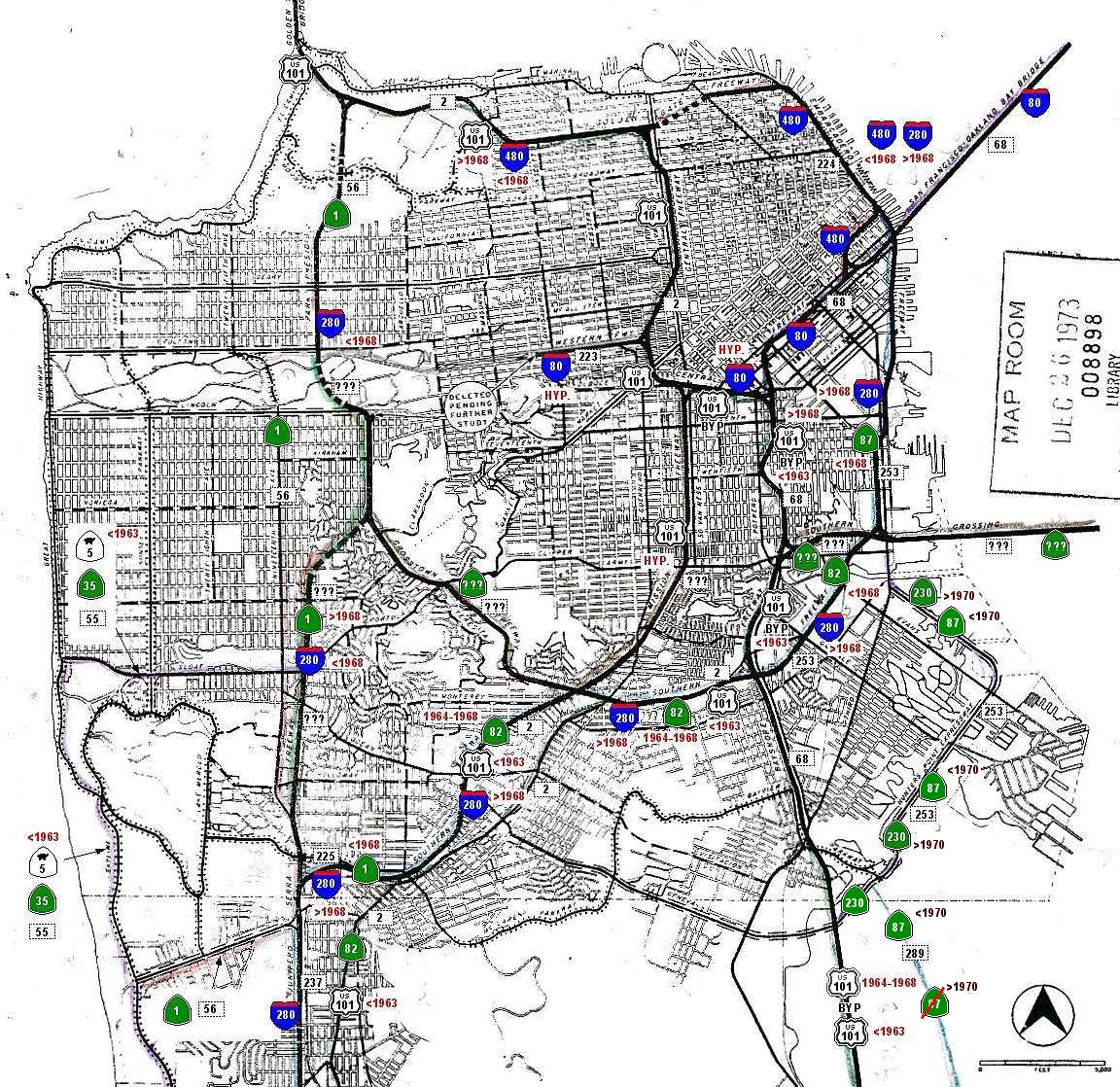
I do not doubt that there were places where this happened, but speaking about it as some absolute is simply disingenuous and untrue. For example, San Francisco is the birthplace of our cultural concept of freeway revolts, but San Francisco's 1950s freeway plan was intentionally routed to avoid bisecting any of the City-and-County's residential districts.
Check out this composite map I just whipped up and you should be able to see how the planned freeways were routed along district boundaries, not through them: https://i.imgur.com/MSbpF5e.jpeg
I specify “residential” districts because SOMA is bisected but SOMA was all warehouses and freight railroad yards at the time so there was no reason to care. Even the famously-hated Embarcadero Freeway was on formerly-CA-state-owned land where the “State Belt” waterfront industrial railroad ran: https://en.wikipedia.org/wiki/San_Francisco_Belt_Railroadhttps://i.imgur.com/Mq3mWQr.jpeg
Yeah, this car-centric, low density lifestyle model also likes very strict zoning: no third places that aren’t a church are allowed to be near suburban homes.
2. People have lost the will and/or ability to spontaneously socialize with strangers around them.
I don't see any realistic solution to this problem. The convenience of online "socialization" is too much for people to resist and I don't think most people understand what a poor substitute that is for actual human interaction.
I recently got into TCGs for the first time in 20 years (I’m in my 40s), and holy hell is the structured activity with recurring people liberating. I’ve made more fiends in the last six weeks than I had in the previous three years.
The formula is simple: show up in the same place at the same time, over and over again, as part of a group that does the same.
This is why so many friendships and relationships come out of work and school.
For me, it happened by accident, first in the techno music scene (clubs and parties are third places), and then again in the poker scene in Las Vegas. 100% of my local friends in Vegas are math/strategy nerds.
I had a similar path. In the 90’s I was very much into Magic. Too much. But in 2017 I picked up Pokémon TCG and enjoyed it immensely. The local scene was strong pre-covid, and regional tournaments were a blast.
The premise here seems to be that people are generally no longer explicitly looking for socialization (if they ever did). If you build an environment for the sole purpose of socialization, they aren't apt to come.
People haven't stopped going outside. Certainly if you give some other reason to get together (to play a sport, to listen to bands play music, whatever) on a frequent basis, then yes, socialization is bound to occur as part of that, but that is not the same as having a place centred around socialization; a place where you can turn up when you feel like it and find other people there also waiting to socialize.
Did you mean to reply to a different comment? The trick is not to have socializing be a destination. It ought to be a byproduct of normal life. In a car-dominated world there are no such things as chance encounters and we’re all acting confused as to why people can’t build relationships.
> The trick is not to have socializing be a destination.
The trick of the third place is that it is a destination. But perhaps you are recognizing why the third place is difficult to support: There are a million other places to socialize. A destination isn't necessary.
> In a car-dominated world there are no such things as chance encounters
Why not? Hell, just last night I was driving my car and noticed the aurora, so I stopped to look at it, and then someone else came along and stopped too. We had a good 20 minute chat before parting ways. Without cars, I would have probably been at home and probably wouldn't have talked to anyone.
A third place is difficult to support because people don’t want to go there to socialize with people they don’t know. That’s the whole point! Neighborhood pubs are great because you run into the same people you run into in various other parts of your life. When you meet someone at the grocery store you can say “I’ll be at the pub later if you wanted to come by” and that is a low stakes invitation both to offer and to accept.
You need loose connections to make a third place functional whatsoever, and those loose connections cannot emerge when everyone is going from steel box to drywall box to steel box.
Your example is a great argument but not for the point you’re trying to make. People talk when they are given the chance to talk in a low stakes environment. It took an extremely rare natural event to get you to stop your car and by golly, look, people talked!
> A third place is difficult to support because people don’t want to go there to socialize with people they don’t know.
People prefer to socialize with those they know, but you have to start somewhere. That's where the third place is an effective tool and the neighbourhood pub is, indeed, especially great for that because, if all else fails, the bartender will talk to you. And the bartender will introduce you to other patrons and get the conversation started. That's their job!
However, it is clear that the neighbourhood pub is also a dying breed. I expect in large part because parents are now hyper focused on the activities of their kids and using that time with other parents as their own social life. Additionally, young adults are now going to college, which brings its own social venues. That leaves a small gap between college and having kids, and maybe a small gap as one enters into retirement (although I would argue that this group is still fairly well served in the third place arena), along with a small segment of the population who remain childless, which doesn't leave all that many people to even support a third place realistically. These days there are an endless number of places to socialize, creating much fragmentation. A third place struggles when you find such fragmentation. It turns out that third places are more appealing when one third place has 20 people in it rather than when 20 third places each have one person inside.
> People talk when they are given the chance to talk in a low stakes environment.
Yes, you captured my point well. Cars don't change this. More often than not they will get you to that low stakes environment.
> It took an extremely rare natural event to get you to stop your car and by golly, look, people talked!
The natural event may have been somewhat rare (although not all that rare around here), but stopping the car wasn't particularly rare. Unless I'm on a determined mission where nobody is getting in my way, ventures out in the car usually lead to meeting other people. And when I'm that determined, I'm not stopping while out walking either, so it's not the car that is significant.
When I lived in the big city, there were all kinds of places that could have been the third place, but with so many options to choose from nothing ever established itself as the place to be. People would just aimlessly bounce around to them all instead of settling on one place to consistently show up to.
Now that I live in a rural area, where there are only a few places to go – period – everyone seems to congregate around them, and thus finding that third place is quite easy.
Oh dang this is a good take. I live on a city block that has no fewer than 300 people, but we have at least three options for third places depending on your criteria. If we had just one in reasonable travel distance, and people couldn’t self-select, perhaps we’d be more neighborly
People have lost the willingness to build/contribute to such spaces, they just want them to magically exist in the off chance they might want to drop in. The very act of creating social clubs has been stigmatized as dumb/dork/out culture. The places that did exist other than the VFW only have the generation before baby boomers left going to them which is now self fulling in guaranteeing no new people will join. Next to go will be any local symphony/theaters/museums that depend on season ticket holders and committed fundraisers as the new 'everything just exists in case I want to just drop in' culture stops buying season tickets and only come on the 'free' open hours intended to get new supporting members to see the value of the places' existence.
Very true all. It might be harder to find a third place, but I think it is still very possible. There are people out there who like to be social. That muscle might be hard to rebuild after COVID, but many communities are still there.
An important topic. The article would benefit from interviewing (in person!) the hosts of local private/public institutions known for their hospitality and culture, often for decades. There may not be many of those places remaining, but we can learn from their stories.
It's also worth comparing cities with some public (boulevards alongside commerce) vs mostly privatized space.
> At their very best, third places allow people of differing backgrounds to cross paths — to develop what are known as bridging ties. As opposed to our closest connections, bridging social networks encompass people who have varying identities, social and economic resources, and knowledge. “Studies have shown that just having a diversity of folks in your life … more informal and infrequent and unplanned, can be really protective for health and well-being,” Finlay says.
What is intrinsically valuable then: third spaces, diversity, or individual health? It feels like the first has the most value in service of the second, which is really just a supplement for the third. Almost like we stopped believing we can convince people to get on the same page about anything that looks like a shared value...
Also much respect to the persistence of patronizing Vox-speak in 2024: "to develop what are known as bridging ties" Known to who? "Studies have shown that" Studies where?
The article references four books including "The Great Good Place" which originated the term along with the classic "Bowling Alone", which documents the decline of social connections in the United States. Additionally they interview four university professors who have studied the topic and they link to at least five academic papers, three surveys and several more newspaper articles. It seems to me that the article offers quite a bit of information on where the studies are.
"known to" isn't patronizing; it indicates jargon, and in this case likely indicates a scientific term used in those studies. I agree that it would've been nice to link to the studies.
Weak take. Social clubs have been the norm for this forever. How ignorant to reality are you? Social clubs require funding in some form to exist. How would you expect them to work? Someone donates their space and the club exists entirely on their good will?
It's weird how all of the sudden in 2024 people have completely forgotten how things work. There is a local symphony because of the people that buy season passes and attend fundraisers. People don't buy season passes to see every performance, they do it to support having XYZ. When I lived in Santa Cruz we bought season passes to the State Parks, Monterey Symphony, Monterey Aquarium, and others because we wanted them to exist. We attended fundraisers for things like museums, etc. My parents did similar. It seems like now people just expect everything to be there 'in case they happen to want to drop in'. It doesn't work that way. Someone has to actively keep things going both by running them and by funding them (and create them initially). I think the next generation is either just too used to 'someone else' doing all that, or they really don't understand that someone else did it in the past and think things just magically existed. It's the equivalent of growing up and being shocked you have to pay for your own food, with your own money.
I think part is also having so many 'free passes' people forget this stuff takes money. 'Free state park pass if you have kids' is a great idea, but families are the people that use the parks the most. Families are the people that originally banded together to do fundraisers. To build the trails. Not passing on funding/maintaining something to the next generation ensures it's death when the older people pass. At some point it has to stop being 'other people' that take care of making sure all the stuff you enjoy exists and is maintained. Free park days, totally. Free park pass and it just becomes expected, like state parks always existed and always will somehow. No, they exist because people pushed to create them, fundraised/crowdsourced to create them, and fundraised/crowdsourced to maintain them. When I was a kid we had community social events. And most of those events were also fundraisers for things that benefited the community. It seems like people now expect all the stuff that in the past the community fundraised for to just magically exist/stay forever. Now fundraisers all seem to be a very specifically charity versus general 'build the community. I remember my grandparents town holding events (which brought people out, like dances, concerts in the park, etc) in order to fundraise to add a beautiful fountain to downtown. I bet people today think that fountain just magically came into existence and 'someone' should pay to maintain it (and don't understand how the trust the does maintain it was funded and how precarious it's existence is).
Edit: this is already too long but here's a better example. When was the last time you went to your local library when they were having a book sale? You don't go because you want a warn out copy of a random book you are barely interested in, you go because you believe in local third spaces. You buy worn out random books you barely have interest in because you want your library to exist. If you can't go do that and spend the $1 a book on that, the future is really bleak for society. So I will ask again, when was the last time you did that? They sell off old books multiple times a year. If we can't count on the HN community types to go do this multiple times a year to help out their local library we are doomed. Go buy crappy old books. Go buy starter plants from your local horticulture garden's/parks department's fundraiser. Buy a season pass to your local/state parks. Buy season tickets to things you enjoy having around.




This is all they have to say about this, which is unfortunate, because it dramatically understates just how important religion has been as a community builder and just how much of the loss of the third space is actually just a loss of religion. In 1999 70% of Americans were a member of a formal organized church/synagogue. In 2023 that number was down to 45% [0]. That is an absolutely staggering difference.
Some commenters have noted that it's hard to find a third space in suburbia. This is true if and only if you ignore churches as an option. In your average US suburb or small town you'd have a hard time finding a home that isn't within walking distance of some church or another. These were the third space for most of America for most of history, and they were very accessible.
No matter your opinion on what the future of organized religion should be, it's weird to have a discussion about the disappearance of third spaces in the US while only giving a token nod to our single most significant historical source of community.
[0] https://news.gallup.com/poll/358364/religious-americans.aspx