There are reports and indications that the Chinese leadership is 'okay', possibly even inviting of this move and may respond only lightly to save face.
- Xi knows the Chinese economy must rebalance for domestic reasons and that excess capacity must be shed. The US move provides Xi political cover and fallguy as the inevitable unfolds.
- Chinese investors are eager to invest more in US assets and companies. Through the trade negotiations to come the US is likely to open its doors to greater Chinese investment as Chinese doors open to less or unrestricted investment from the US. This may take the form of sole US-owned investment, an end to technology transfers, or both.
- Xi's power consolidation was widely reported as the product of ambition. The alternative explanation, and the one I favor, is the inevitable rebalancing of China's economy will necessarily cause some social and political instability - at all levels of the Chinese body politic. Whereas social and political pressure has forced policy retreats the past decade in China, Xi's new power suggests he'll enjoy the authority and longevity necessary to complete China's adjustment. Suggests only, a lot can go wrong.
- China has much to do in supporting provincial governments, SOE, and other systemically important institutions. I don't think China has sufficient reserves in-place for a trade war, even if it were so inclined.
Hate to say it, but if this is the case its also the best possible outcome for Trump and a boon for his re-election.
"I took on China and negotiated a new deal. Sure, it was painful at first, but it brought them to the table, and now we're much better off. American factories are open again."
I have a sneaking suspicion Trump doesn't care if he wins re-election or not and could give a crap if tariffs lead to recession. It plays into his narrative and image well, and that's all he really cares about. If he were smart, he would play a card that Dan Carlin over at hardcore history hypothesized: The 1-term president. Basically, it can be summed up as: "I'm going to shake this system so far to the core, I may only be a 1-term president, but I don't care! It must be done." I think he much prefers the billionaire lifestyle to a presidential one anyways. He hates living in the "shabby" white house.
Trump isn't stupid unless you narrowly define intelligence as an IQ test.
I'm in the many intelligences camp: to me, emotional, academic, and athletic intelligence are very real consequences of a lifetime spent in different domains. To me Trump has spent his entire lifetime building and selling himself as a brand. The substance never mattered. He just knows how to make people want to buy "Trump".
From my perspective, his success in that realm is genius.
the reports are just 'face-saving'. China lost big here without a way to counteract. bad for the new dictator
> Xi knows the Chinese economy must rebalance for domestic reasons
China lacks the middle class to be able to absorb the rebalancing.
> Chinese investors are eager to invest more in US assets and companies.
CFIUS already rejected most of the intended Chinese government purchases of US companies via shell companies.
> Xi's new power suggests he'll enjoy the authority and longevity necessary to complete China's adjustment
Xi has been aiming for dictatorship ever since he came to power, under the guise of 'routing out corruption'. that was long before stock market collapse. It's good US is crippling this dictator's desire to grow any stronger. Look no further to the uigher concentration camps to see the fate that could befall any western countries around the world.
> I don't think China has sufficient reserves in-place for a trade war
Correct. They are a cash-flow economy. Any small decrease in cash flow will severely crash it.
Hey what's with the down votes to this comment? There's nothing stupid, derogatory or sarcastic here. You might not agree with the content but it states an opinion that many would agree with.
I've been seeing this more and more on HN in the past few weeks (maybe months?) of unpopular and dissenting comments getting down-voted like on Reddit.
You may notice a distinct lack of uncertainty in the comments here, in spite the numerous dimensions of complexity involved in this issue - and not just economic complexity, but political, technological, environmental, psychological, etc. Reading this thread most people seem to see this as basically a one-dimensional issue, as if there's no level of complexity involved here that a quick read of Smoot-Hawley on Wikipedia wouldn't solve. I wonder if any of these people have ever been wrong before.
Mr. Trump’s advisers and some lawmakers don’t like this arrangement. For starters, they question why China’s average tariffs are about three times as high as those in the United States — and its tariffs on manufactured goods, which involve a lot of jobs to produce them, are far higher still. Those levels are allowed because when China joined the World Trade Organization in 2001, it was clearly a developing country. Lower American trade barriers have helped China increase exports to the United States, while importing fairly little.
Are we to believe in a well-balanced, fair world, tariffs should remain constant over time? China has gone from a 3rd world country to the 2nd largest economy in under two decades. It won't be long until they surpass the US, and they're just getting warmed up. Chinese people are smart, and incredibly hard workers, but they were given a lot of help by the west taking our technology over there and setting up shop, as well as accepting without questions any strategic restrictions placed upon them by the Chinese government (equity ownership, disclosing technology secrets, etc).
They're just now starting to move beyond the low skill manufacturing into hi-tech innovation, which is what "we" do, and has always been used as the simple reason for glibly dismissing any concerns about the growing economic dominance of China. I see very little reason to believe once China gets rolling in this area, they will become dominant in this as well. And what "doesn't come naturally" to them, for cultural/educational reasons ("lack of creativity" in their schools and all that), they can just buy.
China progressing to dominate the entirety of the manufacturing chain, from research and design through manufacturing, seems not just possible to me, but likely. And given their economies of scale and non-democratic political system, whose leaders don't have to concern themselves with the restrictions of election cycles (and now even term limits, yaaaawn) and the short term policy decisions that come with it, what's stopping them from dominating everything? And then what do we do?
But of course, that could never happen. All of this is going to work out peachy keen, don't you worry child. Last time I checked, there's more to history than Smoot-Hawley. How long ago was it that tens of millions of people were dying in China due to poor political decisions? How long ago was it that the entire world was at war, and the Japanese were cutting women's breasts off and using bodies for bayonet practice? Trump is likely the "the second coming of Hitler" our newspapers hint, yet simultaneously, all of the other barbaric behavior that has plagued mankind for thousands of years is all behind us, never to return. The end of history, at last!
Presumably this comment will be downvoted so I won't be able to reply to any follow questions or criticisms, in case I don't reply. But before that, it's probably a good idea to note that I am not predicting what is or is not going to happen - unlike so many others here, I have no way of knowing the future with any certainty. I can't predict where the DJIA will be 6 months from now. I don't even know what I'm going to cook my wife for supper tonight. So I certainly wouldn't presume to lecture anyone on what is or is not going to happen with about the most complex system the world has ever seen.
But the stakes are high enough that it makes me worry for my children's future, and I sometimes wonder if rather than taking what our leaders tell us at face value, a better idea might perhaps be to stop everything for a while, maybe educate ourselves on the details of the situation, maybe even listen to the reasoning of people who (gasp!) hold a different opinion. Perhaps we should be doing more structured, intentional diplomatic missions between countries of the world involving real people instead of professional politicians, so we can get to know our neighbors better and make judgement on facts rather than the propaganda we've been fed for decades. I feel like with the technology advances we've seen in the last decade, particularly in automation and social media, economics and politics are starting to accelerate beyond the point where our societies can safely handle the repercussions, at least with a high degree of certainty. If we're not as smart as we think we are, the consequences could be a lot more severe than a bad recession.
> " It's good US is crippling this dictator's desire to grow any stronger. Look no further to the uigher concentration camps to see the fate that could befall any western countries around the world."
Can you cite these reports and indications? How does economic rebalancing affect their ability to impose tariffs? How does wanting to invest in American companies influence China’s decision on tariffs, especially since the new tariffs restrict Chinese companies from investing in American companies. Why doesn’t China have sufficient reserves? Don’t they have the highest foreign exchange reserves of any country in the world?
Where are you getting this information from? If trade negotiations opened up investment both ways, that would an enormous win for both parties, and certainly solidify Xi's rule .
- The Chinese economy, being almost totally under centralized control, has been in a state of imbalance for much of its existence. This situation is not special in that regard.
- Chinese investors have a lot of restrictions, and if the government actually cared about this they would've relaxed some of the restrictions that don't have anything to do with the US
- It is not necessary to transfer more power to Xi in order to complete some sort of "adjustment" for China. History does not suggest a lot of happy endings for this type of scenario.
Many educated people are very critical of this, but as far as I know most countries that have developed successful industries had a period of protectionism during which they prevented foreign competitors from bringing in competing products in order to give their industries time to develop. This was coupled with strong export requirements to ensure that the products these industries produced were globally competitive and high quality. The most recent examples I can think of are the successful Asian countries (Japan, China, Taiwan, and South Korea). Many times these countries directly defied World Bank recommendations that encouraged a more laissez-faire, free-market approach.
Obviously the people critical of these policies are fairly well educated and should know what they're talking about, but I wonder how much is born out of academic ideas that don't hold up in practice or a projection of their disagreement with Trump's personality and other political actions.
Edit: I'm not saying this is the right approach, but I don't see many people arguing for these trade reforms, and I think it's unlikely that there are no decent arguments for them.
India tried this approach for multiple years and was a catastrophic failure. Indians had to survive on subpar cars such as Ambassador and Maruti, expensive TVs and fridge with subpar quality, and a dwindling economy. The way many Asian economies have succeeded is not by protectionism, but by identifying their niche capability and focusing on them. For example, automobile in Japan, semi-conductor in Taiwan, appliances in Korea. The equivalent approach in the US would be to concede low end manufacturing to China and focus on improving high end manufacturing and future industries that can sustain higher labor costs. Not trade tariffs.
India actually _didn't_ try this approach. Nearly all our industries were corrupt government owned 'public sector' industries. The idea using this approach is to develop innovative, private industry in a regulatory-friendly environment while providing proper trade protection and financing.
I'm not sure about the other Asian countries mentioned, but in India we kind of messed up when public sector companies were competing with privately owned companies in the same sphere. The government always bailed out the public companies whenever they messed up, but the private companies themselves have managed to set up organized anti-competitive cartels wherever possible.
But that said, tariffs alone can't explain how some economies succeed or fail. There are a lot of other variables which tend to be ignored in such simplistic thesis about macroeconomic outcomes, as there always are.
But they don't just focus on one industry. South Korea has steel making, automobiles, ship building, and more. Japan has automobiles, steel, consumer electronics, and more. India hasn't even figured out how to get most of its population out of poverty, so I don't think it's a good example. It's hard to have competitive industry when your population can't feed itself. Plus it's a huge country that has had what are effectively ongoing civil wars within its states, and its problems are compounded by it's cultural and linguistic heterogeneity.
The Asian countries I mentioned that succeeded all had major agricultural reforms (some violent, some not) prior to their industrial success.
How can you think India got screwed? There would be nothing but sweatshops without protecting own market, instead India got Tata Group which owns Land Rover/Jaguar and Daewoo car business. Look what happened in eastern Europe after "progressive" governments opened to the west and sold everything for pennies.
The difference is that the US is home to some of the best universities, attracts a lot of educated/talented people and has the largest knowledge economy in the world. So while India might have failed to develop great cars and whatnot as you claim, the US could (and does) that just fine. Taiwan and South Korea can hyper-focus on one or two sole industries because their population's sizes are fairly small (comparatively), and that has turned out well for them -- but I think the US needs to at least partially dominate a range of industries to stay afloat.
Also, people forget 1850 Germany essentially entered the industrial age through a good dose of protectionism. It worked because they already enjoyed a good educational system and skilled workforce.
Although I wonder how much of that was helped by the US post WWII to counter communism. I remember looking online for something like 'how did japan become so wealthy after WWII considered how much they lost after WWII. I got a few links like this one: https://www.quora.com/How-did-Japan-become-wealthy (points 1 and 3 of first answer, second answer is interesting as well)
And what I got form it was that in was in the US' interest to have successful capitalist countries in the area during the cold war. Because there was so much communist influence is that area of the world.
Are you suggesting that us like India of old cannot manufacture good technology in house?
That's just plain dumb sorry. It's not even apples vs oranges. It's apples vs orange seeds.
> or a projection of their disagreement with Trump's personality and other political actions.
I see this often nowadays with callers into NPR, who I've generally thought of as very informed people over the years. At least twice in the past week has someone called in to criticize Trump, only to have the host correct them that Trump did indeed take a certain action or that a certain policy is more detailed or nuanced than they believed. After said correction, the caller still continued on with their criticism, for no other real reason than they don't trust him.
I could see such a mechanism making sense while a low-wage country gains experience to achieve productivity (measured in output / labor cost).
But what would the US be gaining during this time of protection? It cannot make the sort of productivity gains a developing economy can.
I don’t know enough about these tariffs on China to offer judgement, and it may depend on the details. The stated rational mentions IP rights, so it may actually be more sensible than the alu and steel tariffs which seem rooted in some 1950s worldview.
But sometimes politics trumps economics. Turning your relationship with Canada and Mexico into a zero-sum family brawl will without a doubt lead to a breakdown in trust that will haunt North America for decades.
And for what, exactly? Selling a few more cars when unemployment is already at a record low?
It seems like free trade is beneficial when you're at the top or among relative equals. The educated people you are talking about are presumably American and/or European, so they benefit from free trade. However, countries that are behind in an area would benefit from protectionism in that area, otherwise the companies strong in that area will come in and take the market. This makes local competition much harder. Imagine a local African grocery store trying to compete with Walmart; there is no way they can match Walmart's worldwide distribution system.
I think this is probably one of the reasons why there is no European equivalent of Facebook: it's not easy to compete with Facebook. By the time it was clear that Facebook was something useful, it had already ironed out any scalability and usability problems in the US college market. So unless a European competitor had started around when Facebook did, they would be behind both technically and in the fact that any American friends were already on Facebook. The only Facebook competitors that I am aware of are in protectinistic countries: Russia (VK) and China (Renren and WeChat Moments). (I don't know if Mastadon is European, but I don't see it as an actual competitor, at least at the moment.)
> free trade is beneficial when you're at the top or among relative equals
Wealthy people tend to be politically connected. Politically-connected people do well in the midst of lots of red tape. There is no evidence free trade agreements effect in-country inequality [1].
Making goods more expensive for Americans seems like short-sighted protectionism. But the desire to protect sensitive industries from Chinese takeover and IP exfiltration is a valid national security concern. So I'm both for and against this measure.
I doubt the reasons for these periods of protectionism were economical. Most of these countries had (and still have) companies which are very closely intertwined with the government. Protectionism ensured that these companies would keep their market share and that the government and its sponsors could keep their (economic) power. Once they could compete internationally these protections were reduced. However for the consumer an immediate opening of the borders would most likely have been better, with the difference that most of the economic decisions would then be made by foreigners and with less influence by the government.
There are argument for protectionism, just not for a highly developed country such as USA.
But I'm not going over them for a single reason. This act will fail "bigly". China is the 3rd largest export market for USA. It imports a lot of grain and cars and can retaliate on politically sensitive goods.
Midterms are coming and China may use it to restrict tourism to Florida, put tarifs on soybeans from midwest, cars from Michigan. Companies from those states will likely suffer more in short term than benefit from the protectionism - it takes a while to build up capacity and conquer markerts. Meanwhile people will put the blame on Republicans as companies start the lay offs.
This argument goes both ways. If you look at the trade equation (https://ustr.gov/countries-regions/china-mongolia-taiwan/peo...) - US imports 3 times it exports. So, for every $ of tariff that China imposes, US can impose roughly 3 times the pain. While it would increase prices in the US, it will just kill the Chinese economy which already has overcapacity and > 20% of its exports are to the US.
There are many Chinese practices that are unfair. US companies cannot enter China alone, they need to do 50-50 joint ventures when they setup shop in China. They also need to transfer technology and there is little IP protection. Finally, China imposes tariffs on many manufactured goods while the US doesn't.
It doesn't goes both ways. China is not a democracy and Mr. Xi is increasingly more powerfull. Trump is way below 50% ratings and Republicans are behind in the generic polls.
This trade war is not about who gets hurt more. It's about who can sustain being hurt for longer time. There's a major election in 7 months, so I'm betting on China.
So you’re willing to hurt yourself as long as your enemies also suffer? That’s... quite sad?
But in any case: power today derives far more from other’s willingness to do what you want without being paid or threatened. That idea is called “soft power”, and it’s really how the US managed to lead the free world after WW2. Hollywood and the WTO did so well that all the hatred you got for Vietnam etc. didn’t cause any lasting damage.
Those alliances are obviously gone now. With China now taking the lead even in free trade and climate change mitigation, the US is losing its seat at the table.
Encourage behaviour change. Same as with Iran. Everyone lost, economically (in the short term), as a result of the Iran sanctions.
Those short-run losses were deemed sufficient compensation for the possibility Iran would agree to limit its nuclear program. Similarly, if China agreed to loosen access to its own market and stop forcing American companies to give up their IP to Beijing, that could be better for all in the long run.
The market access you are referring to presumably involves setting up factories in China on a wholly-owned basis without forced technology transfer. That is all good but in what ways would that reduce the trade imbalance? So even if China agrees to that it would stay the perennial whipping boy, no?
> even if China agrees to that it would stay the perennial whipping boy, no
These tariffs were sloppily executed because they're for a domestic political audience that doesn't understand economics. Better tariffs would involve terms for release. If you do X, we release the tariffs. What China has to do to get these measures reversed is nebulous, but even the tacit link to forced tech transfers and the blocking of China's domestic market adds another variable to Chinese policymakers when considering additional measures.
...and from now on I will start calling it the "Echoes of Smoot-Hawley" Tariff.
For those here who don't know, the Smooth-Hawley Tariff Act, signed into law around a year after the Stock Market Crash of 1929, is widely considered to have exacerbated the Great Depression of the 1930's.[a]
If I may quote George Santayana: "Those who cannot remember the past are condemned to repeat it."[b]
Hopefully this tariff and China's retaliation will remain an isolated incident, without significant repercussions for global trade. One can hope.
Ignorance is a scarily powerful force in world affairs.
That's an interesting read. To be clear, the tariff rate on durable goods was increased from 40% to 59% in 1932. [1] That seems like a far cry from what we're talking about here.
It's my understanding these tariffs are levied against a single country (China) who is (widely believed to be) manipulating trade to their benefit and engaged in widespread IP theft.
If the former is true, the tariffs (to me, a non-economist) don't seem terrible. Perhaps you can further elaborate on why a focused and limited tariff targeted to a single country is such a bad idea?
I don't think $60B matters a whole lot. The issue is always if it escalates. It's pulling the lever of economic sanction over mainly political disagreements (voters who support the optics), a little distraction, if you will.
There's a difference. Smoot-Hawley was a massive and unprovoked tariff. China already taxes products made by US companies at similarly massive levels - I've been to China multiple times and everything from American brand toiletries to cars costs nearly 2-3x as much as they cost here in the US! Part of that is shipping and premium brand pricing, but a large part is Chinese protectionism aimed at putting our products out of reach of the masses.
You can choose - either continue to suffer Chinese tariffs being 10x greater than ours, or engage in reciprocal rate matching that will motivate negotiations for mutual rate lowering.
I'll just paste the same thing I said the last time someone said 'this reminds me of smoot-hawley'[1]:
> Some differences between the two being that Smoot-Hawley broadly applied tariffs to tens of thousands of products from most countries in the midst of a major economic depression in an attempt to help out American farmers and other related industries.
That would make for a interesting long term bet for 2020. In order to match the great depression we would need to see a worldwide gross domestic product drop of 15%, which by comparison is 15x worse drop than the one we had during 2008. International trade plunged by more than 50%, and crop prices fell by about 60% during 1930.
How big should we estimate the risk that we will repeat 1930?
The word "recession" has many definitions (depends on who you ask), but in the US we tend to defer to the NBER.
>The NBER defines an economic recession as: "a significant decline in economic activity spread across the economy, lasting more than a few months, normally visible in real GDP, real income, employment, industrial production, and wholesale-retail sales."[1]
GDP was up 2.6% last quarter[2], so no, we're not in a recession. A stock market dip does not a recession make.
> GDP was up 2.5% last quarter, so no, we're not in a recession
That both starts with a false premise and, more critically, is an invalid argument.
First, the GDP grew at a 2.5% annualized rate last quarter (Q4 2017), it wasn't up 2.5%.
Second, the definition you provide indicates that recession is normally visible in a set of variables, but not that it can be conclusively ruled out when it is not visible in one variable in that set.
Third, and most critically, the condition of the economy last quarter doesn't tell you whether we are in a recession now, only, at best, whether we were last quarter.
It's been 56 days since the DJIA's peak close of 26,616.71 Yesterday's close was 23,957.89 and there has been a sustained loss of 2658.82 in the time since. I'm not the NBER, but a dip lasting almost 2 months sure smells like the start of recession to me.
> Those who cannot remember the past are condemned to repeat it
But time goes by and things change. Sometimes things that have not worked in the past might work today because of the changed environment. Don’t you agree? Remembering the past is one thing, being stuck in it is another.
> Something that have not worked in the past might work today because of the changed environment. Don’t you agree?
Applied as you have described it, this advice would prevent us from ever learning from the past. Why not try Stalinism again? It might work today because of the changed environment. You need to explain specifically what has changed so that tariffs might be a good idea now even when they have repeatedly not been so in the past.
Doesn't your argument also apply to the other side though? That we can't just say "It didn't work in the past so it won't work now" without any context or actual evaluation?
Keep in mind, the US is by far the LEAST protectionist country according to the WTO, with China being the most, and Europe somewhere in the middle.
Europe also has anti-dumping and high tariffs on China, with some steel import tariffs as high as 71.9% in some cases to prevent dumping. Cars being shipped from the U.S. into Europe faced a 10% import duty while European cars into the U.S. face only a 2.5% percent duty.
China makes its immensely difficult for US based companies to enter Chinese markets, and IP enforcement is abysmal. Fixing this access imbalance was the only thing good the TPP had going for it, but the concessions were too much and ultimately it was scrapped.
I sincerely hope this does bring everyone back to the negotiating table eventually for a better deal.
The WTO uses bound tariffs, not the actual applied tariffs, as far as I know. The applied tariffs adjusted by real trade shows that US is not the least protectionist country, Japan and Singapore are less protectionist. Anyway, the adjusted tariff is lower than the China tariff. https://ftalphaville.ft.com/2018/03/08/1520526203000/America...
Could just be coincidence, but this was signed at roughly the same time that China started selling oil futures in yuan. Some see that as a big threat to the primacy of the dollar in international oil trading.
Also known as a tax on the poor. Tariff taxes just get pushed onto the consumer as the US doesn't have any domestic competing products anywhere close to the price point of Chinese goods. We will continue to buy China, just at 10% more than in the past.
People will just pay yet another tax as everything will become more expensive.
The disconnect between "China is taking our jobs" and "I want a tv for cheap" is astounding. Different sides of the same coin.
Foxconn's investment in Wisconsin is a perfect example of this- there's simply no US competitor in a lot of consumer product areas for the same price point. What we're faced with is like having the choice between an American 720p TV and a Chinese 1080p TV for the same price at a retailer: there's no incentive to buy the American version when the foreign one's BOM\shipping\import costs beats that of the US-made one.
Also implying that American made electronics are even appealing to the American consumer anymore. That to me is the big question. Everyone talks about buy American, but look at the mass produced American goods and it doesn't scream quality, even if it is at the right price point.
Everyone buys Korean washing machines, Japanese cars, and Chinese electronics. Not simply because of the cost but also because of quality. My Toyota is a far better deal than Ford/Chevy/etc.
LG washer/dryer (Korea). Wolf kitchen (German), German cars (soon to be American, Tesla). All Apple everything else (designed in US). TVs are Vizio (American HQ). AG jeans (American) but I have my suites made in Singapore.
I think the reality is more of a mix.
I would never buy an American car (traditional) because they do not appeal to me.
BTW Toyota Civic for example is 75% US domestic parts made in the USA.
The reality is that for an American company trying to do business in China the playing field is far from level, and that’s the major issue. Remove the IP transfer requirement and the 50% joint venture requirements and make the rules equal then we can see who will win (hint, the American company).
Fair access to thier market is the requirement. No one really believes that good old 1950s factory jobs are going to return to the USA. Heck, they are leaving China now!
Call me crazy, but I'm kinda hoping for a recession. Housing prices seem very tightly correlated with the economy boom. I'd sure like to see a nice correction back down to sane levels, so that some of us who've been saving for a long time, can finally afford to buy something.
Downvote of course if you're a current home owner.
It doesn't hurt current home owners as long as they are not over leveraged. It doesn't necessarily help people without houses either. When there is a recession, credit could dry up. Most people in the US can't afford to buy without a mortgage. The solution to a housing crisis isn't a recession; it's more housing and better transportation. A recession hurts everyone and often hurts the poor harder than it hurts the wealthy.
A recession is part of an economic cycle to rebalance misused assets.
More housing isn’t the solution. Many House bubbles had ample housing for people to live in, but not enough for speculation.
Building more houses kicks the bucket down the road as it accumulates more than necessary housing. When a recession hits, and asset bubbles are deflated, speculation goes to zero, and you’re left with an over supply, an indebted society, and the country may lose generations of productivity (what actually happened in Japan in 1990).
Since interest rates are positive now, The number of jobs is currently controlled by the fed. The stronger labor demand is, the more they raise interest rates, thereby reducing job creation. So all of these make work programs, like the huge military spending boost, are currently just leading to higher interest rates and prices and shifting workers from one industry to another. Specifically it will shift workers out of export production and construction, because higher interest rates hurt our exports and construction. No job creation, more expensive products and homes. Thanks.
Fortunately these tariffs are pretty insignificant: 50 billion worth of stuff is not that much for us, although it might be for certain cities in China and the precedent is bad.
Good. The Chinese government subsidizes and protects many industries within their economy. Additionally, workers in the United State have been forced to race to the bottom with China. I, for one, am happy to see some protectionism.
We will have to wait for the details. Will they really tax Nike shoes, HP/Dell computers or Apple phones? As for what Lighthizer allegedly cares about - "electric vehicles, high-tech shipping and aerospace technology", I am not aware that this country buys in any significant quantity from China so not sure how they can be targeted with tariffs.
In NYT's exact words: ... Those industries include electric vehicles, high-tech shipping and aerospace technology. Mr. Lighthizer called them “the ones I care about” for tariff purposes.
The numbers involved wouldn’t make any significant difference either way. The fear is retribution, counter-retribution, and the breakdown of the free market consensus of the last 70 years.
The size of the tariff changes. No concrete numbers have been announced, but the tariff may be in the range of ~10-40%. That would mean the actual tariff value is several times smaller than the reported $60B value.
There's also a chance Trump himself might reverse course in the next few weeks. Trump's steel and aluminum tariffs went from "no exceptions" to a handful over the course of a month.
If you really want to open the tired old “middle America” vs the “coastal elites“ cliche, you may want to consider that the US exports significant amounts of agricultural products to China, which are likely to suffer first.
And unless they have children willing to stitch sneakers, any new jobs are far more likey to be created in Vietnam or Bangladesh than Kansas.
The promise of cheaper goods is a lie. Corporations outsourced labor and then kept the difference as profit instead of passing the savings onto consumers. Hence why corporate profits are at record highs while the average American's buying power continues to drop.
What? Middle America probably benefits the most from cheap goods because they need to buy them. "Everyone else" are the ones who can either afford to be brand-conscious or are too poor to buy anything.
The reason why Middle America has so little spending power is because regulations and taxes have decimated their manufacturing and resource extraction industries and effectively moved them overseas. This of course led to a loss of specialized workers who can pass down their skills and loss of technical knowledge.
Flossing your teeth may be unpleasant in the short-term, but it has long-term benefits.
You can't turn back the clock. The factories are already closed, the companies are already bankrupt, the workers have already been laid off and in many cases been out of work for 10-15 years, the young people (those that can get out) have already left. If Middle America wants to rejuvenate itself they need to engage with the world as it exists now and plant new seeds, not try to freeze-frame the world of the 1960s.
You (or politicians you support) are welcome to try. It probably won't turn out the way you hope.
Historically, tariffs and protectionism have benefitted emerging manufacturing powers much more than entrenched incumbents. U.S. manufacturing might was built off the back of tariffs; by keeping them high, the U.S. protected its nascent domestic industries until they could become efficient enough to compete globally. China has been following the exact same playbook, as did Japan before it.
But just because tariffs can build emerging industries doesn't mean that they can preserve those industries once they start going into decline. Usually the result isn't that the industries are suddenly revitalized, it's that the whole country goes into decline with them. (We've seen this play out historically with post-WW2 Britain and post-1990 Japan.)
The US has a lot of high end manufacturing. Where do you think all the aerospace tech and advanced weapons systems are built? It's the low end manufacturing that has gone overseas.
The whole thing of turning the clock back is quixotic. Did the US benefit over all from this change and does it continue to do so? Yes. Are there winners and also losers? Yes, and crucially the gainers gained more than the losers lost. The problem then seems to be one of distribution of gains, and you can solve that by fairer redistribution. All that turning the clock back does is to make the country poorer on average, and it's a very roundabout way to achieve redistribution.
This question will inevitably come again with robots and there will be people who want to turn back the clock then too, but they will be called luddites.
I don't see China playing fair re IP theft anytime soon. They undercut everyone by exploiting their poor in their factories. So, in order for the manufacturing to start happening here in a way we can afford, wages would have to be very very low, or else robots. So, probably robots. I don't see this creating any jobs here.
...or move up the value chain. The idea behind that is that if Chinese goods are unreasonably cheap, there are bound to be some things that you can manufacture using these cheap Chinese components that would previously have been economically infeasible. Go take advantage of this and stop wasting time trying to build things that can be built better elsewhere.
This was behind the whole hardware bubble of ~2014, along with the Kickstarter/Alibaba/Octopart/Flexport ecosystem and certain new consumer product categories (eg. fitness trackers, smartwatches, VR). The problem is that hardware startups (like any startups, really) are hard, and it's quite challenging to bring together cheap components in a way that actually adds value to a consumer. That, and primary capital markets are fairly inefficient, so oftentimes hardware startups run out of money before they can work out the kinks in their supply chains.
From my personal perspective, the main potential impact of this trade war probably won't be my programming career, but the "Middle America" farm that's in our family.
One of our crops is soybeans. China loves US soybeans. (https://www.agweb.com/article/will-chinas-hunger-for-us-soyb...) US soybean exports are one of the obvious targets of any trade war with China. Artificially reduced demand (due to what is in effect a, um, regulation) doesn't seem like really good news if you grow soybeans, right?
The consensus in the media is that it is actually the manufacturing / resource / agriculture states (eg: the "red states") who will be hurt the most by tariffs (eg, articles like this: http://money.cnn.com/2018/03/05/news/economy/trade-war-red-s...). Professional opinion wise, I searched and actually couldn't find an economist who had anything positive to say about tariffs (if someone can find one, I'd love to read the link, but it's pretty telling that the overall sentiment is that negative). So right now, I'm not sure at the moment what long-term benefits you are thinking of. Political or strategic, maybe?
And the consequence of these groups having lower discretionary income shifts their buying habits to favor items that are cheaper to manufacture and likely don't fall within having an active Chinese patent covering them. Putting a tariff on the foreign good targets people who see equivalent value between the US and non-US good in order to sway their decision to the domestic choice.
This is a good point. Chinese govt is doing a lot of things to keep manufacturing cheap there - from keeping their currency artificially low by buying USD, to using those USD to subsidize manufacturing and then to export those products internationally to decimate local manufacturing. It is not as simple as some who have commented below would say.
The fact that the local manufacturing industry has been decimated is no reason to keep it like that. If profit is to be made, industry will come back - that is the beauty of capitalism.
> The reason why Middle America has so little spending power is because regulations and taxes have decimated their manufacturing and resource extraction industries and effectively moved them overseas. This of course led to a loss of specialized workers who can pass down their skills and loss of technical knowledge.
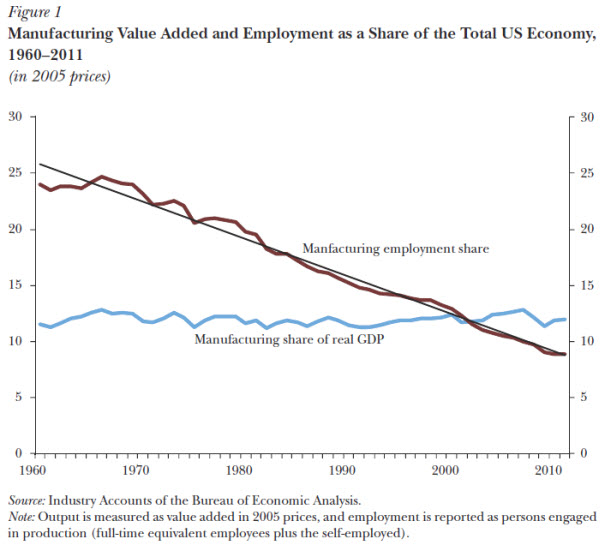
And yes, this graph is inflation-adjusted. The number of $$ of manufactured goods has risen for like 50 years straight in the USA.
Spoiler alert: The US manufactures more today than it did at any other time in history. Automation has killed jobs. It takes far fewer workers to make the same (or even 10x) the number of products.
[citation needed] on every last bit of this. You've bundled a whole bunch of claims into a short space, and all of them are wrong.
> regulations and taxes
Measured in GDP, American manufacturing has increased since 2000. This suggests that the chief culprit is automation, especially when China's taxes aren't significantly less than ours.
> resource extraction industries
Need a citation here too. What percentage of the middle class derived its income from resource extraction even when that was at its peak in America? And don't forget to exclude coal from that percentage, because the decline of coal is mostly because it's now cost-uncompetitive with LNG and solar.
Nothing about America's current economic woes is going to be fixed by a Chinese tariff. This is firing blind and aiming in the wrong direction.
Why do you say they are aimed in the wrong direction? They are reciprocal and only in industrial sectors where China already has tariffs on our goods up to 10x larger than our rates.
"it is still much lower than what it would be in an unregulated environment."
Counterfactual. The article you link to is laughable on the face of it. "A new study for the Mercatus Center at George Mason University" carries about the same intellectual heft as "A new study for the Eat More Beef Center at Hamburger University."
You seem the sort of person able to recognize others' ideologies while incorrectly assuming your own beliefs are rational and well-founded. Are you generally tolerant of or convinced by counterfactuals when they don't support your ideology?
It's worth noting that "appreciates" isn't equivalent to "benefits from". Voting against one's self-interest is not unprecedented.
I'm not savvy enough to know whether this is sound economic policy, but to someone wary about China's economic growth this could sound like a good idea.
Do you view any tariff as protectionist, even if China is illegally subsidizing certain industries and stealing intellectual property? Or do you just not buy that China is actually operating against trade agreements they signed?
From an IP basis, I do agree that China is on a land grab to establish its own patent system because of how new it is. It's also unfair to the Utility Model which the US lacks to be attacked by these higher import costs- markets like Shenzen flourish because of it's ability to sell so many things for so cheap. I for one enjoy the ability to buy cheap electronic parts from Aliexpress and Ebay without minding the high lead time because of the low barrier to entry and creative freedom it grants to buy more parts; and see this tariff as being more of a defensive move than a reciprocal agreement.
Entire swathes of high-end US industry are propped up by DoD procurement - a thinly disguised state subsidy. This has a huge trickle-down effect on propping up their upstream suppliers, and, by proxy, unrelated manufacturing segments.


- Xi knows the Chinese economy must rebalance for domestic reasons and that excess capacity must be shed. The US move provides Xi political cover and fallguy as the inevitable unfolds.
- Chinese investors are eager to invest more in US assets and companies. Through the trade negotiations to come the US is likely to open its doors to greater Chinese investment as Chinese doors open to less or unrestricted investment from the US. This may take the form of sole US-owned investment, an end to technology transfers, or both.
- Xi's power consolidation was widely reported as the product of ambition. The alternative explanation, and the one I favor, is the inevitable rebalancing of China's economy will necessarily cause some social and political instability - at all levels of the Chinese body politic. Whereas social and political pressure has forced policy retreats the past decade in China, Xi's new power suggests he'll enjoy the authority and longevity necessary to complete China's adjustment. Suggests only, a lot can go wrong.
- China has much to do in supporting provincial governments, SOE, and other systemically important institutions. I don't think China has sufficient reserves in-place for a trade war, even if it were so inclined.