reading the first comment from the article, exactly my thoughts:
"The trends for advantaged and disadvantaged subjects are taken from a line fit to the data points on the chart.
A line fitting routing will always produce a line, even to the random shot pattern of shotgun blast, but it takes human judgment to decide if the slope actually means anything.
Team, look carefully at the data clouds. They are both shaped like flattened spheres and are approximately symmetrical. The line fitting routing produces a line anyway, and from this, articles are published and careers are made.
Sorry, but there is no meaning here, as much as the researcher would like it to be otherwise. The distributions are nearly the same. The observation and explanation go out the window."
It would be great to look at the original publication.
Article is based on Self-control forecasts better psychosocial outcomes but faster epigenetic aging in low-SES youth (http://www.pnas.org/content/early/2015/07/08/1505063112.full...), someone with access who can check N and the significance of change of the groups?
Given the data found on this chart http://cdn.static-economist.com/sites/default/files/imagecac... (which shows more than a hundred of points, quite good compared to the size of the sample : “almost 300 black American teenagers”), I'm really sceptical about the relevance of the results …
I think it's The Economist's visualization that is confusing, not the data. I read the paper, they have 292 subjects. Here's the Tukey plot (which to me, is less confusing than the scatter plot) from the paper on age in low and high self-control groups: http://imgur.com/ijL6nrp
One of those rare cases where the paper title explains the phenomenon better than the article. If this is based on DNA-methylation, does that mean the 'damage' is heritable?
You seem to be asking whether epigenetic traits are inheritable. It will take a while for the scientific community to fully accept this since it smells of Lamarckism, but if we do not accept transgenerational epigenetic transmission it gets really hard to explain things like this: http://phenomena.nationalgeographic.com/2013/12/01/mice-inhe...
Yes, there has been some recent studies that suggest the Central Dogma [1] may not apply in all cases. If I remember correctly, some forms of DNA methylation is heritable on the male side. Disclaimer: not a molecular biologist.
From a quick scan of the article the chart is based on figure 1. p-value for the more disadvantaged group is 0.017 for the less disadvantaged it's 0.02. There's a 3rd group, 'medium disadvantaged', which has a horizontal line.
The trend is more obvious when the points for the individual groups are separated out, but it does seem to me that a small number of points at the extremes might account for slope - if you removed one or two key points from each group the slopes might go away.
I'll take that self-control over worse health any day. Health is something you can at least throw your money at, especially the money you got thanks to self-control. Knowing you are using only 10% of your potential because of lack of self-control is depressing.
Health is absolutely not something you can throw money at. I don't understand where this attitude comes from. And nothing kills your earning potential like a long-term health condition.
In many cases, it absolutely is. A lot of long-term health improving strategies, like good diet, going to the gym, ensuring enough sleep, regular checkups, etc. are much more available when you have the money. So if lack of self-control prevents you from getting enough money, it also restricts your ability to take advantage of the above means.
I had a relatively good diet, a regular fitness routine, slept well, visited my doctor, and still ended up unable to walk for 6 months with back pain. That was with access to private medical insurance, in Europe. Even with theoretically unlimited money behind my problem, I was unable to get it sorted quickly. 18 months on and I'm not in bad shape, but I still can't walk for more than a few hours, and have trouble sleeping sometimes.
I agree. If you can 'throw money' at it, it's before things get really bad. It's better to spend the money on getting into a healthy lifestyle and that way, you don't even spend all that much and live a healthy life - which allows you to do more.
Spending money on getting a healthy lifestyle has diminishing returns. Sure, if you are holding two part time jobs and barely holding yourself above poverty line, getting an extra $100 per month to put into fresh produce (or simply keep into your bank account for the peace of mind to let you sleep better at night) will do tons of good to your health. On the other hand, if you prioritize health over frivolous consumption, there are few and highly specific situations where making a 7-figure income will ensure a measurably better health outcome than a 6-figure income.
On the other hand, jumping from 6 to 7 figure incomes requires more than raw talent. You need to consistently push yourself to comply with social expectations above and beyond what most middle class people would consider "normal". Whether you are serving bosses or clients, your perceived value added will go up if you go the extra mile in whatever you do.
When you are young, in your late 20s to early 30s, you can afford to pull off that kind of thing without (much (perceived)) costs to your health. The thing is that the more you exceed expectations, the more unreasonable the next round of expectations are going to be, even if your compensation grows at the same rate.
And to tie this up with the OP, let me say that self control is a tool. Its not good or bad in itself, but you can use it for fair or ill purposes. You can use your self control to assess when you have reached enough success and stay there, or you can use it to push through whatever personal problems your unsustainable success is causing you. Most people disengage too early and never realize their full potential, others (the over achievers among us) tend to keep going until they burn out or worse. Few people are wise enough to stop near the sweet spot.
Second, as some other have pointed out, what exactly is self control? What exactly do you do with that self control? This seems to me a little like saying that workers who take 10min breaks from work all have shorter life spans. Only to forget those 10min breaks are to smoke cigarettes. (I believe this contrived example is from Naked Statistics).
What's next, "Diet and exercise forecast better physical outcomes but faster epigenetic aging in low-SES youth"?
The results are interesting, sure, but warrant a lot more research before an article like this makes any sense.
> Second, as some other have pointed out, what exactly is self control? What exactly do you do with that self control?
That is a simplistic criticism. The way you answer this question for yourself is to (1) look at the paper and how they define self-control (and cellular aging!), (2) follow the references that they cite for measuring self-control, (3) review the literature and critique it. Else, your suggestion is that people in the field of self-control haven't bothered asking your question, which is unlikely since they are specializing in the study of self-control!
I see this but there was another sentence you left out of your quote that I was leading to. I'm not criticizing the research - I'm positive I bring no new line of questioning. What I do want more information on is what happens if your self control leads you to diet and exercise (which plenty of study shows improves cellular aging)?
And I would love to read further in detail but I can't afford the access. If someone has it and can easily answer - please do!
I find it's not helpful to derive any result from this study. It's like a study of personality and health. It doesn't help people be the way they are. The best we can think of is to take vacation every once a while to relief stress, or not too anal on things, etc., which are already being said. So, what's the point? Focus on actually solving hypertension and other health problems make more sense to me.
Could the obesity be related to the fact that they were better at optimizing for candy intake? Would the same results be there if the reward was something else?
I'm sorry but that graph is just too funny. Let's see, what slope do we want the red line to have? Here, that fits the conclusion we want to promote. And the blue line? The inverse of that slope, of course!
That's a good question. I don't know why you are being downvote. How does self control correlates to obesity? That can only be the case if we are talking about a narrow way of self control.
Wasn't the metric for calculating self control was how long you were willing to wait for an additional marshmallow? Seems like a proxy for measuring self control that would be biased towards people with a propensity for obesity.


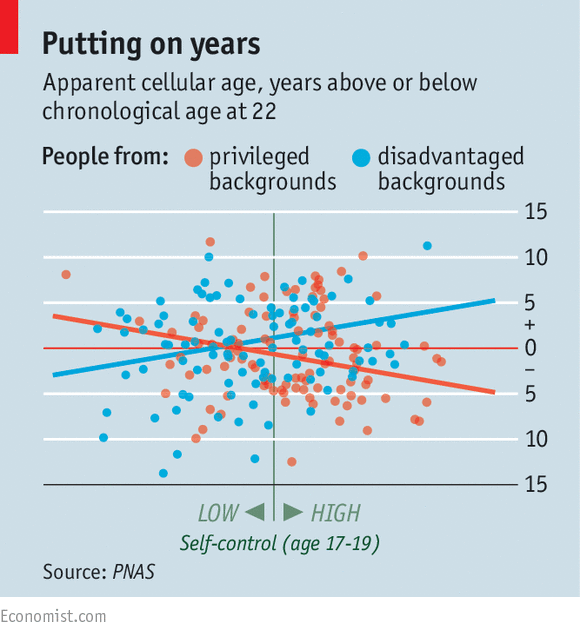
"The trends for advantaged and disadvantaged subjects are taken from a line fit to the data points on the chart. A line fitting routing will always produce a line, even to the random shot pattern of shotgun blast, but it takes human judgment to decide if the slope actually means anything. Team, look carefully at the data clouds. They are both shaped like flattened spheres and are approximately symmetrical. The line fitting routing produces a line anyway, and from this, articles are published and careers are made. Sorry, but there is no meaning here, as much as the researcher would like it to be otherwise. The distributions are nearly the same. The observation and explanation go out the window."
It would be great to look at the original publication.