The point I think needs making about GMOs is that they aren't really a category. That is, there aren't any true, important statements one can make about all GMOs, except for the obvious one that they are produced by genetic manipulation. But as far as their benefits and their dangers, they have to be evaluated individually.
So on the one hand I'm very concerned about Roundup Ready crops, not specifically because they're GMOs, but because I'm concerned about long-term glyphosate toxicity. On the other, as far as I can tell from a small amount of reading, Bt corn, "golden rice" (rice that makes its own beta-carotene), the non-browning apple, and now this Bt eggplant are all probably okay.
I think that failure to understand this point, that each GMO is sui generis and has to be approached individually, has two dangers. On the one hand, there is a tendency to oppose all of them indiscriminately, and of course we're already seeing this. But there's also a real possibility that once that blows over and GMOs get more accepted, we might get complacent and not check out new GMOs as carefully. I do think some safety testing is in order, though in many cases the modification certainly sounds safe. Beta-carotene is certainly a valuable nutrient, and AFAIK is hard to overdose on. The non-browning apple gets that way by having one of its enzymes (polyphenol oxidase) turned off -- what could be dangerous about removing an enzyme? The Bt mods deserve a little closer examination, as they are producing a new protein, and there seems to be the potential for allergic reactions in some small fraction of the population; but Bt is considered an acceptable pesticide for organic crops (it is a protein, after all, not some chlorinated petrochemical) so it could well be pretty safe.
(All that said, I do still support GMO labelling laws. People should be able to know what they're eating, even if they overreact to that information.)
The short version of this post: there is a wealth of evidence to analyze from significant human exposure to glyphosate (from farmers, for instance) and none of it supports significant toxicity. Because glyphosate is so precisely targeted to the metabolism of plants and not animals, it is among the least toxic herbicides in use.
The main issue is that the microbiology of soil is largely under estimated by the industries selling glyphosate-based products. It's much more than an herbicide, the impact is on the metabolisms of the biofilm organisms. That's one of the main factor that kills the soils and force the agriculture to use synthesized-fertilizer.
1. The 2A classification is based on things like mouse models; epidemiological studies --- which have been done, on people with exceptional exposure to glyphosate --- don't support it.
2. There are a lot of 2A carcinogens that you're exposed to far more routinely. For instance, do you also avoid potatoes? Acrylamide for-sure causes human cancer.
I guess my point with #2 here is that the IARC classifications give a misleading sense of the precision involved here: there is no direct causal link between human cancer and glyphosate, but many of the 2A carcinogens are simply known to be cancer-causers.
The biggest thing that focusing on the IARC classification misses is this: the dose makes the poison. I will gladly have a gram of a known carcinogen if I know that I'll need 10 tons of the substance to increase my risk of cancer substantially. We simply can't know anything about this without knowing 1) what we're exposed to (realistically), and 2) what the actual risks are. Given the observed results, it evidently can't be too terrible.
They aren't talking about the glyphosate you eat when you eat food from a non-organic farm.
They're talking about the glyphosate you breathe in, year after year, when you're a worker on that non-organic farm handling glyphosate without proper safety equipment.
> For the time being, I plan to do my best to avoid the stuff.
How do you actually go on about avoiding glyphosate? If you buy organic, your food crop may have been treated with e.g. rotenone, which is a notably nastier poison than anyone has claimed glyphosate to be.
The erosion of organic standards under political pressure from agribusiness is a very valid area of concern. But that's another conversation.
And anyway I'm not sure rotenone is an example of that. Yes, it's quite toxic, but it degrades pretty rapidly [0]. And it's a carbohydrate, with none of the chlorine-carbon bonds that tend to be biochemically problematic in many synthetic pesticides (though glyphosate is an exception here).
Retenone is also carcinogenic in mouse models. If I had to choose exposure to retenone or glyphosate, I guess I'd go with glyphosate, which at least isn't neurotoxic.
> (All that said, I do still support GMO labelling laws. People should be able to know what they're eating, even if they overreact to that information.)
Why do there have to be laws?
Kosher food isn't handled by federal inspectors. Why should GMO labeling?
Listen, if a bunch of people want to get together, found an organization for a GMO-free labeling, and you can choose to only buy products that go through that inspection process, go nuts. I have no problem with that.
But if you're saying you want to take my money, my tax dollars, to do something based on anti-science lunacy, excuse my french, but no fucking way.
>Kosher food isn't handled by federal inspectors. Why should GMO labeling?
Because corporations would sell cyanide labeled as children food if it was allowed and they could make a profit out of it.
In fact, even with laws, they frequently break them worldwide, lowering quality inspections below standards, etc.
>to do something based on anti-science lunacy, excuse my french, but no fucking way.
Well, if the majority asks for it, fucking way. Besides, with all the big tobacco sponsored research in the 50's to 70's, one could be led believe that "scientifically" smoke is good for you too.
It's neither empirical nor scientific to believe that scientists don't lie, and facts can't be distorted to sell stuff to huge markets. It doesn't have to be some big conspiracy, after all scientists working in the field have an inherent bias to consider the stuff that gives them a paycheck as "safe". "Thalidomide? Sure, it's great, release it already".
> Well, if the majority asks for it, fucking way. Besides, with all the big tobacco sponsored research in the 50's to 70's, one could be led believe that "scientifically" smoke is good for you too.
> It's neither empirical nor scientific to believe that scientists don't lie, and facts can't be distorted to sell stuff to huge markets. It doesn't have to be some big conspiracy, after all scientists working in the field have an inherent bias to consider the stuff that gives them a paycheck as "safe". "Thalidomide? Sure, it's great, release it already".
This is the same "you can't trust scientists" rhetoric from climate change deniers.
Please show me peer reviewed evidence that GMO are dangers & we can talk. Until then, I'm simply point to the MOUNTAIN of peer review evidence saying they don't.
>This is the same "you can't trust scientists" rhetoric from climate change deniers.
While I'm not a "climate change denier" (in fact, I believe the opposite), that's not an counter-argument (as it doesn't address the arguments made or the core of the matter).
There's a mystical idea about science, as some pure field, that works in abstracto outside of financial, political, commercial and ideological influences, and that because of "peer review" the end result will always converge rapidly to the truth (e.g. we would never get BS ideas prevailing for 10 or 50 years before we get to the truth). I don't ascribe to that.
>Please show me peer reviewed evidence that GMO are dangers & we can talk. Until then, I'm simply point to the MOUNTAIN of peer review evidence saying they don't.
You can publish Markov generated BS in a peer reviewed journals:
But, here's some non-markov generated paper, that provides some healthy scepticism:
>The probability that a research claim is true may depend on study power and bias, the number of other studies on the same question, and, importantly, the ratio of true to no relationships among the relationships probed in each scientific field. In this framework, a research finding is less likely to be true when the studies conducted in a field are smaller; when effect sizes are smaller; when there is a greater number and lesser preselection of tested relationships; where there is greater flexibility in designs, definitions, outcomes, and analytical modes; _when there is greater financial and other interest and prejudice_; and when more teams are involved in a scientific field in chase of statistical significance. Simulations show that for most study designs and settings, it is more likely for a research claim to be false than true. Moreover, for many current scientific fields, claimed research findings may often be simply _accurate measures of the prevailing bias_.
> So on the one hand I'm very concerned about Roundup Ready crops, not specifically because they're GMOs, but because I'm concerned about long-term glyphosate toxicity.
For what it is worth, I grow non-GMO soybeans and they still often get sprayed with glyphosate towards the end of the growing cycle in addition to a host of other chemicals earlier in the season. Not being roundup ready doesn't mean no roundup.
Straight from Monsanto's mouth: they sue farmers who replant Monsanto seeds. If you buy Monsanto's seeds, you are not allowed to plant the seed from those crops. Otherwise Monsanto will sue. Why? As they explain, verbatim:
1) no business can survive without being paid for its product
2) the loss of this revenue would hinder our ability to invest in research and development to create new products to help farmers. We currently invest over $2.6 million per day to develop and bring new products to market.
3) it would be unfair to the farmers that honor their agreements to let others get away with getting it for free. Farming, like any other business, is competitive and farmers need a level playing field.
I'll let you make your own conclusions, but...
1) Seed-sellers have survived hundreds of years without repayment each year.
2) Monsanto currently pulls in around $10 million dollars per day in profit, meaning that such an investment hit would not exactly hurt their bottom line.
3) This is dependent on the practice being a constructive one.
> And they still can. Farmers can still use them also - no one is forcing them buy Monsanto.
> If you don't want to pay for them, don't use them. Problem solved.
Problem not solved. Seeds from a neighbouring farm are naturally dispersed through wind or animals into a farmers ground. Now he is breaking the law and will be sued. This has happened.
I don't think the issue with Monsanto is how they're paid, I think it's what modifications they make. If a company makes golden rice, insect resistant crops, or adds nitro-fixing genes, I have no issue with the being rewarded for their effort. The real problem with Monsanto is that the business is based on turning or farmland into a barren wasteland that can only grow their crops.
Roundup is carcingenic to human[1], killing the monarch butterfly[2], and the monoculture practices it encourages is causing massive soil erosion in our nation's farm belt. [3] Without grasses or other groundcover, erosion is certain.
Glyphosate (Roundup) is not known to be carcinogenic to humans. IARC has controversially classified it as a 2A "probable" carcinogen, but the best epidemiological studies of humans with extreme exposure to glyphosate have shown no link. Glyphosate has very low toxicity in mammals. It targets a metabolic pathway (shikimic acid) that does not exist in animals. It is among the most widely used herbicides in the world, and its deployment does not correlate well with cancer occurrence.
RE #2. _Possibly_ loss of milkweed is killing the Monarch, not necessarily Roundup. (Better weed control means less weeds). Weed sprays have been in use for decades. Roundup happens to be one of the safer ones. Claiming that Roundup is killing the Monarch is just.... silly. Farmers need to control weeds. That's the bottom line.
If people are (rightly) concerned about the Monarch they should do the obvious... cultivate some dedicated patches of milkweed rather than expecting farmers to have weeds in their fields. Put your money where your mouth is. Get a campaign together and pay farmers to grow a few acres of milkweed.
Sure you can claim there's no "smoking gun" between Roundup use and the loss of the Monarch just like the FDA refused to acknowledge the link between antibiotics in livestock and superbugs in humans in the 1970s. [1] Or you can look at it as a clear sign from nature that we're causing serious harm to our ecosystem.
As a kid, I grew up with Monarch as part of my summer experience. So much so, that we only mow the back meadow in the fall to allow the milkweed to grow. Yet, last year I didn't see a single Monarch. And may be the last generation in my family to see them.
Humans are amazing at adapting to short term changes and terrible at planning for the long term survival of our ourselves and those we share the planet with.
> Without grasses or other groundcover, erosion is certain.
Spraying herbicides is actually the less disruptive method for fighting weeds. The other option is tilling the soil, which leads to much higher erosion.
Not to mention that superweeds have already caused thousands of acres of US farmland to be abandoned. [3]
Instead of using GMO for good like golden rice, Monsanto uses it to turn farmers in toxic chemical addicts at the both the expense of our heath and that of our nation's farmland.
Contrary to popular opinion, farmers in 2015 are not particularly dumb; over the last 30-40 years, agriculture has been transformed into an analytical and technology-centered enterprise. If glyphosate isn't as productive for farmers as Monsanto claims, why is it so overwhelmingly widely used in modern agriculture?
That's true, and I'm not saying we shouldn't still be careful and do some testing, but I certainly won't be surprised if it turns out there's no cause for concern with the non-browning apples.
Chipotle's "No more GMO food" announcement was the worst "great news" I'd heard in a long time. It was clearly just for PR and nothing else. It's good to see some sanity--this obsession with "clean/pristine nature" which has no rational basis has to stop.
It has a very rational basis - the 'clean nature' fad is a reaction to various food manufacturers deliberately producing cheap but bad food, for a long time.
Now, that doesn't mean it's always the correct reaction. But it's a simpler proposition than 'you must thoughorly research each individual ingredient in everything you eat'.
I live in Sonoma County California and I'm so sick of all the people around me just assuming that GMOs are obviously bad. It seems people here, a lot of them farmers, are not at all interested in facts. They are attracted to the anti-science, anti-corporation, anti-establishment aspects of the anti-GMO movement. Facts take a backseat. Granted, these are also people who believe in Biodynamics and its horns full of crystals which channel cosimic power. Perhaps an expectation of basic reasioning is too much.
Regarding this irrationality, my pet theory is that the arena of "food" is an attractor for superstition.
Maybe it has something to do with the mysterious process by which you are built from the stuff you eat.
From fad diets, to religious diet restrictions, to diet-based "studies have shown" trends (antioxidants!), to made up allergies. It's no accident that most established religions have dietary rules. (Yes, I know some of these allergies are real. And some of the diets have merit.)
Diet attracts all kinds of attention, and only a small part of it is based in reality. It's like a projector screen where other anxieties play out.
If you prefer a more scientific rationale to be cautious of GMOs, check out any of Nassim Nicholas Taleb's books on risk. The short version is, our standards for safety must match the potential dangers.
E.g., you're dying of cancer? No need to worry about minor (or even major) side effects of medication, because you're facing death. There's a 1 in a million chance of producing a GMO with worldwide consequences? You have to be absolutely positive, nearly 100% certain they're harmless. A handful of studies is nowhere near sufficient (without even addressing the inherent conflict of interest in investigating your own GMO for safety). Even if you had a couple dozen studies on one GMO, could you ensure that level of caution for all?
Yes, you could; GMO crops are studied far more carefully than the grab-bag of interventions routinely used in conventional farming is. GMO crops are more efficient --- that being the point of spending more money on GMO stock than on conventional plants --- and so require fewer pesticides, herbicides, and fertilizers, which in conventional agriculture also contaminate the land and food supply with carcinogens and endocrine disruptors.
Strange nobody mentioned Nassim Taleb and his work on that matter: The Precautionary Principle - www.fooledbyrandomness.com/pp2.pdf
Quoting the first paragraph of the paper:
The precautionary principle (PP) states that if an action
or policy has a suspected risk of causing severe harm to the public domain (affecting general health or the environment globally), the action should not be taken in the absence of scientific near-certainty about its safety. Under these conditions, the burden of proof about absence of harm falls on those proposing an action, not those opposing it. PP is
intended to deal with uncertainty and risk in cases where the absence of evidence and the incompleteness of scientific knowledge carries profound implications and in the presence of risks of "black swans", unforeseen and unforeseable events of extreme consequence.
The act of publishing a book or an article (edit: or a cartoon), has occasionally led to far-reaching, sometimes violent, unforeseen and unpredictable systemic consequences, sometimes bringing down governments.
Yet Taleb has published several, apparently with no concern whatsoever about his own precautionary principle.
Not at all. The point of his book is to educate people and reframe how they think about risk, so he achieved exactly what he intended. If one of those is to bring a more risk-based understanding of GMOs, which in turns makes people more cautious from a scientific perspective, then mission accomplished.
The fundamental problem with loosing GMOs into the environment is that there's no plan B for screwing up the earth or your health, so we have to be extra, extra conservative. Even if only 1 in a million GMOs turn out to have disastrous consequences, given enough development and use, eventually we will create something with unforeseen consequences that passes whatever standards for safety we have. But given the replicable nature of biology, it will be everyone's problem instead of a localized disaster.
The people claiming we have sufficient scientific evidence for GMOs don't understand this key point: our usual standards for evidence of safety must be orders of magnitude higher to risk the planet.
Who proposed the precautionary principle and whether they've acted in accordance with it is irrelevant when the considering the matter of whether it should apply to GMO food.
There is one big reason, I oppose G.M.O. Food: They are "patented life". Big corporations take life forms and make them patent-able and this way they make that that once belonged to all their "intellectual property".
And don't forget one thing: GMO might help to stop hunger in some regions, but in the current state of it, it does not. Many farmers in poor regions where lured into the GMO trap, just to find out one or two years later, that the proposed additional productivity of the crops did not make up for the additional costs of the fact that they had to buy the crops (and in case of Roundup, the glyphosate) from big corporations, which before they could take from their own harvest.
Seems a bit patronizing to assume that farmers will buy a product that does not work, then continue to do so after it had proven that it yields no advantage. If it were the case that the advantage lasts only two years, then nobody will buy the product on the fourth year.
Lastly the "patented life" argument is incorrectly attributed to GMOs. First proponent of patents in this field was no other than Luther Burbank (1849-1926), a pioneer in agricultural science. He had spent the better part of his life arguing for a means to protect his achievements. Finally the Plant Patent Act was passed in 1930, some years before his death. As it stands now "life was patented" for 85 years already, while the first GMO appeared in 1994 only.
Not at all. We speak of farmers of third world countries, where many barely can read and write and are not schooled in economics or corporation trickery.
> which before they could take from their own harvest.
Could. But didn't. There are many advantages to buying your seed even without the patent debate. Patented crops have been so successful in the marketplace because they have no real impact on farming operations.
This is like opposing software because it is "copyrighted generally useful technical information". You should rather oppose patentability of life, or advocate for a hack analogous to copyleft, than oppose the technology.
I'm always amazed how many people who would balk at a single corporation controlling their operating systems are amazingly complacent when it comes to corporations copyrighting and controlling their food supply.
The problem is there are two separate issues related to GMOs.
One is that the companies who are behind them are mostly evil from a business practice/IP sense (yes, I am talking primarily of Monsanto). The other is that there are a lot of people who think GMOs are inherently "toxins" that are going to give us all cancer or whatever.
It tends to be difficult to have a rational conversation with people on GMOs when you take the (IMO rational) views that yes, Monsanto is kinda evil, but no, GMO foods are not inherently evil or bad for you and are, in fact, the best way forward in feeding all these people we have.
This NY Times piece is rightfully on the side of GMOs as a safe food source. All the terrible patent-related stuff is a wholly different issue.
One of the most rage inducing wikipedia articles you will ever read: https://en.wikipedia.org/wiki/Golden_rice. People who block this stuff are nothing less than murderers in my opinion.
That's a bit hyperbolic when there are some reasonable concerns about golden rice. From the article you link:
> In 2008 WHO malnutrition expert Francesco Branca cited the lack of real-world studies and uncertainty about how many people will use golden rice, concluding "giving out supplements, fortifying existing foods with vitamin A, and teaching people to grow carrots or certain leafy vegetables are, for now, more promising ways to fight the problem"
Branca isn't some hippy idiot opposed to GMO for some stupid non-reason.
> In that respect, it is significant that vitamin A deficiency is rarely an isolated phenomenon, but usually coupled to a general lack of a balanced diet
So these children still need additional micronutrient fortification? Where are they getting iron, zinc and iodine?
> Dr Jorgen Schlundt, Coordinator for the Food Safety Programme at the World Health Organization, commented: ‘‘Before genetically modified rice can be widely introduced, scientific evidence will need to be provided to assure that the rice is safe and nutritionally adequate, does not pose unacceptable risks to the environment, and will provide the human health benefits suggested.’’ He added: ‘‘WHO, along with the Food and Agriculture Organization of the United Nations (FAO), and the jointly sponsored FAO/WHO Codex Alimentarius Commission are developing the methods and criteria to be used for the international assessment and management of genetically modified foods, including requirements for the labelling of such foods and their products. WHO is studying possible human health hazards from the release of genetically modified organisms into the environment and, as a first step, the WHO Regional Office for Europe has organized a seminar on this topic for September 2000.’’
At the time (fifteen years ago) this was a calm rational statement made in the face of over 30 companies holding over 70 patents who were campaigning heavily to be able to sell this product to the developing world. After being challenged by WHO some of the patent owners gave reassurances such as free licensing for farmers making less than $10,000; and the ability to save and resow grain.
It doesn't sound particularly calm and rational to me. We already know that rice isn't nutritionally adequate (that's why it's usually combined with beans). Why should a new variety of rice need to be more nutritionally adequate than older varieties?
Because it's being sold as a solution to malnutrition. Part of that money will come from poor farmers and part of it will come from the budgets of aid organisations. But it's not a solution to malnutrition. It is a solution to only a single aspect of malnutrition, leaving the children affected with unknown but probably sufficient amounts of Vit A but still probably inadaquate amounts of iron, iodine, and zinc which need to be supplemented. Since you're supplementing iron zinc and iodine, and others, why not also supplement with a known dose of vit A instead of allowing companies to target poor people in the developing world. And, yes, poor people in the developing world do need protecting. The companies selling multivitamins as cures for AIDS, or Nestlé aggressively pushing formula milk, sometimes as better than breast milk, show that there are some companies who put profit above human lives.
It doesn't solve the problem. It partially solved a problem, but introduced significant risk.
It partially solves vitamin A deficiency, but we didn't know how well until better tests had been done.
It also carries risks.
* Monsanto were including terminator genes or prosecuting farmers for re-using seed that didn't have terminator genes. After intervention by orgs like WFP and WHO Monsanto agreed not to use terminator genes and agreed to allow farmers to collect and reuse seed. This one rice product has 70 patents from 30 different organisations. At the time the WHO and WFP were objecting the licencing situation was unclear.
* Vitamin A is toxic in overdose. So, if people are getting vitamin A from rice you need to re-formulate your micronutrient supplement products to lower the vitamin A content. That means you now have two versions (one with and one without vitamin A) (because the rice can't be used everywhere) which complicates the entire chain from manufacture to end user supply.
A quick read through the article seems to indicate that a lot of the opposition to it is due to the fact that it is a patented crop, and will no longer be grown by locals.
If you would like to get deeply into the weeds on most important facets of the debate on GMO crops, this is the best set of articles: http://grist.org/series/panic-free-gmos/
To me, it seems that there are two sides to the GMO coin. On one, we have a technology and a science that can clearly benefit everyone, especially helping combat malnutrition and disease in developing countries. On the other, we have 3 or 4 major companies controlling the distribution, creation, and production of GMO's both physically and legally. If we want GMO's to be effective with their intended purpose, we have to figure out how to dethrone Monsanto and Syngenta. This whole system seems eerily analogous to Computer Software and Hardware monopolization in the early 70's. IIRC, we solved that monopolization with the Open Sourced movement...
> we have 3 or 4 major companies controlling the distribution, creation, and production of GMO's
One reason for that is that the legislation and regulations on GMO's are so much heavier and more expensive that other crops, that only bigcorps can afford the legal process of trying to bring GMO varieties to market.
The problem with GMO is that growers want to keep it secret. They are not proud of what they are doing and do not want to label their products as GMO. They believe that we, the consumers, are stupid and need to be protected by big brother (Communist party central planning committee) because we are not capable of making our own decisions.
But we do not want that. We believe in honesty, openness and freedom of choice. And if this means that it takes 10 generations to weed out the good parts of GMO from the bad, then so be it.
Nobody has to guarantee anybody else obscene profits from some clever idea. Most clever ideas are not that beneficial to the market, and therefore they either fade away or they fill some obscure niche which is less lucrative and glamorous than the founders had expected. So be it!
That is actually true capitalism and true market forces. Recently Elon Musk announced a home battery product that could actually cause the end of nuclear and the dominance of solar power generation. It came about, not through some central committee deciding what is good for us, but through pure capitalism and entrepreneurial spirit. And that is good.
So put a prominent label on any products containing GMO, and explain what you have in there and why it is good. The people will decide because that is their right. The right to make informed decisions is more important than any other right, because there is no liberty when your decisions are manipulated or when the rich and powerful keep you in ignorance and confusion.
the anti-gmo labeling advocates express the concern that requiring gmo labeling will undermine the market price for gmo products due to consumer fear and that this is bad because gmo products have $benefits. A commonly cited $benefit is that gmo crops can require fewer harmful pesticides.
A good compromise: require food be labeled as gmo or not -- and also require that food be labelled with all pesticides used.
You wouldn't know it from the article but I thought the anti-GMO argument went something like: sorta different from natural breeding; long term effects unknown; moving anecdotes notwhitstanding, necessity is modest; crates some unappealing situations due to the scope and dynamics of food production.
Can you fill in some of the blanks on why the necessity of GMOs is modest? Apart from things like "supporting the Ugandan cassava crop that would otherwise be devastated by diseases cured by GMO", don't most GMO strategies also drastically reduce other harmful chemical inputs to farming?
I'm not sure I understand the last argument.
Just curious; I know you're just explaining the argument, not making it.
Those anecdotes are powerful but I think they are mitigated by the fact that we can easily produce enough non-GMO food to feed the planet.
The last point was a weak attempt to note the problems you hear of, for example, proprietary strains infesting non-customer farms. Not strictly a GMO problem, tho.
I'm not reflexively anti-GMO but don't think the case is quite closed (for or against).
This is a little like the nuclear-vs-coal debate. We can generate more than enough power for the country with coal, and because we've been using coal for centuries, we're blinded to the costs (for instance, the annual death toll) of coal. The same may be true of the environmental costs of large-scale farming of genetically inferior crops.
I'm not sure what to make of GMO foods to be honest. Safety is a concern, as are concerns about crop patents.
My opposition to GMOs was softened somewhat by an incident a few years ago (2012) in the UK. Scientists at Rothamstead Research (an agricultural research institution) wanted to grow genetically modified wheat to deter aphids.
I thought the scientists put forward a good case for the research. But a campaign group opposed to the trial planned to destroy the crop. It prompted the scientists to make a public plea to the campaigners to not destroy the crops.
https://www.youtube.com/watch?v=I9scGtf5E3I
I'd like to hear more from the scientific community on the topic of GMO. In Europe, there is a strong anti-GMO movement which skews the debate against GM crops.
Like many things, I suspect many people are against the idea of GMO food _in principal_.
In practice, most of the people who are against in principal will have no problem eating a Twinkie that has GMO wheat in it so long as everyone else is eating one too.
I thought a good reason to oppose them was the monocultures that often result from their use, knocking out species like bees that depend on a diverse array of pollen sources (hence the almond industry's woes with bee pollination)
Looking at the comments, the pro-GMOers are just as blindsided as the anti-GMOers. Shame on us all.
One of the anti-GMO arguments is that you don't want to get a knock on your door (and a lawsuit) from Monsanto for accidentally having a field next to your Monsanto-loving neighbour.
> One of the anti-GMO arguments is that you don't want to get a knock on your door from Monsanto for accidentally having a field next to your Monsanto-loving neighbour.
Except that it's never happened, to my knowledge. Monsanto has sued farmers for using their seeds illegally, and in those cases it was shown that the farmers did so knowingly -- accidental cross-contamination has never been sued over. For instance, in one case a farmer claimed accidental cross-contamination while using Roundup on the same crops (which would've killed non-GM crops); in another, the field was found to be nearly 100% GM crops, a virtual impossibility unless seeds were explicitly and knowingly planted.
Monsanto does many things that people can take issue with (e.g. patenting seeds, which isn't reserved for GM crops, mind you), but this is pure, unadulterated bullshit.
Wrong is me miscalculating some figures; bullshit is people spreading FUD that can be debunked with 2 minutes of Googling. This myth didn't start as a misconception or simple wrongness -- it was created to persuade people that Monsanto is a big bad company that's doing horrible things.
> knock on your door (and a lawsuit) from Monsanto for accidentally having a field next to your Monsanto-loving neighbour
This is pure FUD and has never happened. If you are ready to stop spreading false propaganda, you can go to Wikipedia and read what really happened in those cases: http://en.wikipedia.org/wiki/Monsanto_legal_cases
Oh, you even stopped quoting in mid-sentence. Isn't that a bit dirty?
Let me quote a bit more:
"In 2002, Monsanto mistakenly sued Gary Rinehart of Eagleville, Missouri for patent violation. Rinehart was not a farmer or seed dealer, but sharecropped land with his brother and nephew, who were violating the patent. Monsanto dropped the lawsuit against him when it discovered the mistake."
They mistakenly sued him -- that part is the mistake. The mistake was not them suing at all, because the people actually operating the land were, in fact, violating their patents; they just mistakenly thought that he was one of the people using that land at the time.
No it does not. What /u/nodata wrote was: "...for accidentally having a field next to..." and Gary Rinehart was not sued for accidentally having his field next to whatever. He was sued for some other reason.
The single issue is whether it is safe or not. Articles telling me how great it would be for poor, despserate farmers in third world countries as a last resort choice is really a fringe issue that is - I suspect - cloaking the point on purpose.
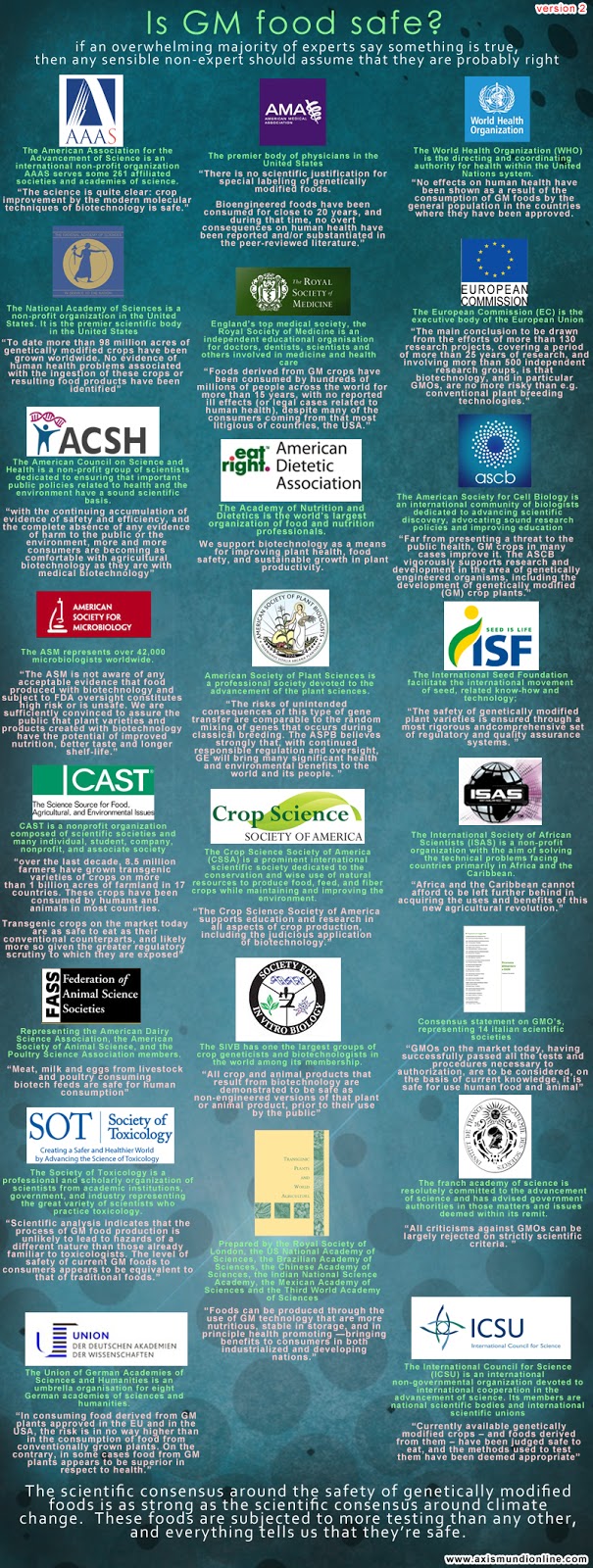
Most of the major scientific and medical organizations have issued a statement that GMO food is safe (in the sense of being as safe as non-GMO food). This is just an image, but in most cases you can verify the statements back to the organizations' websites by googling.
Ah yes, science says it's safe and who wants to be a climate change denier? Case closed!
Here in Germany rabbits are dying a gruesome death by overeating genetically modified rape. Supposedy the bitter taste that told them to "stop" was removed and now they eat until the die.
So the food is of course "safe" as in you can eat it without any direct harm; examining complex biological interactions however is far beyond the scope of lobbyists and companies that want to bring products to the market.
So now we already have fruits that look "fresh" even if they are already a bit old, tomatoes that are just huge bags of water without any taste (eating someone's homegrown variants are a huge revelation), stuff genererally optimized for size, looks, and a superficial taste. To me that is not progress at all.
You posted a link to a 30-year-old event, and for which there was an hypothesis that it could be linked to the genetic modifications of a rapeseed.
As far as counter-examples go, that doesn't seem particularly strong.
EDIT: Actually, the "new" seed they are talking about is 00 rapeseed (AKA Canola), which is not a GMO, since it was bred naturally: http://en.wikipedia.org/wiki/Canola
The GMO versions of Canola only appeared years after that event.
> Most of the major scientific and medical organizations have issued a statement that GMO food is safe (in the sense of being as safe as non-GMO food)
Given two samples of some food F, where one sample was produced by GMO techniques, and one was produced by traditional breeding methods, they will be equally safe. In that sense, GMO is safe, and there is almost no serious scientific disagreement over that.
The concern of many, including myself, over GMO is that it greatly increases the range and rapidity of modifications that can be done to food compared to traditional methods. If/when someone produces a GMO food that harms people, it is not going to be because GMO is unsafe. It is going to be because they were given sharper and faster tools, and they did not have adequate internal and/or regulator oversight to use them wisely.
If that's all you're concerned with and think articles/opinions discussing other aspects are "cloaking the point" you should know the scientific consensus on GMOs is that they're safe.
There was a Forbes article[1] last year that linked to quite a number of studies. If you're looking for a less journalistic take and want to poke around with the data/studies yourself check out GENERA[2] (a database of peer reviewed GMO studies). FiveThirtyEight did a piece on the gap between "what the public thinks and what scientists know" and saw the widest margin in the subject of GMO safety[3].
"Politicians in the EU are generally not friendly to GMOs" and spent over 200 million Euros on a decade of research[4] and the "main conclusion to be drawn from the efforts of more than 130 research projects, covering a period of more than 25 years of research, and involving more than 500 independent research groups, is that biotechnology, and in particular GMOs, are not per se more risky than e.g. conventional plant breeding technologies."[5]
I blame monsanto for the G.M.O. hysteria, they gave G.M.Os a bad name and now people who call themselves environmentalists behave irrationally because they can't be bothered to look past the name and actually look at the facts... In a lot of cases G.M.Os are safe and are actually better for the environment because they can reduce the amount of pesticides used (or reduce deficiencies in the target populations).
G.M.Os should be studied on a case by case basis.
It's the same with nuclear power. Banning nuclear power and all research on nuclear power (e.g. Thorium) is short-sighted.
Well yes but it's also what they did that's a bit of an issue. The roundup ready crops are crops that are engineered to be resistant to the Roundup herbicide which is a bit more iffy than the example given in the article of a eggplant with a gene transferred from Bacillus thuringiensi which is allowed to use in organic farming.
On Monsanto side, the controversy was originally about the use of Roundup (which the G.M.O. permitted) and the potential toxicity of glyphosate.
Monsanto - the creator and producer of Agent Orange is responsible for suffering and deaths of millions of people. In China and Vietnam, hundreds of people are born with serious health issues even to these days.
GMO are created with barbaric methods with unknown long term effects on human or environment. AFAIK, GMO are created by infecting DNA with a virus and mixing 'terminator' genes to be sure, that species won't have offspring.
Now, please somebody tell me, why should I trust the very same company, that was manufacturing Agent Orange, with my food. Monsanto officially stated that: "reliable scientific evidence indicates that Agent Orange is not the cause of serious long-term health effects". Now, they are saying that GMO poses no risk to health or environment. Thanks, no but thanks.
I'm very skeptical of Monsanto being the only reason "hundreds of people" are born with serious health issues in China and Vietnam.
Anyway, the reason I don't take anti-GMO people very seriously is I get the same vibes from the anti-vaccination sort. Refusing to ingest GMO food is perfectly acceptable if you're worried about the health concerns, I would happily welcome more study - I just have trouble believing these crops pose a direct risks to humans. We don't worry about blood-borne diseases from plants. As I understand it, plant DNA is incompatible with our own. I'm not a scientist but I'm pretty sure what they modify can't modify us. I would worry about environmental impact - how these crops affect soil acidity or something else.
I want to stand with the anti-GMO people but it just comes off as blind fear. I'll support study of long-term effects but not much else ~
Monsanto are evil. But even Monsanto are giving away licences to grow their yellow rice - it's free for farmers earning less than $10,000 per year. The rice doesn't have terminator genes and Monsanto have said that seed collection and re-sowing is allowed for free.
And it's not just Monsanto calling the yellow rice safe. Plenty of other studies have shown it to be safe.


So on the one hand I'm very concerned about Roundup Ready crops, not specifically because they're GMOs, but because I'm concerned about long-term glyphosate toxicity. On the other, as far as I can tell from a small amount of reading, Bt corn, "golden rice" (rice that makes its own beta-carotene), the non-browning apple, and now this Bt eggplant are all probably okay.
I think that failure to understand this point, that each GMO is sui generis and has to be approached individually, has two dangers. On the one hand, there is a tendency to oppose all of them indiscriminately, and of course we're already seeing this. But there's also a real possibility that once that blows over and GMOs get more accepted, we might get complacent and not check out new GMOs as carefully. I do think some safety testing is in order, though in many cases the modification certainly sounds safe. Beta-carotene is certainly a valuable nutrient, and AFAIK is hard to overdose on. The non-browning apple gets that way by having one of its enzymes (polyphenol oxidase) turned off -- what could be dangerous about removing an enzyme? The Bt mods deserve a little closer examination, as they are producing a new protein, and there seems to be the potential for allergic reactions in some small fraction of the population; but Bt is considered an acceptable pesticide for organic crops (it is a protein, after all, not some chlorinated petrochemical) so it could well be pretty safe.
(All that said, I do still support GMO labelling laws. People should be able to know what they're eating, even if they overreact to that information.)