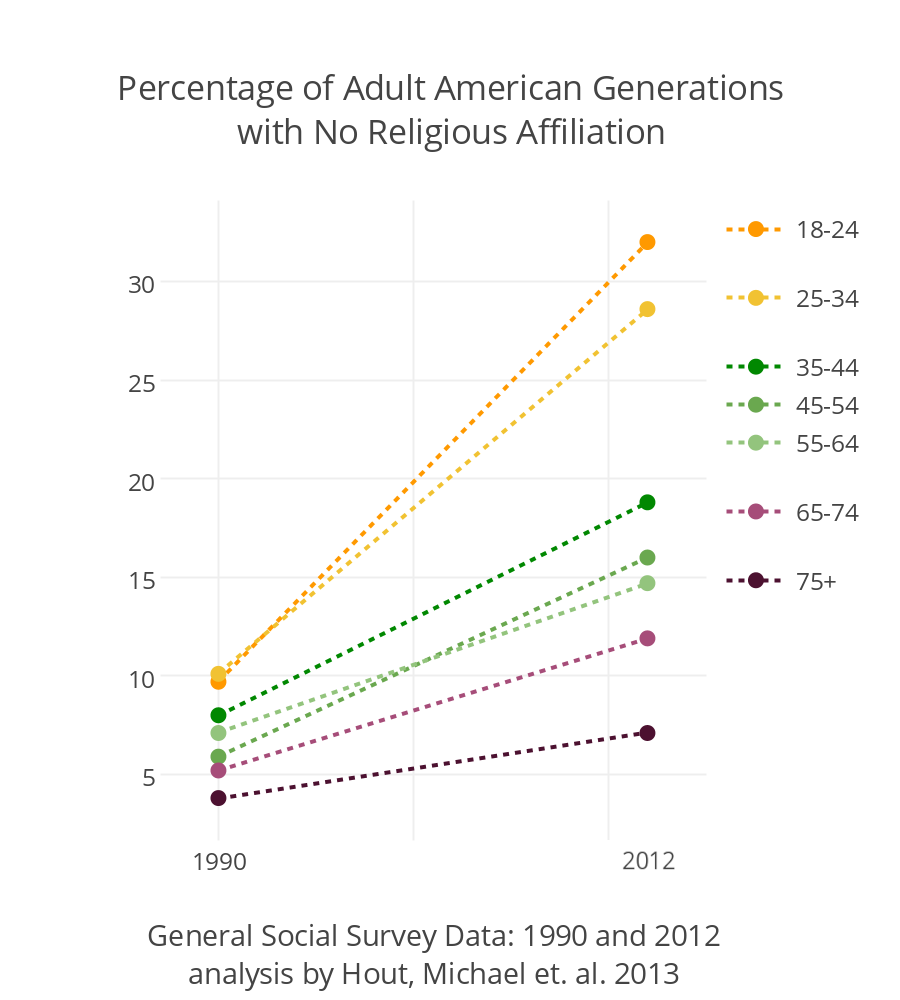
This shows that younger generations are less likely to be religious, but there's no indication that they will not become more religious as they age.
The best "proof" it provides for the assertion is this:
> According to GSS, “unaffiliation” actually increased for all age cohorts over the past few decades, but most dramatically for the youngest among them
So maybe we can say America is (very slowly) becoming less religious, but it's still over 70% for the youngest age group listed here
General indications are that the US is more than twice as religious as anywhere in Europe (Poland might be highest, catholic countries seem to have mpst persistence of religion). We are atheist, muslim, or generally not bothered.
51% in Europe believe in a God, and another 26% believe in some sort of spirit or life force. 20% do not believe in a God, spirit, or life force. Source: Eurobarometer Poll 2010, quoted in Wikipedia [1].
Poland is not the highest for belief in God. They are bested by Malta (94%), Croatia (93%), Romania (92%), Cypress (88%), and tied with Greece (79%). Others above 50% are Italy (74%), Ireland (70%), Portugal (70%), Slovakia (63%), and Spain (59%).
Germany is at 44%, the UK at 37%, France at 27%, and Sweden at 18%.
Note the above is belief in a God. When you add in the spirit or life force belief, some of the countries shoot way up. Sweden is only 18% belief in God, but 45% spirit/life force, with only 34% not believing any of that.
That still leaves Sweden with the third highest unbelief, behind the Czech Republic (37%) and France (40%). Germany is 27% unbelief and UK is 25%.
If any Poles say otherwise, feel free to correct me, but my impression of Poland's religiosity is largely dependent on the strong role of the Catholic Church in recent historical affairs (Pope John Paul II, keeping Polish culture alive during USSR era, etc.) and less on the population being more "religious".
I don't think the majority of Poles are actively "Catholic" in their religious metaphysical beliefs, but rather they all belong to the church because of its cultural importance. I could be wrong, however, as I don't live there.
It makes me wonder about other countries where the church plays an important cultural role (Italy, for example.)
I see what they've done there with the color coding (all variants on Christian being blue) but that is totally unreadable. I'm not colorblind but the only way I can identify what is being shown is by counting the stripes and legend entries (second stripe from the bottom is the second from the bottom legend entry). I swear "Protestant (Black)" and "Jehovah's Witness" are literally the same color.
Are graphic designers no longer hired for this sort of thing? Or do graphic designers no longer care?
I wonder if there is a way to distinguish the evolution of "values" as opposed to the support of an organized religion. So while organized religion may fall from favor, the value systems aren't going anywhere. And I don't think this is such a bad thing, I just wish the supposed "secular" folks could stop congratulating themselves for not going to church.
I say this because I see conventional "secular liberal" values as deeply christian - one of the biggest being our obligation to care for the poor. A scientifically organized society might well look at spending on the poor quite differently, and not in ways we would recognize or agree with.
Interesting, the linked page displays that up to 80% have a religious affiliation, but the wiki article says that only 36% actually attended religious services.
A large percentage of Americans participate in religious activities without even knowing it, but these results are pretty typical given how these surveys are usually conducted.
This only shows that people no longer self-identify as strongly with traditional religions. This doesn't actually show that America is becoming less religious though in either beliefs or practice.
You do realize that that was an intentionally chosen endorsement specifically done in protest of the Johnson Amendment? It's a bit of a reach to extrapolate that into "it happens all the time".
A few years back I used the IRS's form to report three local churches for prominently displaying candidate's promotional signs on their property. I also included photographic evidence of said signs, clearly on church property. Anecdotes be anecdotes, but I can personally guarantee that there have been at least three instances where a church has illegally promoted candidates, been reported, and yet maintained their tax-exempt status.
> "You do realize that that was an intentionally chosen endorsement specifically done in protest of the Johnson Amendment"
As opposed to what? An unintentional endorsement? They perfectly know what the law is and they choose to break it. They have been doing it for decades, because they know the IRS won't do anything.
Hundreds of churches have been caught doing it. How many of them have lost their tax-free status?
Without getting into a religious argument about truth, science, the existence of God, etc...
I think there is a real unintended consequence of younger generations turning away from all forms of religion or absolute spiritual truth in any form. In short, there is a set of morals and ethics that is deeply rooted in Christianity and Judaism that for a long time helped steer this country in a generally good direction. In the absence of any great sense of moral authority, right vs. wrong, good vs. evil, etc. you have a completely situational and relative morality.
That is to say, what is right and wrong depends on who you are, what you believe, and your own personal sense of justice or fairness. Eventually, things are only wrong if they are deemed illegal, and laws can be written to say anything or do anything. At some point the only thing that is "wrong" is upsetting someone more powerful than you. As in, it's only wrong if you get caught or get in trouble.
For example, many international companies play on the fringes of the international tax code by routing money through various shell companies and intermediaries so as to avoid paying taxes in various countries. If it was the mafia and they sold drugs instead of software or advertising, it would be considered money laundering, which we should all agree is illegal and wrong.
Now, when people read stories on that topic, they comment that Google or Apple aren't doing anything wrong because what they are doing is "perfectly legal", even if they are going out of their way to avoid the spirit of the law. Shareholders are fine with this behavior because they are greedy and it makes them more money. As long as nobody is thrown in jail, what does it hurt right?
A stronger moral standard would be to say that if you are doing business in a country, you should pay a reasonable and fair tax rate along with everyone else doing business in that country. To skirt tax obligations through financial maneuvering and engineering the flow of money is somewhat akin to stealing.
I am not pro media companies ripping people off, but people take a very similar approach to illegal file sharing for their favorite shows and movies. If something is available for rental or purchase at a reasonable price, people should pay the $1-4 to rent or about $5-15 to buy. However, many people choose to download things illegally without any intent of paying the producers of their favorite movie, game, or tv show. At some point, theft is theft.
I'm not saying that life is perfect if everyone is a Christian believer or anything like that. What I'm saying is there are morals and ethics that are falling by the wayside amongst Christians and non-Christians and I've seen nothing in secularism, athiesm, or agnosticsm that is doing much to replace them.
I don't know where we end up as a country, but the trend away from faith and any sense of moral or ethical absolutes is going to be one of the worst unintended consequences of the modern "enlightenment" of science and technology.
For all the technical or intellectual progress we've made in the last 100 years, morally and ethically we seem to be worse off.
By your assertion, morally and ethically we're worse off without religion. That is an incredibly difficult stance to defend over the long term.
The problem with morality as prescribed by religion is that the authority on morality is provided by some ephemeral being whose wants and desires can only be gleaned from texts written thousands of years ago. Even if we accept that the Christian God is real (as requested by your lead in), we have no way to refine our understanding of his definition of morality under the religious model. We can only rely on the texts. These same texts prescribe things like stoning women who cheat on their husbands. These texts were "canonized" by a group of men who decided what was and wasn't the bible.
To posit that this is the best possible basis for a rational system of morals (to prevent things like tax fraud no less) is either not very well thought out or willfully acting in opposition to thousands of years of well documented behavior on the part of religious worshipers.
It looks like we stone people to death less and don't burn witches and less likely to put your penis inside a metal tube to prevent masturabation.
Now, if somebody would teach more people not to put their dirty feet on seats that would be nice.
I definitely like your argument that all of those old books were written as a life rulebook, but it got kinda carried away after and I think we're due for update, like bible 2.0 or something.
> "I definitely like your argument that all of those old books were written as a life rulebook, but it got kinda carried away after and I think we're due for update, like bible 2.0 or something."
I like the idea of a religion in which "this religion is bullshit" is considered dogma. Bokononism toys with the idea, although arguably that all goes wrong anyway..
"A man's ethical behavior should be based effectually on sympathy, education, and social ties and needs; no religious basis is necessary. Man would indeed be in a poor way if he had to be restrained by fear of punishment and hopes of reward after death."
— Albert Einstein, "Religion and Science," New York Times Magazine, 1930
Generally it means that you do not identify with a particular religious sect. It may also mean that you do not believe in the organized supernatural ideas that most religions do.
Exactly, but that doesn't tell us if you're actually religious or not! You may or may not have a personal religion. That's why I found it weird in this case, where the while point of the survey was to know if people are religious.
IMO, religion is something organized and part of a community. "Spirituality" is when it's something personal (and, as I get older, I am coming to believe is an important part of my life, even though I don't believe in anything supernatural.)
It's not clear because secularity usually means the subject - usually an institution - is not tired to a specific religious order (like your definition implies). But unlike institutions, people may have personal religions/religious beliefs, so "secular" doesn't actually tell us if they're religious or not!


The best "proof" it provides for the assertion is this: > According to GSS, “unaffiliation” actually increased for all age cohorts over the past few decades, but most dramatically for the youngest among them
So maybe we can say America is (very slowly) becoming less religious, but it's still over 70% for the youngest age group listed here