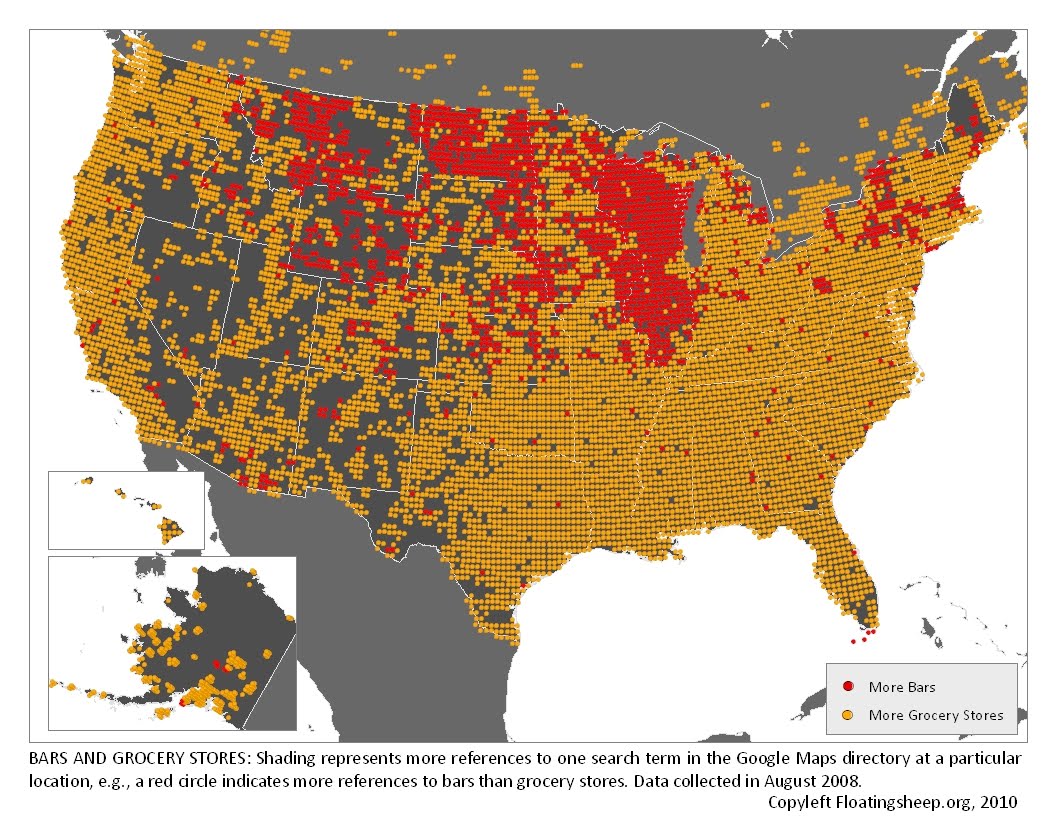
I was wondering if the map would capture the Alaska Mat-Su Valley/Minnesota connection. Back in Fall 2008, people started asking me why I, being from Minnesota, talked like Sarah Palin, doncha know. I was amused to discover an article that October which explained that the US Government had relocated a bunch of Minnesotans to Alaska in the 1930s[1] as part of a government relief program, eh.
edit: regarding that American accent quiz elsewhere in the thread[2], I score a 93% 'north central' accent: "North Central" is what professional linguists call the Minnesota accent. If you saw "Fargo" you probably didn't think the characters sounded very out of the ordinary. Outsiders probably mistake you for a Canadian a lot.
So, I actually grew up in the Mat-Su Valley. I lived in Palmer (a quick bike-ride from Wasilla) from 1987 through 2004. I was born in '86. My grandparents were some of the original settlers in the area in 1936.
Sarah Palin's accent is not typical there, nor even common. My own and those of my friends growing up would probably be classified squarely as "General American" and unaccented. I recall knowing exactly one person with a noticeable Minnesotan accent while I was growing up, and I think they were actually Minnesotan.
As far as I can tell, calling upon the influence of a portion of Minnesotan settlers 80 years ago to explain Palin's atypical accent is more of a back-justification than a real explanation of cause-and-effect.
Too bad I missed you - I've been growing up here for the last 18 years. Lived in Talkeetna for a while, now I'm near Wasilla, soon to be in Anchorage for school.
And you're absolutely right. Palin's accent is very atypical of the accent here. The accents are very eclectic, because the population is, but it's generally unaccented. I might add that her politics are atypical - despite her being a very conservative politician on the national scene, she was actually among the most left-leaning Republican politicians up here.
One thing I find strange is how this Minnesota accent has come to represent "Canada's" accent in American pop culture. It is, unsurprisingly, somewhat similar to nearby parts of Canada (Manitoba, Northern Ontario) but it is not the accent of a large percentage of people in Canada, and it never was.
This would more accurately be called "White United States Dialect Map". I clicked through all of the videos from Mississippi, a state which is 37% black, and there is not a single video featuring a black person. From what I can tell there is no acknowledgement whatsoever of the fact that non-white people exist in America and speak distinct languages from white people.
I don't know if it's racist to make a map exclusively of white people's accents, but it's definitely racist to call it an American Dialect Map.
Also, the map seems only to cover the United States. America extends up to the Arctic and down to Cape Horn.
Edit: Just noticed the section "Classical Southern and African American Vernacular English". The author basically writes off Black language as "derived from Southern English", which is a cop out. And "African American" doesn't begin to cover the wide range of non-white people in the U.S. Many black people are not from Africa, and many people of color are not black.
I suppose you want him to have an English dialect map that includes Spanish speaking countries? It might ease your sensibilities, but it would be meaninglesss.
While it must be truly invigorating to get the rush of moral superiority you feel by pointing out perceived racism, it is absurd nit-picking that allows you to arrive at your conclusion.
Every other nation in the Western Hemisphere has a name that allows the citizens to be uniquely identified: Mexican, Canadian, Haitian, Brazillian, Ecuadoran, etc. Tell me, what do you propose we call citizens of the United States of America, other than "Americans"? I once was the only American working at an international school. One time, and one time only, a young Spanish man from Madrid made a stink when I referred to myself as "American." The 2 Argentinians, the 1 Brazillian, and 3 Englishmen in attendance all rolled their eyes and collectively told him off with the same question I just asked you. It's absurd, it's over sensitive, and it screams out "Pay attention to me! I'm pointing out oppression!!"
The author doesn't try to cover AAVE because the vast majority of the African American population outside of the South emigrated FROM the South less than 3 generations ago. There's an entire field of study on AAVE, and its not his field. FYI, I'm from the south, and to most northerners, AAVE and "white" southern dialects sound extremely similar, to the point where a white Seattle teenager I encoutnered saying "yall" picked it up from the hip hop culture he was immersed in. It's not necessarily that AAVE is derived from white southern, its that the two dialects grew around each other, with rather extensive interaction between poor whites and black slaves in the rural south. I would say the influence is surely two way, and know for a fact that many of the words my family uses are African in origin.
Black people in the south (and north) speak many different dialects, some that would be completely omitted if black people were completely omitted. They, of course, exist on a continuum with historical (and current) white dialects. All American dialects exist on a continuum of historical and current British dialects, so could we just leave Americans out as a special field of study, even when studying Americans? As a black person (along with 12% of the population), with roots in this country from before there was a country here, I resent the implication that I am a special field of study that can be ignored when studying "Americans." Talking about recent immigrant dialects is a cop-out.
>it must be truly invigorating to get the rush of moral superiority you feel by pointing out perceived racism
Bashing people who point out possible moral failings in an enterprise as doing it in order to bask in a sense of moral superiority is about as intellectually vacuous as bashing people who point out logical or factual inconsistencies as elitist snobs or ivory tower eggheads. Shameful.
Also, the map seems only to cover the United States. America extends up to the Arctic and down to Cape Horn.
The definition of a continent is not as universal as one might imagine. Where I grew up, I was taught that "North America" is a continent, "South America" is a continent, and "America" is a legitimate abbreviation for the USA, a country located on the continent of "North America".
In other locations, people are taught that "America" is a continent that stretches from Argentina/Chile to Canada. Someone from the USA who calls themselves 'American' appears arrogant to someone who believes that "America" is the continent composed of North American and South America.
Just keep in mind that the difference is simply due to regional education differences. (How many continents are there? Seems like a simple question, but the answer, 5,6, or 7, is mostly related to where you received your early education)
> Someone from the USA who calls themselves 'American' appears arrogant to someone who believes that "America" is the continent composed of North American and South America.
Genuine not rhetorical question: Instead of "American", what would be the preferred, less-arrogant way for a U.S. citizen to refer to oneself?
(I mean in normal conversation not border control; so presumably not "U.S. Citizen". And I mean seriously; so not "Arrogantian".)
Nobody refers to the union of North and South America as "America". It's, if anything, "The Americas".
To complain that it's confusing is a cop-out.
The "United States" could mean "The United States of America", but could also refer to the "United Mexican States" in Spanish (Estados Unidos Mexicanos vs. Estados Unidos de América).
There's Washington D.C. and Washington state. New York state and New York City. British Columbia and Colombia. Georgia the state, Georgia the country. Are both "Georgians"?
Words mean multiple things. This obviously comes as a shock to some people.
Also, the map seems only to cover the United States. America extends up to the Arctic and down to Cape Horn.
It looks to me like the map includes Canada. The United States and Canada are the only two countries in the Americas where English is a majority language, so the title seems legitimate.
There's also the Bahamas, Guyana, Trinidad & Tobago, Belize, and Jamaica; where most of the population speak English or English-based creoles.
And if you count countries that have English as official language there are also Barbados, Antigua and Barbuda, Dominica, Grenada, Saint Kitts and Nevis, Saint Vincent and the Grenadines, and Saint Lucia. At least.
All combined they have a summed population of more than six million English-dialect-speaking people.
Including those as part of the Americas is certainly reasonably standard, but so is not including them (i.e. restricting the Americas to the mainland). I continue to see nothing problematic about the page title.
While both of those have English as an official language, it is not listed as a majority language for either (though both have an English-based Creole as a majority language so you could probably argue it either way).
AAVE is the answer you're looking for. I presume this is a separate field of linguistic study where one researcher wouldn't necessarily have domain knowledge.
http://aschmann.net/AmEng/#Classical_Southern
I don't know if this map had such a quiz - I was looking for one and couldn't find it. It's interesting to compare notes with the quiz if you work with people from across the US (what do you mean, "bag" doesn't rhyme with "vague"?)
Heh. As a foreigner who has been living in SoCal for 8 years, I tried to answer with how I perceive the accent of californian people around me, and the result is... 100% northeast accent?!
This confirms that I am utterly incapable of discerning the subtle nuances of different american accents. All I can distinguish is the main families American vs. British vs. Australian.
Can you distinguish a Southern (Alabama) accent from a Minnesota accent? To me those sound as far apart as Standard American and British. (I'm American w/ Standard American accent.)
""North Central" is what professional linguists call the Minnesota accent. If you saw "Fargo" you probably didn't think the characters sounded very out of the ordinary. Outsiders probably mistake you for a Canadian a lot."
Good, I am Canadian. :)
One minor nit though, I thought Mary and marry sound the same and merry sound different, but there was no option for that, so I chose "all three different".
Funny I was expecting to get that as well, but I got a tie between "The West" and "The Midland", even thought I've lived in Canada my whole life, and have never been further west then Indianapolis. Wonder if living out in the Maritimes for a few years has any effect on that? Would explain why my American wife says I dont' sound like a typical Canuck.
I get the feeling the quiz isn't really tuned to Canadian dialect differences. I would have guessed I would be classified as something around the Pennsylvania, Ohio or New York state area. I certainly don't sound like someone from Fargo, although some Canadian accents do.
I was born in and raised in California and got The Inland North:
> You may think you speak "Standard English straight out of the dictionary" but when you step away from the Great Lakes you get asked annoying questions like "Are you from Wisconsin?" or "Are you from Chicago?
Interestingly enough though, my parents ARE from Chicago. Hmm.
Took it just for fun as I'm not even American. Scoring a 93% match with The Inland North. They call it "Standard English straight out of the dictionary". I guess that's good as a non-native speaker...
Hmm.. funny, I'm from the South (albeit not the "deep south") and according to this quiz, my accent is "Northeast". I guess I shouldn't be surprised though: when I was a kid, my parents used to tell me things like "You talk funny, you sound like you're from up North" and "you talk too fast" and what-not. Not sure exactly how I wound up with a "northeast" accent.
Then again, most people I meet, who aren't from the South, say they think I have no noticeable accent at all, and guess that I'm from somewhere in the Midwest. Good grief.
Language is a funny old thing...
what do you mean, "bag" doesn't rhyme with "vague"?
Another example, which is also a minimal pair, is "bat" vs. "bait".
If you look at the posted article you can probably find the exact dialects that pronounce these words like that. But I'm pretty sure "bag" doesn't rhyme with "vague" in most English dialects (including British and Australian dialects), even if they don't use /æ/ and /eɪ/.
Well, North Carolina, at least. Those aren't words you hear on TV or in movies a lot, I guess, so it's hard to say which version is "generic American English" to the extent that there is such a thing.
"You have a Midland accent" is just another way of saying "you don't have an accent." You probably are from the Midland (Pennsylvania, southern Ohio, southern Indiana, southern Illinois, and Missouri) but then for all we know you could be from Florida or Charleston or one of those big southern cities like Atlanta or Dallas. You have a good voice for TV and radio.
Interestingly, it seems to have pegged me mostly correctly. I've lived all my life in and around Atlanta. Most people notice a Southern accent on me, but I definitely don't have a Classical Southern accent.
As a French guy living in New York, I am pleased to have gotten 91% Northeast ;)
Judging by how you talk you are probably from north Jersey, New York City, Connecticut or Rhode Island. Chances are, if you are from New York City (and not those other places) people would probably be able to tell if they actually heard you speak.
As someone who's had thier undergraduate studies in Linguistics with an emphasis on Applied Linguistics, this site's a sight for sore eyes (no pun intended). The one thing that's always stayed with me, for whatever reason, is my fascination with the Boston Brahmin accent[1][2]. It's always been a great example of the progression of accents/dialects -- it's like eavesdropping on a conversation that took place 100+ years ago (in the United States).
That aside, the site unfortunately is in dire need of some love, especially considering the density of information on the page and on the maps. I'd be willing to help out if the site owner's poking around through HN.
As an Aussie who is living in Phoenix and has lived in Kentucky I've really enjoyed the variety of dialects I've run into so far.
I'm not sure if it is due to coming from a culture which pulls in media from all over the english speaking world or just a personal "gift" but I really don't find any accent difficult to understand.
Where as I've found that occassionally people I've met in the US have a hard time understanding me (and more so my Aussie wife, who speaks faster and quieter than me), and also mention that they have trouble understanding other dialects from around America.
Where as I've found that occassionally people I've met in the US have a hard time understanding me
My spouse is from England and we live in Ireland. Here, Irish people will have a lot of exposure to English accents (though TV & film), however English people will not have had as much exposure to Irish accents. (There is much more English TV than irish TV, and much more English TV is shown in Ireland than Irish TV showsn in England).
As a result, there is an asymmetry. Irish people will understand the accent of an English person, but not vice versa. But the Irish person may presume that the English person can understand them as well as they can understand the English person, so they probably talk fast and use idioms, etc.
So you might have the same situation. Remember just because you can understand their accent fine, doesn't mean they can understand yours!
Also you find the TV effect on many of the actual accents. Cockney (E London dialect) glottal stops have turned up in Glasgow (Scotland) children because of the very popular BBC Cockney TV soap Eastenders.
http://news.bbc.co.uk/1/hi/scotland/3531075.stm
> coming from a culture which pulls in media from all over the english speaking world
I really enjoyed this about Australia. When I was there we liked to turn on the TV each morning to watch the cartoons, because they had stuff from England and India and all over the place.
The only accent I've really had trouble with is the deep southern accent in and around New Orleans. The heavy Cajun accent from the rural areas is nearly indecipherable to me but even in the city some things are just weird. Most of what gets me in the city is that there is strong French influence but nothing seems to be pronounced the way it would be in French. e.g. Milan is pronounced 'm eye - l i n'.
That's true, I've lived in Texas and now California. The accents vary a lot, even within Texas, DFW, South Texas, Austin have slightly varied accents; the only thing in common is when Texans say "ya'll"
As someone born and raised in Michigan, I've adopted y'all in my own speech. I think its a fun and useful phrase if for no other reason than to confuse others around here, lol.
I'm also glad to see Michigan properly represented. Us trolls that live under the bridge are quite different from the Yoopers who have more in common with Canada and cheese-heads. All in good fun though :)
This is interesting. I'm from Michigan and it took me a couple re-reads to understand you were talking about Upper vs Lower peninsula. I'm from near Detroit, curious if you're more north of that? We generally compare more to Ohioans than "Yoopers" as you say.
I've been living in NYC for a couple years and I've adopted some words and also had "pop" beaten out of me for soda.
I'm in Seattle, and plenty of people around here use y'all. Well, or we're just being ironic. Or we find a second person (explicitly) plural pronoun useful on occasion.
I'd always taken "dialect" to refer more to idiomatic differences than pronunciation differences in regional language usage. The canonical example in the US being the variation in what people call a carbonated beverage, whether it's "soda", "pop", "coke" (note the lower case: in parts of the South, "a coke" is a carbonated beverage, regardless of brand; if you want a Coke, and don't want to clarify, you should ask for a "Coca-cola"), or anything else.
FWIW, I always considered "dialect" to imply slightly different grammatical structures, vocabulary, idiomatic expressions.
Then again, I am italian, to me most of the english speaking world appear to be just "accents".
Anyway, wikipedia appears to agree that pronounciation only does not make a "dialect".
"""
A dialect is distinguished by its vocabulary, grammar, and pronunciation (phonology, including prosody). Where a distinction can be made only in terms of pronunciation (including prosody, or just prosody itself), the term accent is appropriate, not dialect.
"""
My objection to that map, as someone who was born and raised just north of Dallas, is that no one I've ever met in Dallas County has ever used "coke" to mean carbonated drinks generically without prompting (I will admit some people claim to do so; a claim belied by their use of "soda" in casual speech.)
I lived in Dallas for several years, and this was my observation, too. In some of the outlying counties around Dallas (e.g.-Hunt), "Coke" is definitely prominent, but inside the urban sprawl that is DFW, "soda" is used first and foremost. I think it speaks to just how much of an influx there's been to DFW from the coasts in the past decade or so.
>in parts of the South, "a coke" is a carbonated beverage, regardless of brand
I'm curious, is something like Fanta or (carbonated) Ice Tea ever considered a coke?
To me—not a native english speaker—coke means Coca Cola Coke, Pepsi Coke, or Dr Pepper. That is, it's synonymous with the French word 'coca' or the Dutch word 'cola'.
>>It is also very sweet, unless you ask for unsweet.
I noticed that in Wisconsin tea is sweetened or unsweetened; whereas, when I was in Florida the tea was sweet or unsweet.
I also noticed that they make Old Fashions with whiskey rather than brandy. And if you order a brandy sour, it can take the bartender up to 5 minutes to find some Brandy... While attempting to be polite I learned they do not know what gesundheit means either.
I can't answer your original question, but I can say that there does exist the word "cola" in English. This is the "correct" word for the sort of drink that both Coca Cola and Pepsi are.
Fanta is one kind of coke that I didn't see much growing up.
My brother and I used to argue about whether Orange Fanta counted as a coke. He thought it wasn't, because it was orange soda and not cola. I thought it was, because it was sugary carbonated soda.
My wife refers to them all as soda or pop. The industrial name for them all is "soft drink", which I think means they don't have alcohol in them.
You are right, its used for alcoholic beverages and non alcoholic beverages so context is key. Ive never encountered a problem with any confusion. Usually when its used, its clear whether alcohol is meant.
Alcohol:
"Were going out for drinks"
"We have a few drinks with dinner"
Non-Alcohol (Coke/Pop/Soda)
"We got some drinks at the gas station on the way over"
"Will you get me a drink while you are in the kitchen?"
"We have drinks in the fridge"
I think most people that use it would answer "Coke" if asked because thats what southerners are supposed to say, but informally "drink" gets used quite often.
there are two types of iced tea in the south and this is how you order them: (sweet) tea where the 'sweet' is optional and: tea, unsweetened where the waitress gives you a funny look.
I remember I was 10 or 11 the first time I ordered iced tea and it came sweet- I thought their machine had broke in the most disgusting manner possible.
I am totally impressed. There is a tiny place in coastal North Carolina where people speak with an early 1900's Boston-ish accent because they came over on fishing boats. There can't be more than 5000 people that speak this way, and I only know about it because my cousin married one of them (a high-tide'r). I am glad this mildly interesting fact is actually being recorded.
As a native hoi toid speaker I can confirm that we exist, and in numbers greater than 5000. I'd guess at least 20,000. The accent doesn't magically disappear once you get off Ocracoke. Quite a few of us woodsers grew up with it (GGFather migrated from Harker's Island).
This is completely anecdotal, but I've noticed very little difference after moving from Iowa to Boulder, CO although they're considered different dialects here. However, I can pick out people who live here from Texas or California almost instantly as well as anyone from the south/east coast. Of course, I'm not refuting this at all, just giving my own 2 cents.
I think all of these dialects are being lost and becoming the "TV/Movie" way of pronouncing things. IE, most people in Pittsburgh sound like most people in Chicago or Los Angeles (which all sound like the dialect we hear on TV), but you get certain types (especially working class) who have been more isolated (didn't go away to college, etc...) that have very strong dialects.
It depends on who you talk to really. I remember visiting Boston and talking to a girl selling t-shirts on the street and being completely unable to understand her. I asked a gas station attendant in Atlanta for directions once and same thing. My friends from Chicago have very discernible accents. My wife, who grew up in rural Iowa, pronounces "stock" and "stalk" differently (among other things).
This happened to me in Rhode Island. I'm very used to Boston, New York (Manhattan, Brooklyn, Long Island), and various New Jersey accents, but the Rhode Island accent really had me mystified. I just learned about the Maine accent recently (the stereotypical Steven King accent).
That's interesting. I actually grew up in Chicago, but have most recently lived in Iowa. I don't have much of a "chicago" accent with the notable exception of saying "rough" and "roof" exactly the same way.
What got me, as an east coast transplant, was the use of "pop" versus "coke" or "soda." I literally wouldn't register it when people would ask me: "hey do you want a pop?" I'd be like, <pause> "wait, what about your father?" This is even though I knew they called it pop in the Midwest, and over a period of years. It would just catch me off guard.
There's a preponderance of call centers in the area within a couple-hundred-odd mile radius of Omaha, NE, as that's supposed to be the most "neutral" accent in the Continental US. Particularly, that includes the metro areas of Des Moines, IA; Omaha and Lincoln, NE; and Sioux Falls, SD. (I'm not sure if Kansas City, {KS,MO} is also included in that set. I grew up in one of the cities with a lot of call centers, and the MO accent, at least, is pretty clearly distinguishable to me.)
I always figured it was a timezone thing that they eneded up there. They'd end up at most 2 hours difference from all major time zones, and average about 1.33 hours across them all. That makes it much easier than getting people to work by 5am in california to be able to handle the east coast, or working until 8pm on the east coast to handle california.
Having lived in KC for 10 years, I never noticed an accent at the time. But then after living in the Northeast for a while, the KC accent seemed to have a very distinct Southern drawl. Not as much as e.g. Texas, but there nonetheless.
I'm not sure if my ears are just bad, but I notice very few differences at all, not even Texas or California. I've lived in Chicago, Atlanta, Houston, and Los Angeles, and I've very rarely run into people who sounded like they had an identifiable regional accent in any of them. If you go to rural areas it changes—West Texas has some Texas accents—but suburban Houston sounded very close to suburban Chicago to me, except for a few lexical differences like "pop" vs. "coke".
There's a bit of selection bias due to the fact that you are reading HN. I can promise you that the small percentage of people who work in the software field are a type of educational elite, and you are, generally, going to live in places and work in offices with other members of the globo-corporate elite. Also, just to be clear, MANY, MANY people who speak regional dialects at home or informally will shift into a northeastern, "business standard" dialect when in a work setting. I should know. I am one of them. My Appalachian accent does me few favors in business environments.
I'm young enough that I'm thinking more of people I went to school with in most of those cities, not really professional colleagues: elementary/middle-school in Chicago, and high-school in Houston. But it's true that they were middle-class suburban areas, and probably also had a lot of people who moved around (few of my Houston classmates were multi-generational Texans).
A little bit, but not very much. That one did differ in any case: most people in Chicago I knew would say "you guys" for the 2nd-person plural, while most people in Houston would say "you", with a minority usage of "y'all".
It's mostly accents I didn't notice, though. Some wording changes, yes, but nobody in Chicago I knew had a "Chicago accent", like the Superfans on SNL, and nobody I knew in Houston had a "Texas accent". I could be missing more subtle differences.
If you're interested in this, you might also be interested in the Atlas of American English by William Labov, et al (some information about it can be found here: http://www.ling.upenn.edu/phono_atlas/home.html). Brilliant guy.
This is pretty cool, I enjoy hearing different accents and dialects, they remind me that even though most of this country speaks "english" everyone has their own little pocket of something. I was a little surprised to see that the SFBA has its own little dialectical changes, but I'm pretty sure its more than just a few pronunciations.
As a native mid-continent Canadian, I find it interesting that such large swaths of Canada are lumped together. For instance, I find the accent of Albertans quite distinct from Saskatchewan/Manitoba, and BC definitely so.
I really like the in-depth research that went into the creation of the map. An interactive version could save some clutter, which isn't to say that I didn't find this version thoroughly interesting!
Seems about right to me. St. Louis has a distinct accent from the rest of the state of MO and I've usually noticed that they have a bit of a twang that reminds me of Chicago.



edit: regarding that American accent quiz elsewhere in the thread[2], I score a 93% 'north central' accent: "North Central" is what professional linguists call the Minnesota accent. If you saw "Fargo" you probably didn't think the characters sounded very out of the ordinary. Outsiders probably mistake you for a Canadian a lot.
[1] http://www.slate.com/articles/life/the_good_word/2008/10/wha...
[2] http://lewrockwell.com/spl3/american-accent-quiz.html