As someone who's been making art with code for a long time, I'm under the impression that "generative", in the context of computers and art, has had another change of meaning recently.
"Making generative art" now seems synonymous to "giving a prompt to a black-box model created by a large corporation". Maybe Genuary is better described as "algorithmic art"? At the very least, you have to be aware that a wall of misunderstanding has appeared between people using different definitions. Maybe this is invisible to people inside a community, but this wall has appeared around the community and it's probably not helping.
The term "generative art" really has changed the last few years. The wave of interest in generative art a few years ago (along with NFTs) also involved a lot of art that wasn't directly created directly from code [0] and no one seemed to have much problem with it. It's not much of an active market lately, but at the time it was just a different type of generative art from stuff that is much more code-based [1].
and quite a lot of work on Stable Diffusion techniques.
I'm quite comfortable sharing the space. They are not the same thing as each other but neither is it necessary to be dismissive of the approach. People are creating stuff for the sake of creating stuff, that doesn't need to be gatekept
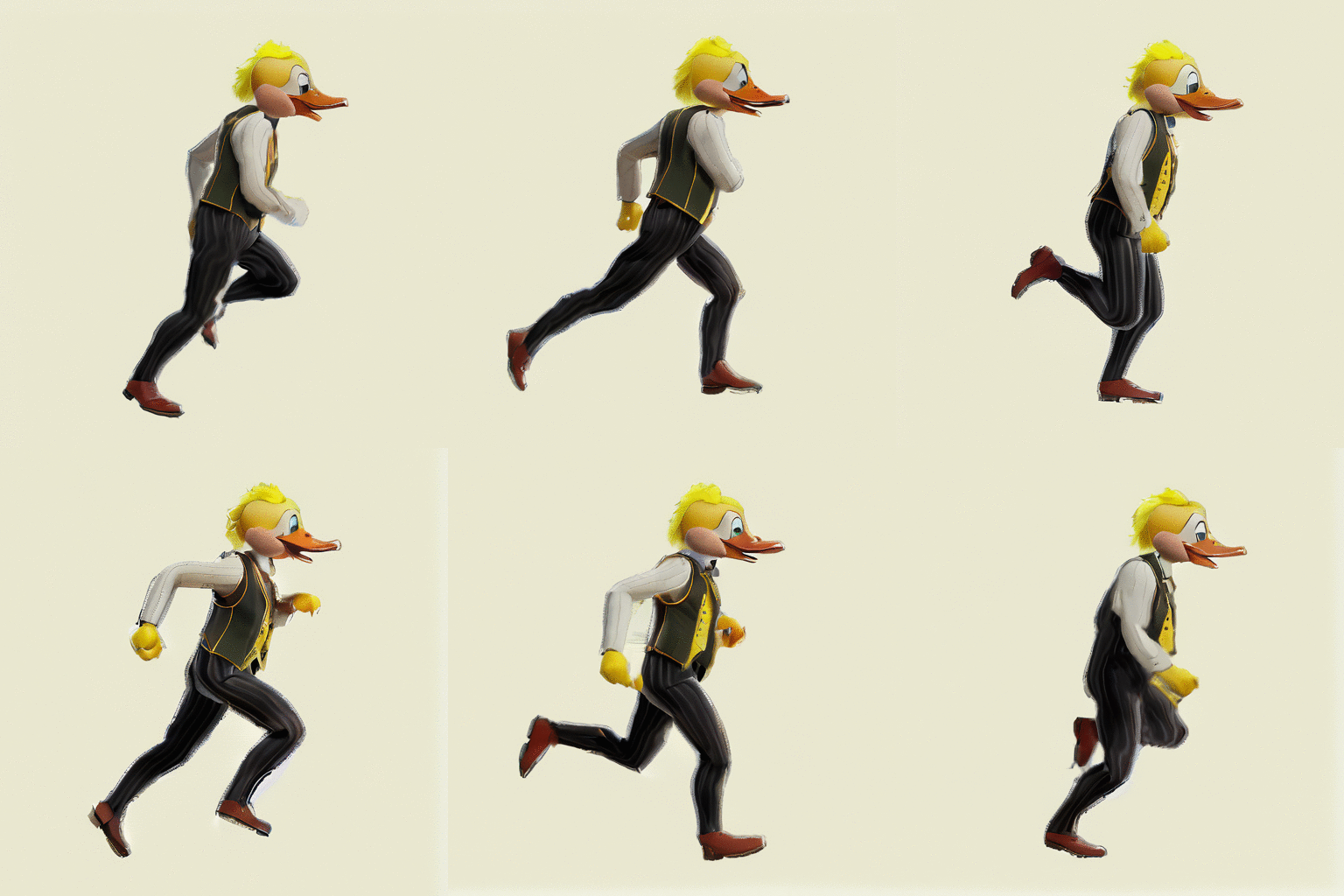
As the comment by holoduke mentions. Quality imagery from image generation models is not as simple as giving a prompt to a black box. This https://fingswotidun.com/AITalk/images/DuckRun/FullAnim.gif took me a lot of work and it is still far from ideal, (the waistcoat jitter, the collar, the beak, the hair).
I think we agree. "Giving a prompt to a black-box model created by a large corporation" is just the average, and the popular perception of the term "generative art". Genuary is also explicitly about making art with code, so there is a more technical distinction that has nothing to do with the amount of effort required.
And maybe the solution is for Genuary to embrace AI art and to stop describing itself as doing things with code specifically. It's something to consider, but I think the AI art would drown out the algorithmic stuff, and the latter would probably have an exodus and be forced to start something else.
As for people gatekeeping and being dismissive, yes those people are out there. Hopefully my comment did not imply any of that.
I don't think one style would be too dominant. Looking at the prompt list I can see some themes favouring code generation and some favouring AI generation.
It would be kinda nice to see some people trying to blend the techniques, like particle systems generating depth-map ControlNets. Animation is still a tough proposition for AI, even with the video generation models available now, having control and consistency is a battle.
“Generative art” has been around for decades; over the last several years it has often been used as a catch-all term that often covered algorithmic art & computer art, and generally with a focus on coding and computation. A lot of artists who practice this (myself included) have long been using this label to define our work.
It has always been a niche topic, but now that “generative AI” is beginning to enter mainstream conversation, it’s basically competing with the terminology.
Except that its not a simple prompt when generating high quality art. It requires wiring of loras, controlnets, upscalers, fine tuned models and more. Take a look at some of many he workflow in Comfui. Gigantic workflows wiyh hundreds of connecting nodes
It seems synonymous to those who have no idea what they're talking about, much like 'programming' is synonymous with 'hitting keys on a keyboard', or really any layman understanding of any field.
For the fourth time (since Jan 2021), we have prepared 31 inspiring code art prompts for anyone who wants to sharpen their creative coding skills during this monthly challenge.
Edit: Hey my bad the prompts for Genuary are all for making visuals, but I suppose they could be interpreted for audio too. My bad, but I'll leave my music-nerd rant below in tact in case anyone finds it useful
----------------
This is awesome, I didn't know about this but I've been subconsciously preparing for it over Christmas break. Here's what I've found useful:
Music:
- Eli Fieldsteel's intro to SuperCollider course is fantastic. SuperCollider language is kind of nice. Function literals are simply curly braces, `{}`, and the last expression is returned. It has pipe's for function arguments, so if you squint it kind of feels like Ruby or Rust.
    // a silly function. Note that paren "blocks" make evaluating multiple lines easier
    (
    x = {|num| num.squared + 42 };
    y = x.(0);
    )
If you've only ever used JavaScript, there's a lot of "wtf is this shit" moments, but otherwise it's really nice. I feel like SCLang is super powerful and want to use it for some projects. Here's Eli's course playlist:
https://www.youtube.com/playlist?list=PLPYzvS8A_rTYEba_4SDvR...
- Sonic Pi is built on-top of SuperCollider, but it's MUCH easier to get started with making bleeps and bloops. Sam Aaron, who originally created Overtone (a Clojure front-end for SuperCollider) created Sonic Pi initially to teach kids computer programming and music, but now it's turning into a pretty nice live-coding setup. The language is basically a DSL extension of Ruby, and although it's very elegant, I feel like it's a little nerfed in terms of a full language when compared to SCLang, so I'm sticking with the latter for now. High recommend checking it out if you're new to making music or code. https://sonic-pi.net/
- This 'Intro To Live Coding' vid from Alex McLean is great. Gives a good overview of a few fun tools out there that I won't mention here for sake of time (check out Gibber and Hydra for web-based coding things. Gibber is really slick). Alex invented Tidal Cycles, which I feel is like god-tier in terms of power and conciseness. Maybe I'll tinker with Tidal someday, but I want to start with SC.
https://www.youtube.com/watch?v=-QY2x6aZzqc
I was really hoping to find a platform that would allow for integrating a programmatic 'score' of music and drive visuals from it, like one step above just using the wave-form to trigger visuals.. I don't know if I've found what I'm happy with yet.. I think I'll try to hook up the OSC signals from SuperCollider with some visuals, but not sure. I want to use shaders if possible, and SC doesn't really support that. Gibber seems great but I'm not sure. Maybe Tidal has it, but the Tidal lang might take a while to learn. I want to use raw frequency values for the notes as much as possible, and that's really easy in SC. I don't want to be stuck using midi notes.
The 31st is music day, so it's not all visuals. Some of the prompts seem ill-suited (looking at you, Bauhaus) but some are fine (I'd like to hear what you come up for "lava lamp"). Perhaps you get a freebie for "wobbly function day" given that music is mostly wobbly functions, but I'd go negative: make music without any trig functions.


"Making generative art" now seems synonymous to "giving a prompt to a black-box model created by a large corporation". Maybe Genuary is better described as "algorithmic art"? At the very least, you have to be aware that a wall of misunderstanding has appeared between people using different definitions. Maybe this is invisible to people inside a community, but this wall has appeared around the community and it's probably not helping.