> For a while tourette syndrome was all the rage and the platform was filled with kids faking tics.
Kind of like all those kids in Le Roy, NY who began experiencing involuntary tics. IIRC, it was interesting that it was mostly girls who were affected by the "craze".
Doesn't work for that site. Archive/Whatever only works if a site lets Google have free access so Google can index it and that one (like most off-brand news blogs) doesn't.
What it shows you is a progress report of what it is doing on the server. If you queue something for it to archive and close your browser and then come back later the page will be archived.
No rates are high excluding the wildfires which has a separate surcharge to finance.
But PGE having to provide power to wilderness areas in genera costs all PG&E customers to bear the cost and it’s a cost that Municipal power companies in CA don’t have and their rates an 1/2 or even more than PG&Es.
1. Santa Ynez Reservoir right above Palisades was empty for the past year, depriving fire hydrants of water. (State incompetence)
2. La City defunded fire department removing 100 fire trucks from service due to maintenance. (City Incompetence)
3 Severe fire warnings reported days in advance of the fire. Rather than take precautions and position fire trucks and equipment etc as was done in the past, the Mayor flew off to Ghana. (City Incompetence, Fire Department incompetence (but partly because of cut budget)
4. Forest maintenance has been stopped. (State incompetence)
Competent management is needed or even worse can be expected in future.
1. Santa Ynez may have helped, however (a) you're still limited by the flow rate of the main to withdraw from the reservoir, but more critically (b) the situation was already well out of hand before any hyrdants ran dry and (c) Eaton had so such issues with hydrants, but a substantially similar outcome.
2. 'defunded' -> about a 2% reduction. Also it's not 100 fire engines, 100 appartus, which covers ambulance, command cars, etc, and it's not clear what exactly is waiting for maintainence.
3. The Mayor doesn't drive fire engines. LAFD and LACoFD prepositioned according to their models, per the chief.
4. most of the LA fire wasn't forest, but chaparral, which is lower, scruby-er, brushy-er terrain. It tends to burn on a 30-50 year cycle, but burning too much more often destroys the ecoology entirely. Indeninous practice and some research[1] suggest small patch-burning; others (NPS) avoid prescribed burns in chaparral in favor of natural fire and structure defense. So it's not clear that there's an unambiguously better management practice than "its gonna burn sometime" combined with aggressive brush clearance and defense around structures.
re: 2/3 Los Angeles (City mostly, but also County) clearly need a bigger fire department, with more people, stations, and equipment. But the specific complaints are ticky-tacky at best, and (AFAIK) no one asserts that a differnt pre-deployment, or a few more engines in service would have changed anything but the margins. I will say LAFD letting their first shift go off-duty as scheduled while LACoFD kept their shift on is an unfortunate unforced error.
re: 4 USFS (and maybe Cal Fire too? not sure). did halt prescribed burns in October 24 in the face of opposition on liability and air quality grounds. Hopefully the LA fires drive people to reconsider their resistance to prescribed burns, and creates the necessary risk-bearing structures for Cal Fire and USFS to actually perform them.
Not sure why you would want to make excuses for management incompetence.
Do you agree that if Santa Ynez reservoir had been full as it should have been, that there would have been no issues with fire hydrant water flowing for the Palisades?
Also, do you agree that in the case of private providing of water during the fire, that an entire mall was saved because of that? [1]
Do you agree that a mayor who promised during the election that she would not travel out of country, that then does travel out of country after extreme fire warnings, is not ideal?
I don't care about Bass. She has no role to play in an emergency besides telling the LAFD chief 'go fight the fire with all available resources' LAFD wasn't even the largest fire department responding, and we haven't heard a peep about LACoFD or the county supervisors.
> If the reservoir had been full
>> you're still limited by the flow rate of the main to withdraw from the reservoir
>> the situation was already well out of hand before any hyrdants ran dry.
To expand for your benefit, they were 6-8 hours into the firefight before the hydrants became an issue and ~15-17 hours in before the tanks were fully exhausted.
>> Eaton had so such issues with hydrants, but a substantially similar outcome.
So no, I don't think water supplies supply made a difference at all. If you have the people, and the apparatus to dedicate to wholly one structure, you probably can save it. The actual firefighters were simultaneously fighting hundreds of house fires while a linear hurricane blew it all further and and further down the hill. They had to make the deploy the (region's worth of) resources had they could in the face of an awful situation that would have overwhelmed a state's worth of firefighters.
> Water is quite important ... Why spin this
Please engage with the reality of the situation instead of the simplified fantasy you've imagined in its place.
> why you would
Because I started seeing these talking points on night of the 7th. Certain factions were and are absolutely thrashing to attach blame anyone and anything they previously disliked. There are policy lessons to take from this disaster. LACoFD and LAFD need to be bigger, we need much more brush clearance, we need fewer NIMBYs to complain about the smoke from prescribed burns, ... the list goes on. But these real, essential changes are not shaped like 'one simple trick to stop the LA fires' or a getting gotchas all the woke dem pols.
Hmm, you think the mayor defunding the fire department had no role to play in this?
Don't you find it curious that the mall to fully survive the fire without damage had private fire fighters with water? [1] Doesn't this imply that had the FD had water they could have prevented damage?
>> If you have the people, and the apparatus to dedicate to wholly one structure, you probably can save it. The actual firefighters were simultaneously fighting hundreds of house fires
> had the FD had water
>> they were 6-8 hours into the firefight before the hydrants became an issue and ~15-17 hours in before the tanks were fully exhausted.
To elaborate further for you, that means a huge portion of the damage took place before hydrants were an issue. Furthermore once there was an issue, the professional firefighters had the same exact same sort of mobile water tankers supplying them as the private company you mentioned. No professional firefighter has indicated that more water availability would have materially changed the situation.
> defunded
>> about a 2% reduction [YoY].
>> Los Angeles (City mostly, but also County) clearly need a bigger fire department, with more people, stations, and equipment.
Elaborating, in general I think Crowley and Park are completely correct, that LAFD staffing should have kept better pace with population growth. That's a much broader and more diffuse problem though - that of the FD being able to keep up with their day-to-day mission.
However, even if LAFD had kept pace, and therefore was 50% bigger than it is currently, that doesn't substantially increase the response. LAFD is already not the largest FD in the area, and the mutual aid system pulled in LACoFD and many surrounding FDs. A 50% larger LAFD increases the size of the response by <<50%. In the morning after the Eaton fire, one of the commanders outlined the problem thus: a typical structure fire needs multiple engines for multiple hours. Fighting every concurrently structure fire would have demanded thousands of engines - in his estimation more engines than exist in the state, nevermind in Los Angeles and neighboring counties.
So on the specific point: of course -2%YoY funding shifts the margin slightly, and Crowley is right to complain that every dollar will shift the margins of the department's capability, and of the day-to-day mission will feel the shift in margins. But no counterfactual policy choice short of "we spend the next 3 years' revenue on fire engines, and put them outside every home in the city" shifts the margin enough to make a difference to disaster of the scale experienced. So no, one responding FD cutting its budget by 2% played ~no role in the outcome.
--
If you're not just trolling, or here to push whatever view you currently hold, please take a few minutes to understand what actually happened in these fires, and the realities of the situation on the ground. Stop looking for gotchas and start looking for solutions.
re: point #1, the fire command team captain himself refuted this disinformation in an interview with Musk.
I don't know about the other three offhand, but it's absurd to claim that state and local governments in California are somehow not taking fire risk seriously. Do you seriously think that the state that has annual wildfire season just happens to be "incompetent" when it comes to preparing for wildfires?
How does the statement of "not taking fire risk seriously" explain the fact that the Santa Ynez Reservoir was and still is empty, and is a primary uphill source of water for those fire hydrants, or that the mayor defunded the fire department and left for Ghana after getting extreme fire danger warnings?[1]
Because Santa Ynez was empty (for the past year), water was supplied from downhill water sources and the pressure needed dropped off to the point there was no longer any water out of the hydrants.
Look, it's known that reservoir was empty, but it's a covered reservoir. You're looking at the the _cover_. That image tells you nothing about the state of the reservoir at the time.
> primary uphill source of water for those fire hydrants
was 3x 1M gallon water tanks. Hydrants were gravity fed until the tanks ran out (8-15 hours into the firefight), at which point water tankers supplied responding companies.
I'm asserting that anybody saying anything has nothing to do with the actual facts. I just offered you a 2025 aerial view of the reservoir designed to provide water at pressure to hydrants that is empty, for example. The Fire Chief warned about the effects of the defunding. [1]
This is nonsense disinformation. Citations? This wasn't a forest fire so forest management isn't an issue. California makes massive investments in wild lands maintenance. It hasn't "stopped". Also most forest land in California is Federally owned. Perhaps our incoming president will invest some money in maintaining the peoples forests. This disaster deserves better responses.
I'm not sure what you mean about forests not involved: "The fire was first reported at about 10:30 a.m. PST on January 7, 2025, covering around 10 acres (4.0 ha) of the mountains north of Pacific Palisades" [1]
California spending money has nothing to do with the outcomes in reality.
I imagine they're rejecting the word "forest" to describe the landscape there. Locals would reserve the word "forest" for the coniferous zone of much higher elevation mountains. For example, the fire that destroyed Paradise, California some years ago was what we would all consider a forest fire.
The wild areas near Malibu and Pacific Palisades are more a mixture of chaparral and hilly grassland. There may be some oak trees scattered about, but it feels like more trees exist in the private home landscaping than in the actual wild areas.
A Santa Ana wind is extremely dry and this one hit 100kmh (not 50). And it hasn’t really rained for 8 months (since May 2024). And we had a very wet winter last year, so there’s extra growth to fuel any fire. And finally, there’s 10 million people live in LA County, it’s a target rich space.
Please let me know where else is having the same sort of fire without destroying homes.
The 50 km/h was sustained, not peak, but ok, I don't think we reached 100.
We have 7 million people living around, and yeah, only 6 months without a single drop of rain (19X days, where I don't remember what X was). Fire often destroys some homes, we got luck last year.
If you like at the skills of each class then it's pretty obvious that wizards, rangers, halflings, elves, dwarves, and orcs are modeled after Gandalf, Aragorn, the hobbits, etc.
Gandalf calls Aragorn the world's best hunter, and Aragorn literally listens to the earth (in the pursuit of Merry and Pippin) like the Ranger class skill. If D&D isn't based on LOTR, weird that so many of the classes are 1:1.
Then look at the way Dragons in D&D affect their environment (e.g. the weather changes as you get near a dragon's den) and it's even more obvious that D&D is based off LOTR. Not to mention the assault on Minas Tirith beginning with a change in weather due to the power of Sauron (or the way Saruman changes the weather on Caradhras). Or look at the mechanics of being frightened, that's pretty much the core class trait of the Nazgul.
Reading LOTR after reading through the Player's Manual makes it extremely obvious where each of the class skills came from - the came from events in LOTR.
Yes, but that's it: the trappings of LotR. I don't think there's anybody that would deny the elf, dwarf, halfling, ranger, wizard [1] of D&D are based on LotR.
The thing is D&D stops at the trappings of LotR, and completely ignores Tolkien's world is a kind of feudalism, with vassals, oaths, birthrights, "noble blood", etc. Upstarts are frowned upon in Middle Earth, and in fact, much shedding of tears is caused by people overstepping their bounds or wishing to dethrone their rightful lords. The very concept of "rightful lord" is so very Tolkenian. Denethor in his pride forgets he is a mere steward and not the rightful king of Gondor. Saruman in his pride forgets he is tasked with a "sacred" task and should seek no earthly glory. Wormtongue covets both Eowyn and the throne of Rohan.
D&D has none of this, as the article explains. You can "earn" your way to having a fortress, lands, etc, without the pesky concept of vassalage. D&D is all about the upstarts seeking fame, coin and glory.
[1] except D&D's magic is Vancian in nature, unlike LotR's. You cannot "learn spells" in LotR, and in fact, Elves don't even consider what they do magic and are suprised of it being called as such.
I assume you haven't read anything written by Vance, because magicians in there are so much more like wizards, especially in the '70s, and arguably still today, than anything Gandalf ever did. Such as their continual quest to amass more spells and their memorizing of The Excellent Prismatic Spray.
If you read the books D&D lists as influences, it's pretty obvious where most of this stuff comes from.
Agreed. And not only the spells: magicians in Dying Earth (Vance) behave pretty much like the psychopathic murder-hobo trope of the D&D player stereotype.
Vance's magicians are childish, petty, reckless, vindictive and power hungry.
Hah yeah. I like to say that D&D has the soul of Vance with a coating of Tolkein. It's not 100% true as there's lots of influences, but as a DM reading that series made me think "this explains so much".
Reminds me a lot of Cal Newport's ideas re: Slow Productivity. He talks a lot about how Context shifts are death for knowledge work and that a lot of offices operate via a "hyper active hive mind" that doesn't allow or value deep work.
I find a timer useful for this. If you use Timery, you get a live activity on your home screen.
I don't care how long a thing takes, and I don't retrospectively analyse the time. The point is that I can only have one timer running: and that's the thing that I'm supposed to be doing.
If I notice I'm doing something else, it serves to bring me back to the task.
And at the end of the day, I do look through the list and see how often the thing I was doing changed. I try to keep that to a minimum, because every change is a context switch.
I've only been doing this for about a week, I'm still working on it, but so far it's been more helpful than not.
I have too many meetings to get anything done. I'll go weeks, or months, without actually doing anything of real value. Eventually it comes to a head and I need to get things done to avoid going crazy. I go on do-not-disturb in our chat app, quit Outlook completely, and turn on a focus mode on my cell phone so people can't even call me. I'll end up working for 8-15 hours straight with no real breaks. I go to the bathroom, but keep my head in the problem, that's about it. I completely forget to eat or do anything else. I get 2 months worth of work done in 1 day.
If meetings were eliminated (or just consolidated into a single planning week), and I cloud just do deep work, I think I could work 2 days per month and be more productive than I am currently working 40+ hours per week.
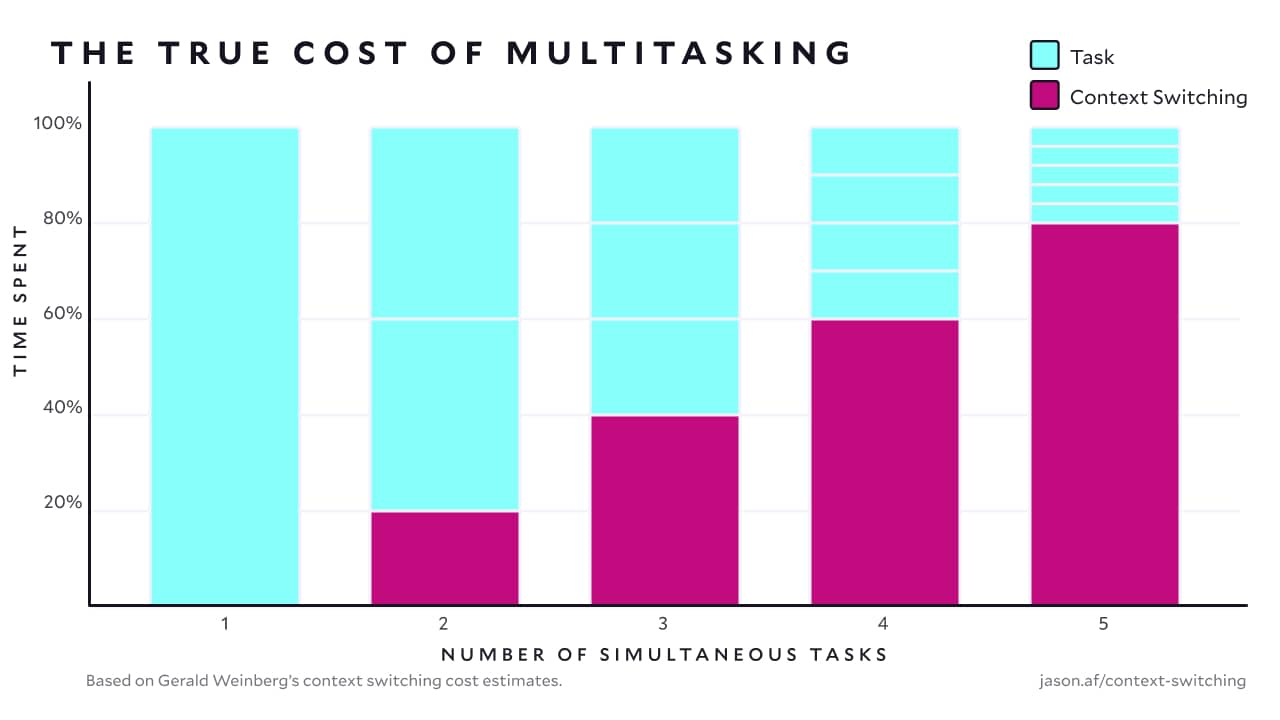
I always want to send my management graphs like this to show them why having 10 projects running at a time is a bad idea...
The image in the article (here, since the link was broken: https://fev.al/img/2024/focus.png) is something I've sent to a boss in the past. He didn't get it.
I feel for you, friend. Maybe you could share the essay "Maker's Schedule, Manager's Schedule" by Paul Graham [0]. It's been somewhat helpful when I've shared it with colleagues.
Thanks for sharing. I agree with everything in the essay.
When it talked about the person effectively working 2 days, once on the managers schedule, and once at night to code on the makers scheduled, I thought back and that resonated with me. I spent a decade or so doing something like that. I’d typically work 12-14 hour days. The normal work day was full of distractions and interruption, and once everyone started to leave and the meetings stopped, I started making stuff and got a lot done. At the time I thought I was just avoiding rush hour traffic, but there was a much bigger side effect in terms of productivity.
With the situation I had in 2017, this essay may have gone a long way. With my current situation I worry sharing it would have a negative impact on my job. It’s not one person I’d have to convince and coordinate with, it’s at least 4, probably more. I have 3 “stand ups” most days, which are all 30 minutes and often run long. If I were to split my day into 2 maker blocks, my mornings are shot every single day with 2-4 hours of meetings. This is usually enough to kill my whole day. 3-4 days per week usually have a meeting (or 3) in the afternoon, which kills that block as well. Some teams have office hours posted to everyone. While I rarely go, simply having them on my calendar has an impact to my ability to see that my day is clear. And of course there are all the chats I need to monitor and respond to, which never stop and might as well be meetings.
A massive culture shift is needed and I don’t feel like I’m in a position to make it. We are getting a new CIO soon, so I can hope for some positive impact there. Right now all bets are off. In the current culture, if something isn’t getting done fast enough, the go-to solution is a daily meeting to talk about it. It makes the project managers feel good and gives the appearance we’re doing all we can, but in reality it slows everything way down.
I will keep the essay in my back pocket to share if the opportunity presents itself.
Goodness gracious. It sounds like having you be ineffective might be advantageous to one or more people above you. Perhaps they get to blame you for their own ineffectiveness, offsetting pressures elsewhere. It truly sounds toxic. I'm sorry you're going through that.



Kind of like all those kids in Le Roy, NY who began experiencing involuntary tics. IIRC, it was interesting that it was mostly girls who were affected by the "craze".
https://www.npr.org/2012/03/10/148372536/the-curious-case-of...