> Cut threads into printed parts with a thread tap for quick design of low-reuse joints.
I've found wood screws work well for this. The wood screw can cut its own threads without needing to use a tap.
It does put some stress on the part, though. I mostly print in PETG, which is strong enough; but PLA might split if the hole was parallel to the layers.
> A design limitation of threaded inserts is that they are not reliably usable for screws inserted from the back side. During insertion, heat-set inserts often push some molten plastic into the hole beneath them, preventing easy insertion of a screw from the back side.
A trick I sometimes use:
1. Before installing the insert, insert the screw from the back side
2. Screw the insert onto the protruding screw
3. Use a soldering iron to install the insert+screw together into the plastic
Because the screw is filling the hole, the molten plastic can't block the hole. Instead, the molten plastic forms itself around the screw, and it acts like a Nyloc nut.
If you don’t gave a tap handy you can quickly “heat-set” threads in a part. Print the hole slightly undersized (I usually go 0.2-0.4mm under for M3-M4 size screws) so it takes some effort to screw in, then quickly screw the screw all the way in with a cordless drill. Friction should heat it up enough to melt the plastic and form it round the screw. Wait until cool before removing the screw. :)
In my experience even small machine screws (M3) can cut their own threads into a properly sized hole, and function well enough for a small number of re-assembly. That said, I'm rarely designing for portability, I just find the right sized hole for my printer by printing some test prints.
Plastic-cutting thread screws can also be great for this; the threads have higher pitch and wide spacing, but aren't as deep as a wood screw. The <1000-pack selection on Small Parts / Amazon can be slim, but in the last year Bambu started selling small packs for reasonable prices.
That doesn't sound right...? Credit/debit card chargebacks are handled by the bank. If the merchant doesn't pick up the phone, the bank will take the money from the merchant and return it to the customer.
> If someone owes you $1B and they owe me $2B, and they've got an asset worth $500M, I can't just pledge $2B of bad debt to buy the asset. The only fair way is to sell it for $500M in actual cash
No, that's not the _only_ fair way. Suppose the $2B creditor bids $200M in cash and also agrees to forfeit their share of the proceeds from the sale. Then the $1B creditor would receive the entire $200M, which is more than the $167M they would have received from a $500M cash sale. The bid is effectively equivalent to $600M.
Isn't that what happened in the InfoWars case? The bankruptcy judge agreed that the structure of the Onion's bid was valid; he just said the auction would have continued for more rounds.
Here's an intuition that might help: Suppose we define β=1/T, the reciprocal of temperature. (See https://en.wikipedia.org/wiki/Thermodynamic_beta.) As a system gets hotter and hotter, T gets bigger and bigger, so β falls closer and closer to zero. If β falls past zero and becomes negative, then T will also be negative.
(Also: If T=0, then β would be undefined/infinity. This corresponds to the fact that absolute zero temperature is impossible. β is arguably a more natural way of thinking about temperature than T is.)
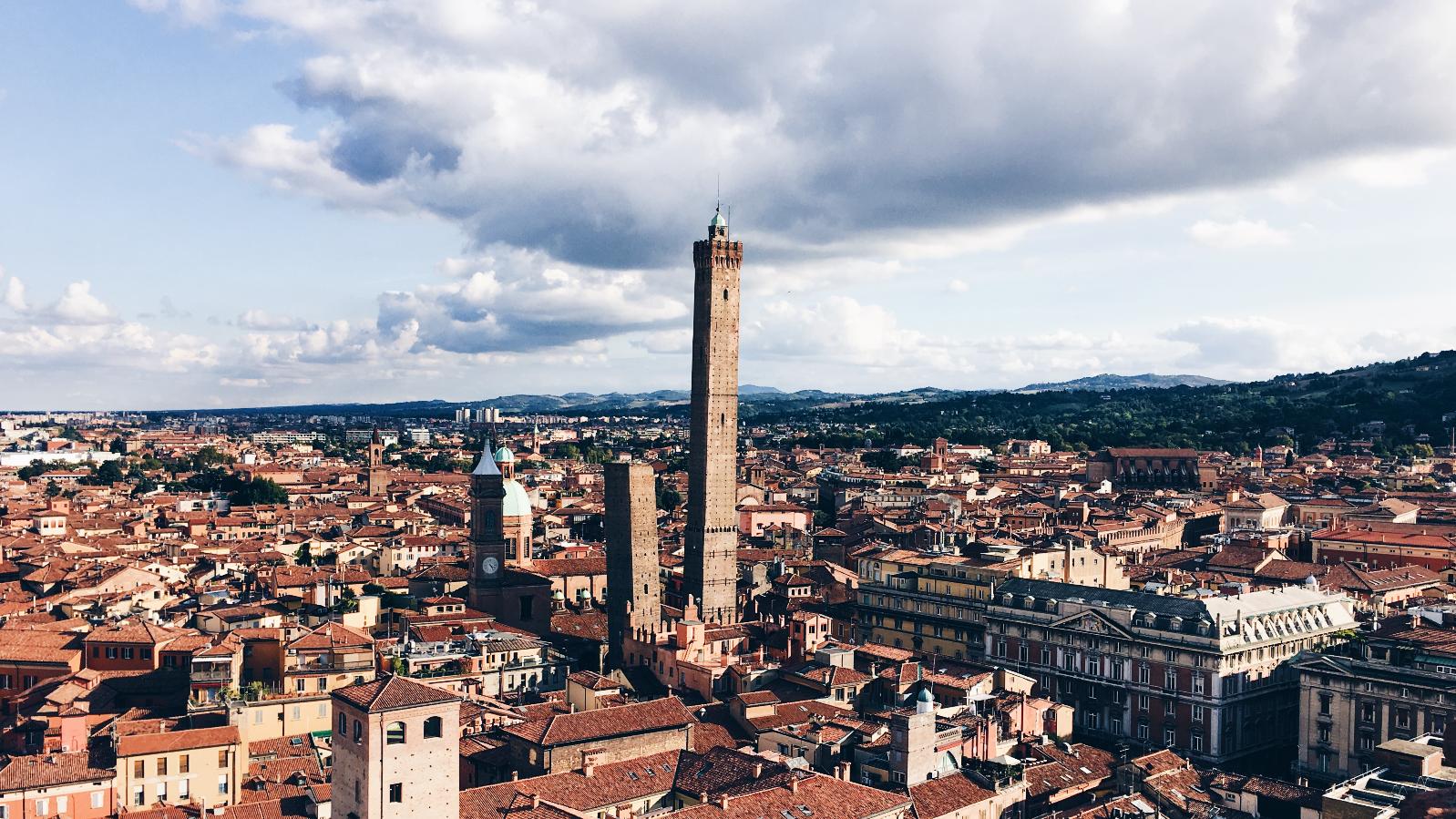
Note, those pictures depict the towers as about 5x bigger than they actually were.
To get a true sense of scale, here's the same view on Google Earth: https://earth.google.com/web/@44.48152905,11.33820409,94.604... You can see the towers that are still standing. They visibly stick out from the shorter buildings, but they're nowhere near as big as in the picture.
I think Google Earth might be more wrong than the illustration. One of the two Towers of Bologna is 97m. On GE it looks less than that. 97m is more than 33 stories.
I think everything in the illustration is at least twice too high. The walled part of Bologna was ~1 km in diameter at that time, and the tallest towers were ~10% of that.
Why do people attempt to use "stories" as a measurement of height? There is no universal agreement for what a "story" is. 97 meters is in fact 97 meters.
which is also not normalized. A referee once told me that - in theory - football fields can be square. I think it was 80m x 80m since 80m is the minimum length and the maximum width. Correct me if I am wrong.
Field size for American football is definitely standardized: 100 yards between goal lines and 160 feet wide. Lots of Americans will have an intuitive sense for how long something like "three football fields" is.
But that intuitive size would in fact be wrong. The size we associate with an American football field is more commonly going to be the distance including the end zones.
Going to play the pedantic card and mention that there's also no universal agreement on how to measure a building's height. The Council on Tall Buildings and Urban Habitat on its own has three different methods and not everyone accepts those as being the correct and true way of measuring the building's height.
Really? I zoomed in on the Towers of Bologna and then used the "measurement" tool to draw a 97m line on the ground. The line seems about as long as the tower is high. If you try that, do you get the same result?
In Python job interviews, I think the interviewer will only judge your code on asymptotic complexity, not absolute speed. I think Python engineers generally aren't expected to know how to micro-optimize their Python code.
Some general tips for algorithmic complexity in Python:
- Python's list is equivalent to C++ std::vector. If you need to push/pop at the head of the list, use Python's "collections.deque" to avoid the O(N) cost. Python's standard library doesn't have a linked list implementation.
- Python's dict is a fast unordered hashmap. However, if you need order-aware operations like C++'s std::map::lower_bound(), you're out of luck; Python's standard library doesn't have a tree implementation.
- Python has a "bisect" module for binary searching in a Python list, and a "heapq" module for using a Python list as a heap. However, neither one is nicely encapsulated in a data type.
If your Python program is seriously CPU-bound, the normal solution is to use a C/C++/Rust extension. For example, if you're doing large numeric calculations, use NumPy; it can store a vector of numbers as a single contiguous array, which is much faster than a list-of-Python-floats.
If you want to parallelize across CPU cores, it's important to understand the Python GIL (global interpreter lock). Often you need to use multiple Python processes. See e.g. https://superfastpython.com/multiprocessing-pool-gil/
Maybe also worth reading about __slots__ (https://wiki.python.org/moin/UsingSlots); it's a micro-optimization that helps when allocating a lot of tiny Python objects.
Hope some of that is helpful! Good luck with your job interviews.
"- Python's dict is a fast unordered hashmap. However, if you need order-aware operations like C++'s std::map::lower_bound(), you're out of luck; Python's standard library doesn't have a tree implementation."
I'm fairly certain that in Python 3.7 and later standard library dictionaries are now ordered by default.
Yes, Python dicts remember insertion order. This is different from C++ std::map, which maintains the keys in sorted order. For example, std::map::lower_bound(X) finds "the smallest key in the map which is greater than or equal to X" in O(log(N)) time. I don't think Python has any data structure in the standard library that supports this operation while also supporting insertion in O(log(N)) time.
The reason people complain about "high art" is because we're told that everyone should aspire to appreciate high art, and that people who appreciate high art are somehow better than the general public, even though it's deliberately niche and opaque.
> There's an endless continuum libraries, languages, tools and machines out there which have trivial impact on the world but are absolute objects of beauty when you know what's inside.
Imagine if the SF MOMA were replaced with a museum full of those niche libraries and languages, showing these absolute objects of beauty to the general public, and (implicitly) saying "you ought to appreciate the beauty; if you can't appreciate e.g. the beauty of the Haskell programming language is, you're ignorant".
The non-wealthy regularly pay for books, music, movies, video games, etc. Hollywood is a $40B/year industry. All these industries follow a model of "make a work of art, then sell infinite copies"; this makes it possible to sell the copies at reasonable prices. These prices are appropriate, and the non-wealthy pay them.
The "high art" world, on the other hand, fetishizes the original physical work of art. If an expert painter spends weeks on a painting, then they must sell it for enough money to cover "weeks of an expert's income"; so of course only wealthy people will be able to afford it. How is this price more "appropriate" than the prices that non-wealthy people pay?
Non wealthy people are largely not willing to pay for books, movies, videogames (I will admit to not knowing about music) what it actually costs to make them. The industries are able to sidestep this by underpaying (all but the highest profile) artists and massively scaling up marketing budgets, but people routinely underestimate the time and effort involved in producing art, even the "infinite copies" version.
> Non wealthy people are largely not willing to pay ... what it actually costs to make them
The general public pays enough money to pay the artists' salaries, plus the marketing budget and all the other costs. Otherwise Hollywood would go out of business.
Yes, but the artists salaries are typically insufficient to actually support their lives. Hollywood exists because enough people are excited enough by the idea of working for Hollywood that they're willing to accept fairly subpar working conditions and pay to get a chance to do what they love. Art is almost universally subject to a "passion tax".
Perhaps some of those people aren't quite as talented as they would like to think they are?
I'm not sure how that creates an obligation in the, uhh, 'non-wealthy', that they just don't appreciate art and should be paying those people more by paying more for media.
There's plenty of room in Hollywood budgets to make a movie that doesn't require the leads to make $30M each while underpaying extras. I think you're railing at the wrong "enemy".
I'm not railing at anyone. I'm saying that if people want more of a say in what kind of art is made, they need to be willing to spend more money on art, and spend it more thoughtfully. If they're only willing to spend very small amounts of money, and only on art that has been thoroughly vetted by the wealthy taste-makers, then they're only going to get what they wealthy taste-makers think is good.
Sorry, the GP has it right. I've worked in that industry, and (like lots of other industries) there's plenty of money (even selling the output at "normal people" prices) sloshing around to pay everyone involved a decent wage. Instead, most of the proceeds are extracted by the people who have the most power. That this will (in the long-term) cripple the entire enterprise (I think we're already seeing it) is not a concern for those making the money now.
There are many forms of art. In many cases people can get for themselves cheap reproductions and could plaster their bedrooms with it if they ever wanted. Or if that is not good enough for them and they can't get original works of some famous expensive artist then they can find some starving ones and get their works.
If Uruguay can run on 100% renewable energy, the unstated implication is "The US could do it too, we just lack the political will". (As opposed to the idea that "Renewable energy is a genuinely hard problem that will take time, effort, and technological advances to solve.") The implication that "we just lack the political will" can feel like a criticism of anyone who's not maximally-environmentalist. I think that's why people are getting defensive about it.


I've found wood screws work well for this. The wood screw can cut its own threads without needing to use a tap.
It does put some stress on the part, though. I mostly print in PETG, which is strong enough; but PLA might split if the hole was parallel to the layers.
> A design limitation of threaded inserts is that they are not reliably usable for screws inserted from the back side. During insertion, heat-set inserts often push some molten plastic into the hole beneath them, preventing easy insertion of a screw from the back side.
A trick I sometimes use:
1. Before installing the insert, insert the screw from the back side
2. Screw the insert onto the protruding screw
3. Use a soldering iron to install the insert+screw together into the plastic
Because the screw is filling the hole, the molten plastic can't block the hole. Instead, the molten plastic forms itself around the screw, and it acts like a Nyloc nut.