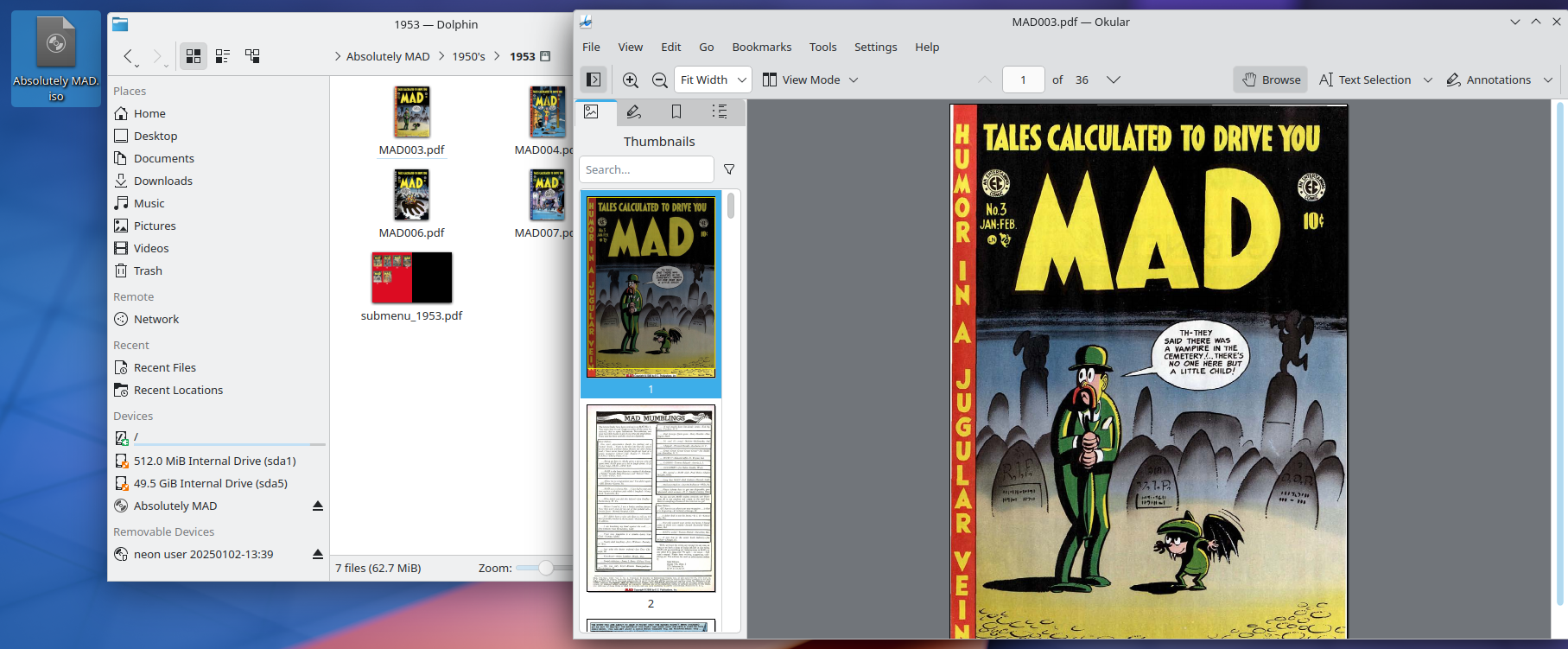
The CDs I have seem to be proprietary for Windows from the late 90s. But I also have PDFs through 2005 on my computer which I must have "acquired" at some point.
The browser app might be some outdated Windows application, that's the case with the MAD DVD too, but you can find the actual issue files in some folders
Yes the file names are something unknown. It has a software to access. They did a damn good job.
For instance, in Disk 1, there is a big binary file mad.m1 492MB. That seems to hold content, but not sure what file type or which program can open it. Rest of the files are very small.
No mine were pre dvd era. In CD. Older. They had a surprisingly good UI with its own funny stuff. Your install that and insert the disk 1-7 based on which issue you select. Even scold you for installing wrong disk & comments about 'you can insert a CD of Yanni if you prefer screeching' or something like that. Lol don't know what mad has against him their comments are always funny.
Sorry I didn't buy framework laptop but did find their prices high. Regarding assigning premium to repairability, wonder what's really premium about that? I mean in terms of materials used. Ignoring premiums paid for branding, I would think it's fair to charge premium if offering such feature comes with higher cost.
It depends on what "premium"/"luxury" mean to you. For some, red leather that has been masterfully tanned and stitched lining the interior of their car is premium. For others, the ability to transport you hundreds of thousands of miles in any terrain and any conditions with equipment failures that are rare and easy to fix is "premium". Being swaddled in high cost materials while stuck on the side of the road in a snowstorm isn't exactly a "premium" experience.
Likewise, for some, there is nothing premium about a product that 1) becomes a paperweight when a single component fails or is no longer sufficient to satisfy the user's changing desires. 2) Hasn't had engineering time and BOM on high-cost materials devoted to making the device easy-to-repair, or has had engineering resources spent making the device hostile to repair.
Framework doesn't just give you permission to repair and modify their product, they have engineered and designed a product that is easy and intuitive to repair and modify, and made out of materials that are designed and selected to endure being touched and manipulated, one great example that probably comes to mind for many FW13 owners that have opened the device is the touchpad cable finger loop in the FW13.
As any technician or DIY enthusiast might tell you, the materials e.g. Apple uses that you interact with during disassembly aren't exactly robustly made, and there is no sign that care or good taste was used when designing the disassembly procedures. But again, it depends on what you want, for some fragility enhances their experience of an object as premium and they have no interesting in upgrading/repairing their own device so the quality of that experience is irrelevant.
I understand and agree with the logic of repairability and user servicability. No arguments there. Point is why should that be premium for non marketing reasons? For instance, is soldered RAM somehow cheaper than RAM slots? Same for SSD, WiFI card, battery, keyboard assembly etc. (all of which used to be perfectly replaceable not too long ago, in most laptops esp high end Elitebooks & Latitudes as well as mass market Acers)
As others have mentioned, a firewall might have been useful in restricting outbound connections to limit the usefulness of the machine to the hacker after the breach.
An inbound firewall can only help protect services that aren't meant to be reachable on the public internet. This service was exposed to the internet intentionally so a firewall wouldn't have helped avoid the breach.
The lesson to me is that keeping up with security updates helps prevent publicly exposed services from getting hacked.
They want to make sure the runtime they depend on continues to be maintained. It's still niche and new, so its continued existence isn't as sure as something like Go.
IIRC Mark Andreessen once said colleges esp ivy league ones, simplify the job of recruiters by acting as filters. Saves them the bother. So they attached lots of value.
I guess that's true even now but in a perverse sort of way. As markers of indoctrination and unsuitability for productive corporate roles.
Employers probably decided to avoid them.
That's not fair to a large number of students but the old system of colleges being markers of intelligence, suitability etc was not fair to large number of others either..
Do you know any employers actively avoiding students from Ivy-league colleges?
I agree that colleges have acted as filters, but the value of degrees has been deflated, even in Ivy leagues, because they’re easier and more common. I think a degree still acts as a filter though; getting a job is hard with a degree but nearly impossible without.
EDIT: There’s the Thiel fellowship, which requires not having a degree, but I’m not aware of other such opportunities. Early work experience looks better to some employers than university, but that requires getting a job in the first place.
I was a hiring manager at a company that didn’t recruit from top universities for strategic reasons. In short we were smaller and a startup so it would have been difficult to compete. As we grew we had a presence at university job fairs but still avoided the top schools.
Similarly we avoided engineers from the Bay Area due to cost concerns.
The company was also a pioneer in the distributed work environment. A decade before Covid. So that opened a huge market for recruitment at that time.
> Do you know any employers actively avoiding students from Ivy-league colleges?
Yes.
The Ivy grads are often considered over-qualified (rightly or wrongly). Especially for government positions that don’t normally hire elite school grads and smallish local/regional businesses.
I know plenty of people who work in different government positions (federal, state, local) who will not hire grads from an elite schools (Ivy, Stanford, Berkeley, etc.) because they think something must be wrong with them (“why would they apply for this job?”), or they think that the applicant will jump ship at the first opportunity.
I agree that those can both be issues, but I’m not sure those issues are limited to or are more likely in elite school grads.
I’ve certainly seen situations in which elite school grads have worked at an org that didn’t normally hire any of them, and the quality and quantity of work produced caused there to be some tough conversations in terms of standards and evaluations (they basically “crushed the curve”). In the two cases I’m most familiar with, the people in question were relatively non-ambitious female employees who just cranked out high quality work. They took those jobs because they were decent jobs near their respective families. In both cases, the companies had bittersweet feelings when said employees left —- they lost productivity, but they no longer had the manage outlier performers.
One of these ladies left her job to become a stay at home mom. The other joined a more prestigious privately-held company who seemed to know how to harness her abilities (she moved up quickly).
I don't know about actively avoiding, but I have worked for multiple companies in London who prefer not to hire at the 'top' end of candidates (hence hiring me!), because they'll cost more and can have cultural issues like not be very fun people or thinking themselves to be above the self-taught and weird-career guys who didn't get a first from Imperial.
There's lot of anecdotal chatter and also mainstream media coverage on this.. It's a genuine concern.
But bigger issue is in USA where general jobless numbers are lower, with several sectors facing shortages, why is there the issue of grad unemployment at all.
The correct answer is important because politicians are filling the vacuum with false narratives to suit their base.


reply